
Brand mentions aren’t a new concept, but answer engine optimization (AEO) is giving them a different weight. Brand mentions are any online reference to your brand, product, spokesperson, or company name; right now, they’re happening in more places than most teams can track.
![Free Kit: How to Build a Brand [Download Now]](https://no-cache.hubspot.com/cta/default/53/814dd420-0d49-40e0-b59c-f01066e186c1.png)
Beyond social posts and news articles, your brand is being named in Reddit threads, podcast episodes, review sites, and increasingly inside AI-generated answers from ChatGPT, Perplexity, and Gemini. If you’re investing in brand awareness but not monitoring where and how your name actually shows up, you’re flying blind on the metrics that matter most: reputation, SEO value, and revenue attribution.
Whether you’re tightening up your brand strategy, protecting your brand architecture from inconsistent messaging, strengthening your brand management workflows, or trying to prevent brand dilution from unchecked third-party references, this guide walks you through everything you need to measure and act on brand mentions across the full landscape — web, social, reviews, forums, and AI search.
Let’s dive in.
Table of Contents:
What are brand mentions and why they matter
A brand mention is any online reference to your brand name, product, spokesperson, or company, whether or not it includes a link back to your site. Brand mentions appear across:
- News articles
- Social media posts
- Review sites
- Forum threads
- Podcast transcripts
- Inside AI-generated answers from tools like ChatGPT, Gemini, and Perplexity
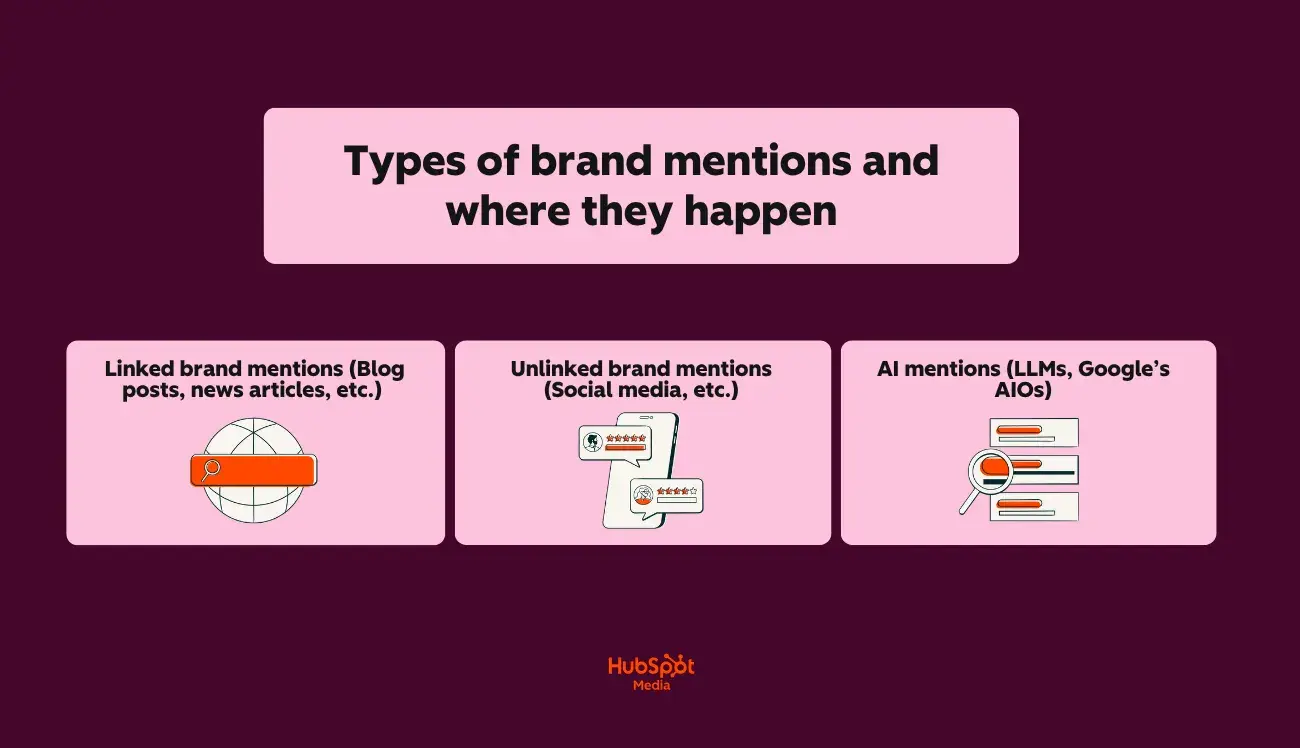
Not all brand mentions look the same, though. Here are the core types you’ll encounter:
- Directly mention your brand name explicitly (e.g., “HubSpot’s CRM” in a blog post or review).
- Indirect mentions reference your product, campaign, or spokesperson without using the exact brand name (e.g., “the orange CRM platform” or “that inbound marketing company”).
- Unlinked brand mentions reference your brand by name but don’t include a backlink to your site, making them one of the most overlooked SEO opportunities in brand monitoring.
- AI mentions are references to your brand inside an AI-generated answer or summary, such as when ChatGPT recommends your product in response to a user’s question.
Additionally, unlinked brand mentions can become backlink outreach opportunities. If a site already talks about you positively, asking for a link is one of the highest-conversion outreach tactics in SEO.
That said, tools purpose-built for monitoring ChatGPT brand mentions, alongside traditional web and social tracking, help you catch these opportunities faster.
Why brand mentions matter for awareness, SEO, trust, and AI visibility
Brand mentions influence brand awareness, trust, SEO value, and reputation, often simultaneously.
Here’s how each dimension breaks down:
- Brand awareness and PR. Every mention puts your name in front of a new audience. For PR teams, tracking total mention volume, reach, and sentiment across media and social channels is the clearest measure of whether campaigns, launches, or events actually broke through. Historical trend analysis shows how brand mentions change over time by source, sentiment, and campaign, so you can connect a spike in coverage to a specific initiative rather than guessing.
- SEO and backlink value. Search engines treat brand mentions, especially linked ones, as trust signals. But even unlinked brand mentions carry weight. Google’s patents reference “implied links” (mentions without hyperlinks) as a factor in assessing authority.
- Trust and reputation. Buyers read reviews, scan Reddit threads, and check social proof before purchasing. Brand monitoring tracks mentions across web, social, reviews, forums, media, and AI systems, giving you a real-time read on how people talk about you in the places that shape purchase decisions.
- Search and AI visibility. This is the dimension most teams are still catching up on. AI visibility improves when brand information is consistent, cited, and easy for systems to interpret. Large language models draw on structured data, authoritative sources, and frequently cited content to determine which brands appear in AI-generated answers. (So, if your brand data is fragmented or inconsistent across the web, you’re way less likely to surface in those results.)
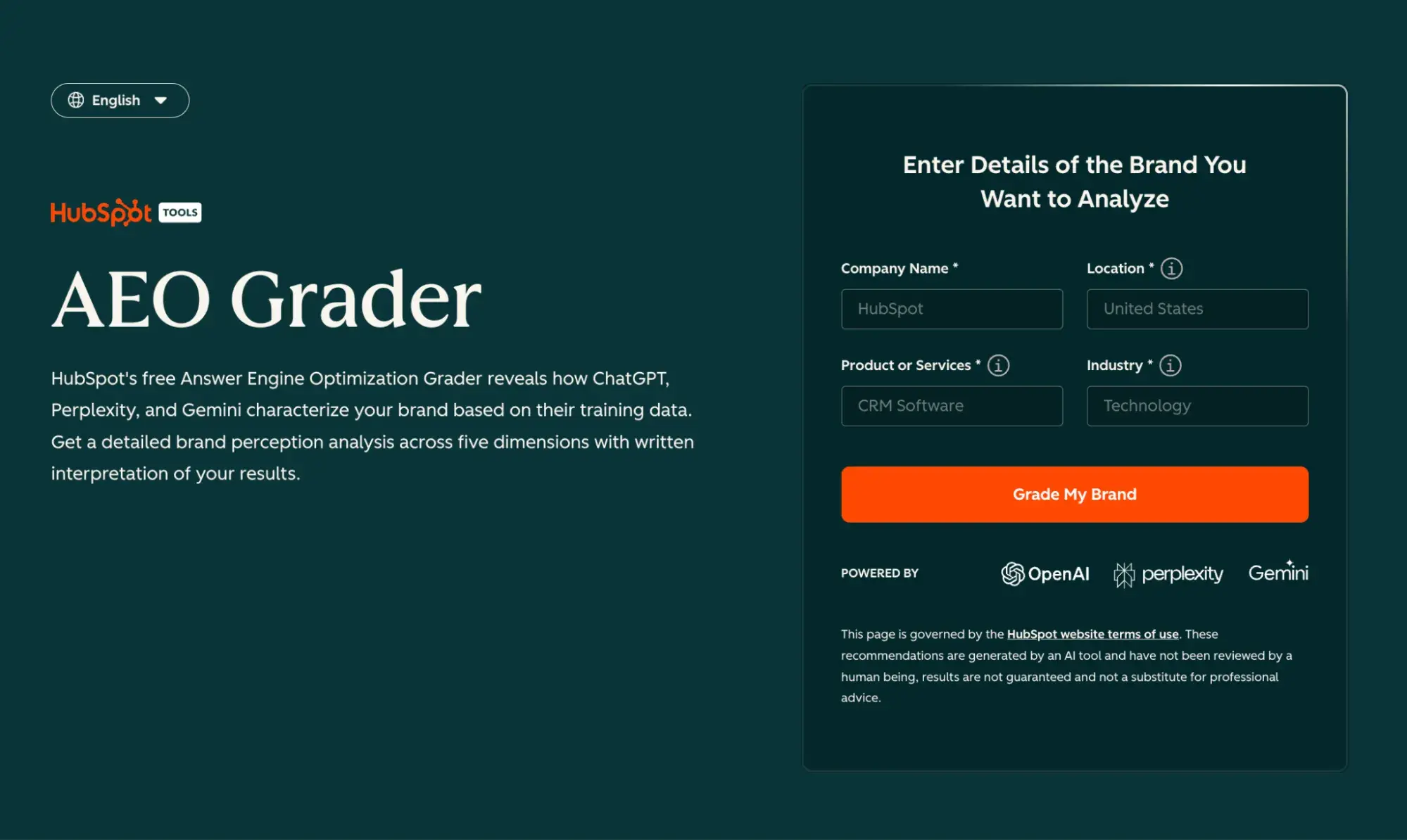
- Best for checking your current AI visibility: HubSpot’s free AEO Grader analyzes how your brand shows up in AI search results and gives you specific recommendations to improve. It’s a fast first step before building out a full historical trend analysis of AI brand mentions across engines.
Brand mention KPIs include:
- Total mentions
- Reach
- Sentiment
- Share of voice
- Conversions
But the real unlock comes from connecting those metrics to revenue. A brand monitoring workflow that includes term lists, alerts, routing, SLAs, and response playbooks turns fragmented mention data into a system your team can actually act on, with faster response times, stronger backlink conversion from unlinked brand mentions, and clearer attribution from brand mentions to the pipeline.
Types of brand mentions and where they happen
Brand monitoring tracks mentions across the web, social, reviews, forums, media, and AI systems.
Here’s how the channels map to mention types:
- Social media (LinkedIn, X, Instagram, TikTok, Threads): Mostly unlinked mentions. High volume, fast-moving, and sentiment-rich.
- Forums and communities (Reddit, Quora, Slack communities, Discord, niche forums): Almost always unlinked. Often contain detailed product opinions that influence buying decisions.
- News and media (online publications, press, syndicated content): Mix of linked and unlinked. PR teams focus here for awareness; SEO teams focus here for backlinks.
- Blogs and content sites (independent blogs, Medium, Substack, industry publications): Strong opportunity for both linked and unlinked mentions. Common target for backlink outreach.
- Review sites (G2, Capterra, Trustpilot, Yelp, Google Business Profile): Almost always unlinked. Directly influence trust and purchase decisions.
- Podcasts and video (YouTube, Spotify, Apple Podcasts): Mentions happen in audio/video content, show notes, and descriptions. Transcription-based monitoring is the only reliable way to catch them.
- AI-generated answers (ChatGPT, Perplexity, Gemini, Copilot, Google AI Overviews): Dynamic, citation-variable, and invisible to traditional monitoring. Requires dedicated tracking through tools built for monitoring ChatGPT brand mentions or manual prompt auditing.
The fragmentation across these channels is exactly why so many teams struggle with brand monitoring. Each source type requires a different detection method, a different response workflow, and often a different owner on your team. Without a centralized system (ideally CRM-connected), mention data stays siloed, and action gets delayed.
Now, there are three core types of brand mentions every marketing, PR, and SEO team should track, and each appears in different places across the web. Below, I’ve overviewed them in detail:
1. Linked brand mentions
A linked brand mention is an online reference to your brand, product, or company name that includes a hyperlink pointing back to your site. These are the mentions brand monitoring tools catch most easily, and they’re the ones that deliver direct SEO value through backlinks.
Here’s where linked brand mentions happen:
- News articles
- Blog posts
- Partner pages
- Resource roundups
- Digital PR placements
You’ll also find them in YouTube video descriptions, podcast show notes, and occasionally in social media posts, though most social platforms use nofollow links that limit direct brand mentions SEO impact.
2. Unlinked brand mentions
An unlinked brand mention is one that does not include a backlink to the brand’s site.
For example, someone writes about you, names you, references your product, but doesn’t link. These are simultaneously the most common type of mention and the most overlooked opportunity in brand monitoring.
Here’s why unlinked brand mentions matter so much:
- Backlink conversion. Unlinked brand mentions can become backlink outreach opportunities with some of the highest response rates in SEO, because the author already knows and chose to reference you.
- Implied authority. Google’s documentation on how it assesses site quality references the concept of implied links (mentions without hyperlinks that still signal brand authority).
- Volume. For most brands, unlinked mentions outnumber linked ones by a wide margin. Without dedicated brand-monitoring tools to scan for these, you’re leaving backlinks (and the ranking power that comes with them) on the table.
Here’s where they happen:
- Forum threads (Reddit, Quora, niche communities)
- Review sites (G2, Capterra, Trustpilot, Yelp)
- Social media posts
- Podcast audio (transcribed or not)
- News coverage
- Blog posts
- Comment sections
Now, I won’t lie, reader: these are also the hardest mentions to find manually, which is exactly why fragmented mention data is such a persistent pain point for teams trying to connect brand monitoring to SEO and revenue outcomes.
3. AI mentions
An AI mention is a reference to your brand inside an AI-generated answer or summary. This is the newest category, and it’s the one most teams are still scrambling to understand.
When someone asks ChatGPT, “What’s the best CRM for small businesses?” or Perplexity, “How do I set up email automation?” — the brands that appear in those answers are getting AI mentions.
Unlike traditional web mentions, these don’t live on a static URL you can bookmark. They’re generated dynamically based on what the model has learned from training data and, in some cases, real-time search results.
To help you wrap your head around this emerging metric, below, I’ve outlined what makes AI mentions different from other brand mentions:
- No permanent URL. AI answers are generated per query, so there’s no fixed page to monitor the way you’d track a blog post or news article.
- Citation-dependent. Some AI tools (like Perplexity and Google AI Overviews) cite sources. Others (like ChatGPT in default mode) don’t. Your monitoring approach needs to account for both.
- Source-quality driven. AI visibility improves when brand information is consistent, cited, and easy for systems to interpret. Models favor brands with structured data, authoritative backlinks, and content that is frequently cited across the web.
- Hard to track at scale. Most traditional brand monitoring tools weren’t built to query LLMs. Monitoring ChatGPT brand mentions requires specialized tools or prompt-based tracking workflows (like running your priority queries on a schedule and logging where your brand appears, or doesn’t).
Here’s where AI mentions happen:
- ChatGPT
- Google AI Overviews
- Perplexity
- Copilot
- Claude
- Gemini
- Any AI-powered search or assistant tool that generates synthesized answers from web content
In the next section, let’s talk through how to measure brand mentions and what you’ll use to track them successfully.
How to measure brand mentions with KPIs and dashboards
As I previously mentioned, brand mention KPIs include total mentions, reach, sentiment, share of voice, and conversions. However, believe me or don’t, the difficulty here isn’t choosing metrics.
Instead, it’s connecting fragmented mention data across channels into a single view that your team can actually use to make decisions.
Luckily, I’ve outlined everything you need to know about the five core KPIs every brand monitoring dashboard needs in the chart below:
Next, allow me to walk you through how to turn those KPIs into actionable insights, from trend analysis and channel-specific measurement to building a monitoring stack that actually covers your blind spots.
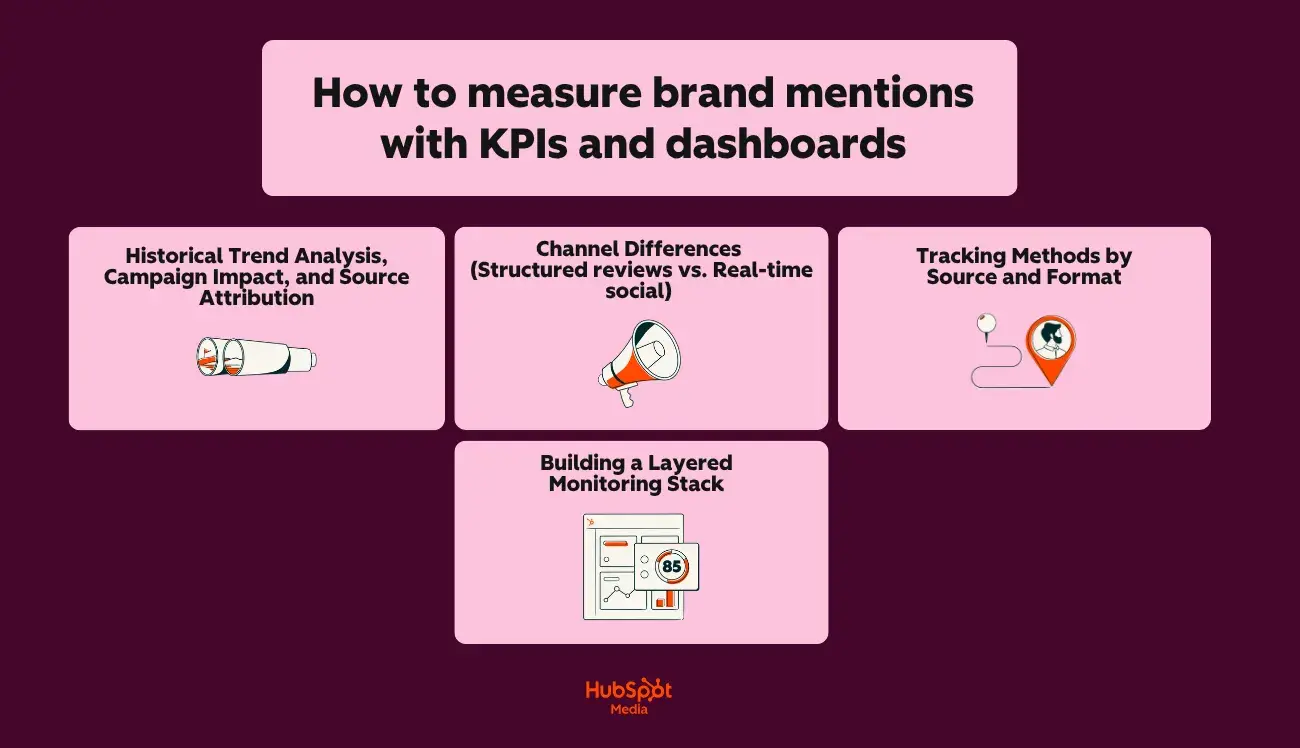
1. Historical Trend Analysis, Campaign Impact, and Source Attribution
Historical trend analysis shows how brand mentions change over time by:
- Source
- Sentiment
- Campaign
It transforms your KPIs from static numbers into a narrative about what’s actually driving visibility, and what’s eroding it.
Moreover, there are three layers to make trend data actionable:
- Time-series trends. Plot total mentions, sentiment, and share of voice on weekly or monthly timelines. Spikes become visible immediately, and you can overlay them against campaign launch dates, product releases, PR pushes, or competitor events to identify causes.
- Campaign impact measurement. Tag mentions by campaign (product launch, event, media placement, influencer partnership) so you can isolate what each initiative contributed to overall volume and sentiment. Without campaign tagging, a historical trend analysis of AI brand mentions and web mentions alike becomes a flat line with unexplained bumps.
- Source-level attribution. Break down mentions by origin. Ask: Which channels generated the most volume, the best sentiment, or the highest conversion rate? Source attribution answers the question your leadership team is actually asking: “Where should we invest more?”
This is also where AI mention tracking introduces a new dimension. Traditional brand monitoring tools handle web and social trend data well, but most don’t track AI-generated answers over time.
Building a historical trend analysis of AI brand mentions requires specialized monitoring, ChatGPT brand-mention tools, or a manual prompt-tracking workflow in which you log AI responses to your priority queries on a regular schedule.
2. Channel Differences (Structured reviews vs. Real-time social)
Now, not all brand mentions behave the same way, and your measurement approach needs to account for the fundamental differences between structured and unstructured channels.
Structured review channels (like G2, Capterra, Trustpilot, Yelp, Google Business Profile, and app stores) produce mentions with built-in metadata, such as:
- Star ratings
- Category tags
- Feature-level feedback
- Verified purchase status
The data is relatively clean and easy to quantify, but it moves slowly. New reviews appear over days and weeks, not minutes. To track structured review performance effectively, I suggest reviewing:
- Volume
- Average rating
- Sentiment by feature or product area
- Rating trends over time
- Competitive rating comparisons
A key advantage of structured channels is, of course, structured data that integrates cleanly into dashboards and CRM records. But, still, reviews represent a narrow, self-selecting audience. They also skew toward strong opinions (very satisfied or very dissatisfied).
Then, there’s real-time social channels, which are unstructured in a sense; they typically include:
- X
- TikTok
- Threads
- Discord
These platforms produce high-volume, unstructured mentions with minimal metadata. Conversations move fast, sentiment can shift within hours, and context is often ambiguous (sarcasm, memes, inside jokes).
To stay on top of real-time social mentions, I suggest tracking:
- Mention volume
- Sentiment velocity (how fast sentiment shifts)
- Engagement rate per mention
- Share of voice vs. competitors
- Influencer amplification
A key advantage with real-time social channels is speed. Social is where brand crises surface first and where real-time response matters most. Oppositely, a key limitation with these channels is, unfortunately, noise. High volume means more false positives, and automated sentiment analysis struggles with informal language.
Pro Tip: Set different monitoring cadences for each channel type. Review sites can be checked daily or weekly. Social channels need near-real-time monitoring with automated alerts for volume spikes or negative sentiment surges.
3. Tracking Methods by Source and Format
Brand monitoring tracks mentions across the web, social media, reviews, forums, media, and AI systems, but each source requires a different detection method.
Here’s how to match your tracking approach to the format:
- Web and news articles. Web crawlers and media monitoring platforms scan published pages for your brand terms. This is where most brand monitoring tools excel. Look for tools that distinguish between linked and unlinked brand mentions so you can pipe unlinked references directly into a backlink outreach workflow.
- Social media. Platform APIs and social listening tools pull public posts, comments, and conversations in near-real-time. Coverage varies by platform. (X and Reddit offer strong API access, while Instagram and TikTok are more limited.)
- Forums and communities. Reddit, Quora, niche industry forums, Slack communities, and Discord servers. Most social listening tools have partial forum coverage, but dedicated community monitoring or manual checks are often needed to fill gaps.
- Review sites. Review aggregation tools or direct API integrations pull structured review data. Some brand monitoring tools include review tracking; others require a separate review management platform.
- Podcasts and video. Audio and video mentions require transcription-based monitoring. Tools that auto-transcribe and scan podcast episodes or YouTube videos catch mentions that text-based crawlers miss entirely.
- AI-generated answers. The best ways to track brand mentions in AI search involve either dedicated AI monitoring tools, manual prompt auditing (running priority queries on a schedule and logging results), or a combination of both. (This is the fastest-evolving tracking category, and the one with the most blind spots for most teams today.)
4. Building a Layered Monitoring Stack
I hate to admit this, but no single tool covers every channel. The most effective brand monitoring setup is a layered stack where each layer handles what it does best:
- Free alerts (Google Alerts, Talkwalker Alerts). Your baseline layer. Set these up for your brand name, product names, executive names, and common misspellings. (They won’t catch everything, but they’re zero-cost and catch a surprising number of web and news mentions.)
- Social media monitoring (Brandwatch, Sprout Social, HubSpot’s Social Media Management Tools). Your real-time layer. Covers public social posts, comment threads, and hashtag mentions. This is where you get velocity (how fast mentions are moving and whether sentiment is shifting).
- Review monitoring (G2, Capterra integrations, ReviewTrackers). Your structured feedback layer aggregates ratings, reviews, and feature sentiment across review platforms into a trackable trend line.
- Forum and community discovery (Reddit monitoring, Syften, manual Quora and Discord checks). Your depth layer. Forums are where your most detailed, and often most honest, brand mentions live, but they’re also the hardest to monitor at scale.
- Backlink and unlinked-mention scanners (Ahrefs, SEMrush, Moz). Your SEO layer. These tools identify who’s mentioning you online and whether those mentions include links. Unlinked brand mentions flagged here are added directly to your outreach pipeline.
- Marketplace and platform integrations. If you sell through Amazon, Shopify App Store, HubSpot Marketplace, or similar channels, add platform-specific monitoring for reviews, ratings, and mentions within those ecosystems.
5. Manual Checks Plus Dashboards: Reducing Blind Spots and Noise
Even with a strong brand monitoring stack, automated tools alone create two persistent problems:
- Blind spots (mentions they miss)
- Noise (irrelevant results they flag)
In my experience of tracking brand mentions for AEO, a combination of manual checks and centralized dashboards solves both.
Manual checks handle the blind spots. Automated brand monitoring tools won’t catch everything, especially in closed communities, on new platforms, or in AI-generated responses where API access is limited.
To close the gaps your tools can’t reach, schedule regular manual audits as follows:
- Weekly: Run your top 10 to 15 brand-relevant queries in ChatGPT, Perplexity, and Google AI Overviews to track AI mention presence. Log results in a shared tracker.
- Biweekly: Scan Reddit, niche forums, and community Slack/Discord channels your tools don’t fully index.
- Monthly: Audit your backlink scanner for missed unlinked brand mentions by spot-checking top-ranking content in your category.
Dashboards, however, handles the noise of making your dashboard work as hard as your monitoring stack. When mentioning data flows from six or seven sources, the raw feed becomes overwhelming. A CRM-connected dashboard filters, deduplicates, and prioritizes what actually needs attention.
To make your dashboard work as hard as your monitoring stack, do the following:
- Route high-sentiment-risk mentions to PR or customer success with SLAs for response time.
- Route unlinked brand mentions with high domain authority to SEO for backlink outreach.
- Roll up total mentions, reach, sentiment, and share of voice into a weekly executive summary that connects brand monitoring to pipeline and revenue.
Pro Tip: A brand mention workflow includes term lists, alerts, routing, SLAs, and response playbooks, but the important piece most teams skip is the routing logic. Define who owns what before you turn monitoring on. PR owns media and crisis mentions. SEO owns unlinked brand mentions and backlink conversion. Customer success owns review responses. Without clear ownership, mention data piles up, and nothing gets actioned.
Brand monitoring tools (at a glance)
Brand monitoring tools
Brand monitoring tracks mentions across:
- Web
- Social
- Reviews
- Forums
- Media
- AI systems
But no single tool covers every channel.
The eight tools below span the full brand monitoring stack, from CRM-native social tracking and AI visibility scoring to dedicated social listening, web crawlers, and backlink scanners.
Each entry covers what the tool does best, its core features, pricing, and limitations to help you build the right layered setup for your team.
Take a look:
1. Brandwatch
Best for: Enterprise marketing, PR, and insights teams that need deep consumer intelligence, advanced social listening, and high-volume brand monitoring across global markets.
Brandwatch is a comprehensive consumer intelligence and social media management platform that monitors billions of online conversations across social media, news sites, blogs, forums, and review platforms. It combines social listening, brand monitoring, influencer marketing, and social publishing into a single enterprise suite.
Brandwatch’s scale is its standout feature. It’s been collecting and indexing web conversation data since 2009, giving users access to one of the deepest historical archives of consumer opinion available.
Brandwatch’s pricing:
- Custom pricing only (no published plans, see here)
- No free trial available, demo only
Brandwatch’s core features:
- Consumer intelligence. AI-powered analysis of online conversations across 100+ million sources, with sentiment analysis, trend detection, and audience segmentation.
- Social media management. Unified content calendar, publishing, approval workflows, and community management across all major platforms.
- Real-time crisis monitoring. Smart alerts triggered by volume spikes, sentiment shifts, or anomaly detection.
- Influencer discovery and management. End-to-end influencer marketing capabilities, including discovery, campaign management, and ROI tracking.
- Competitive benchmarking. Side-by-side comparison of brand mentions, sentiment, and share of voice against competitors.
Brandwatch’s limitations to consider:
- Pricing is opaque and enterprise-focused. Smaller teams and SMBs may find it cost-prohibitive.
- The platform has a steep learning curve. Getting the most out of advanced queries and dashboards requires meaningful onboarding time.
- Does not include AI answer engine monitoring (ChatGPT, Perplexity, etc.) as a native feature. This may create a coverage gap for teams prioritizing AEO, and at Brandwatch’s price point, adding a separate AI visibility tool on top could make the total monitoring investment difficult to justify without a dedicated budget.
2. Mention
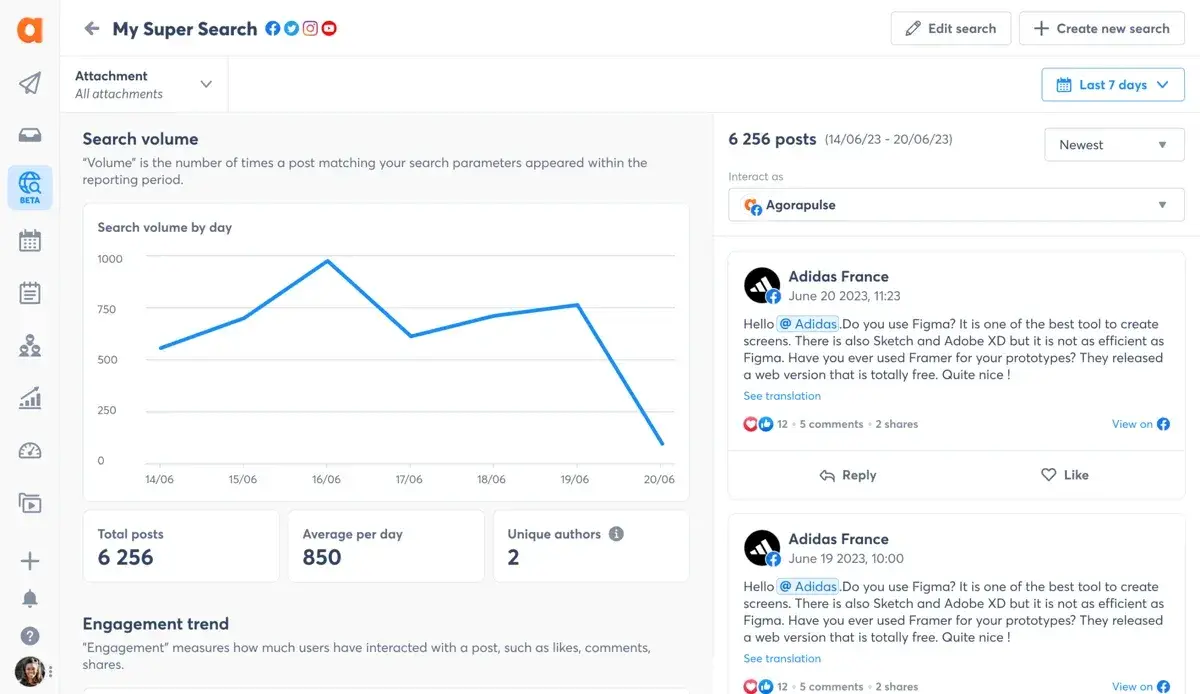
Best for: PR teams, brand managers, and mid-market agencies that need real-time web and social media brand monitoring with competitive intelligence, without the enterprise complexity or pricing.
Mention is a social listening and media monitoring platform that scans over one billion sources daily to track brand mentions across social media, news sites, blogs, forums, and the broader web. It delivers real-time alerts and sentiment analysis through a clean, accessible interface that teams can adopt quickly with minimal training.
Mention’s pricing:
- Enterprise-level plans start at $599 (no published plans available, see here)
- 14-day free trial on all plans (see here)
Mention’s core features:
- Real-time alerts. Instant notifications when your brand is mentioned online, with fast coverage across web, social, and news sources.
- Boolean search filtering. Advanced query builder to reduce noise and surface only relevant brand mentions.
- Sentiment analysis. Automated positive/neutral/negative classification across all monitored sources.
- Competitive intelligence. Side-by-side monitoring of competitor mentions with share-of-voice comparisons.
- Customizable dashboards and reports. Automated reporting with templates and metrics tailored to business goals.
Mention’s limitations to consider:
- Mention is a listening and monitoring tool, not a social management platform. It does not include content scheduling or publishing.
- Does not monitor AI search engines or AI Overviews. This is an increasingly significant blind spot for brand monitoring tools in 2026.
3. HubSpot’s Social Media Management Tools (available with Marketing Hub)
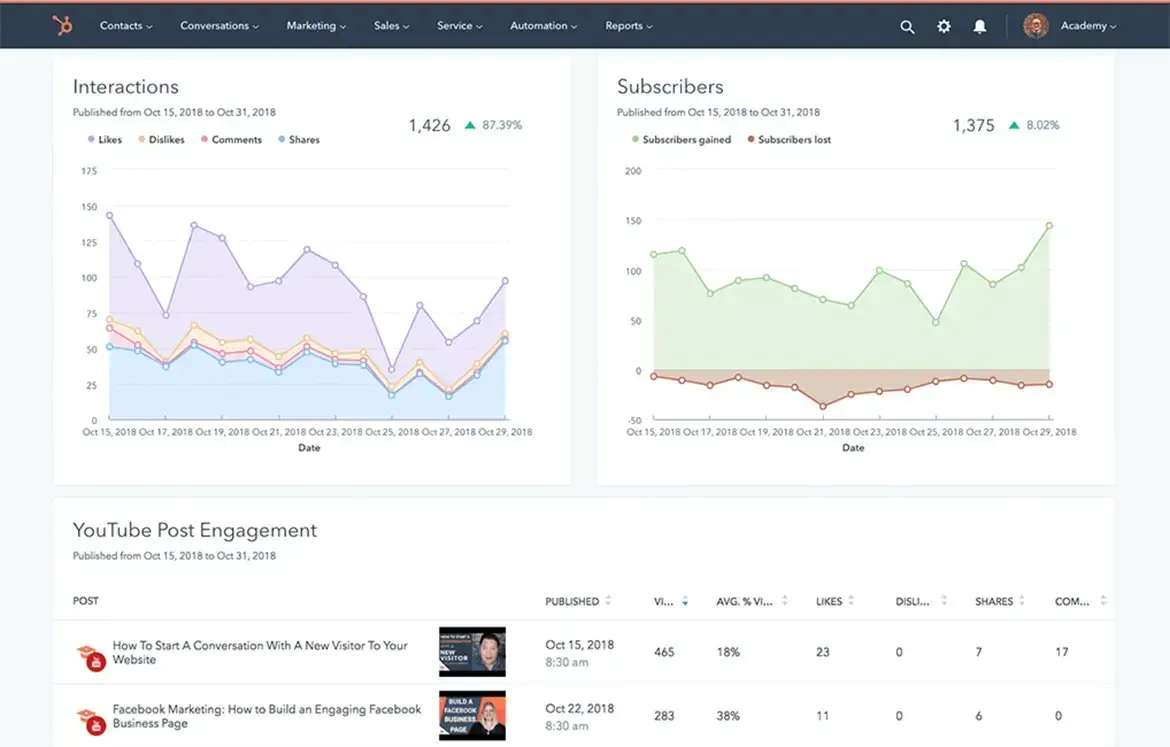
Best for: Marketing teams already using HubSpot’s CRM that want to connect social brand mentions directly to contact records, campaigns, and revenue attribution without juggling a separate tool.
HubSpot Social Media Management Software is HubSpot’s built-in social monitoring tool, available within Marketing Hub (Professional and Enterprise). It tracks brand mentions, keywords, and hashtag conversations across social platforms and connects every interaction to your CRM, so you can see the visits, leads, and customers your social brand mentions are generating.
HubSpot Social Media Management Tools’ pricing:
- Included with Marketing Hub Professional ($890/month) and Enterprise ($3,600/month)
- Pricing is per portal, not per user
- Free trial available (14 days)
HubSpot Social Media Management Tools’ core features:
- Keyword monitoring streams. Create custom streams to surface brand, competitor, and industry keywords across connected social accounts.
- AI-powered sentiment tracking. Track sentiment and protect your brand reputation directly from your social inbox (beta).
- Reddit monitoring. Monitor Reddit conversations about your brand and competitors to uncover insights on sentiment, share of voice, and trends.
- CRM-connected attribution. Automatically associate social interactions with individual contact records and marketing campaigns to measure ROI.
- Publishing and scheduling. Schedule and publish posts to LinkedIn, Facebook, Instagram, TikTok, Reddit, and X from the same tool.
HubSpot Social Media Management Tools’ limitations to consider:
4. Ahrefs
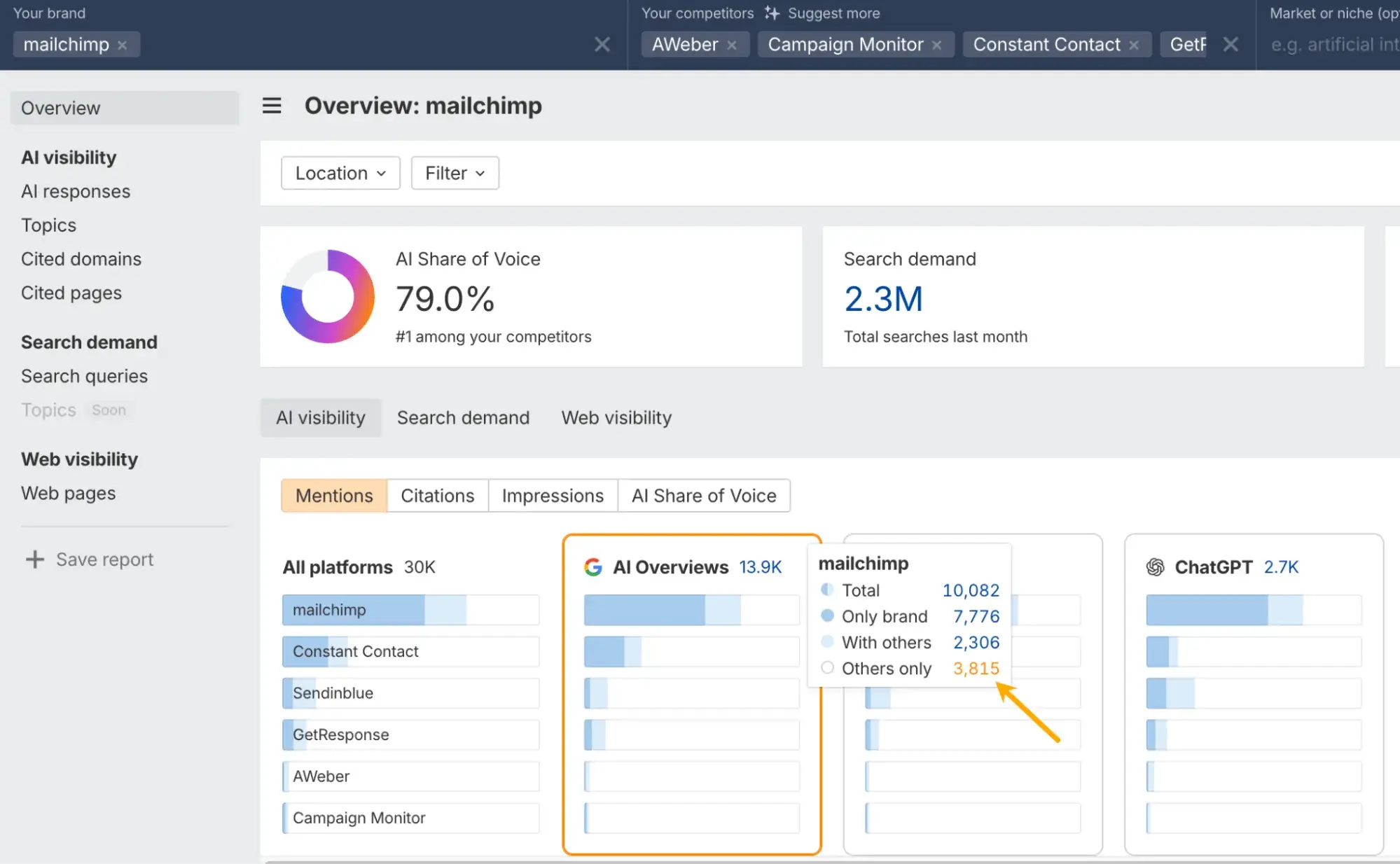
Best for: SEO managers and content teams that need to identify unlinked brand mentions, track backlink profiles, and convert mention data into actionable link-building workflows.
Ahrefs is primarily known as an SEO and backlink analysis platform, but its Content Explorer and Alerts features make it one of the most effective brand monitoring tools for teams focused on brand mentions SEO, specifically, finding and converting unlinked brand mentions into backlinks.
Ahrefs’ web crawl indexes billions of pages, catching mentions across blogs, news sites, and content pages that social-focused monitoring tools often miss.
Ahrefs’ pricing:
- Lite: $129/month (5 projects)
- Standard: $249/month (20 projects)
- Advanced: $449/month (50 projects)
- Enterprise: $14,990/year (100 projects)
- No free trial; limited free tools available (see here)
Ahrefs’ core features:
- Content Explorer. Search billions of pages for any brand mention, filtered by domain rating, traffic, publication date, and whether the mention includes a backlink, making it a purpose-built tool for finding unlinked brand mentions at scale.
- Ahrefs Alerts. Automated email notifications when new mentions of your brand or target keywords appear on the web, or when you gain or lose backlinks.
- Backlink analysis. Comprehensive backlink profile tracking with referring domain metrics, anchor text analysis, and link quality scoring.
- Competitive analysis. Compare your backlink profile and mention volume against competitors to identify gaps and opportunities.
- Site Explorer. Deep-dive into any domain’s organic traffic, keyword rankings, and backlink profile.
Ahrefs’ limitations to consider:
- Ahrefs doesn’t monitor social media, forums, review sites, or AI-generated answers. It’s a web and SEO tool, not a full-spectrum brand monitoring platform.
- No sentiment analysis. It tracks that a mention exists and whether it’s linked, but doesn’t classify tone.
- Pricing starts higher than dedicated social listening tools. This may not be justifiable for teams focused solely on social brand mentions.
Pro Tip: Unlinked brand mentions can become backlink outreach opportunities, and Ahrefs is the most efficient tool for finding them. Use Content Explorer to filter for pages that mention your brand name with a “not linked” filter, then sort by domain rating to prioritize high-authority outreach targets first.
5. HubSpot AEO
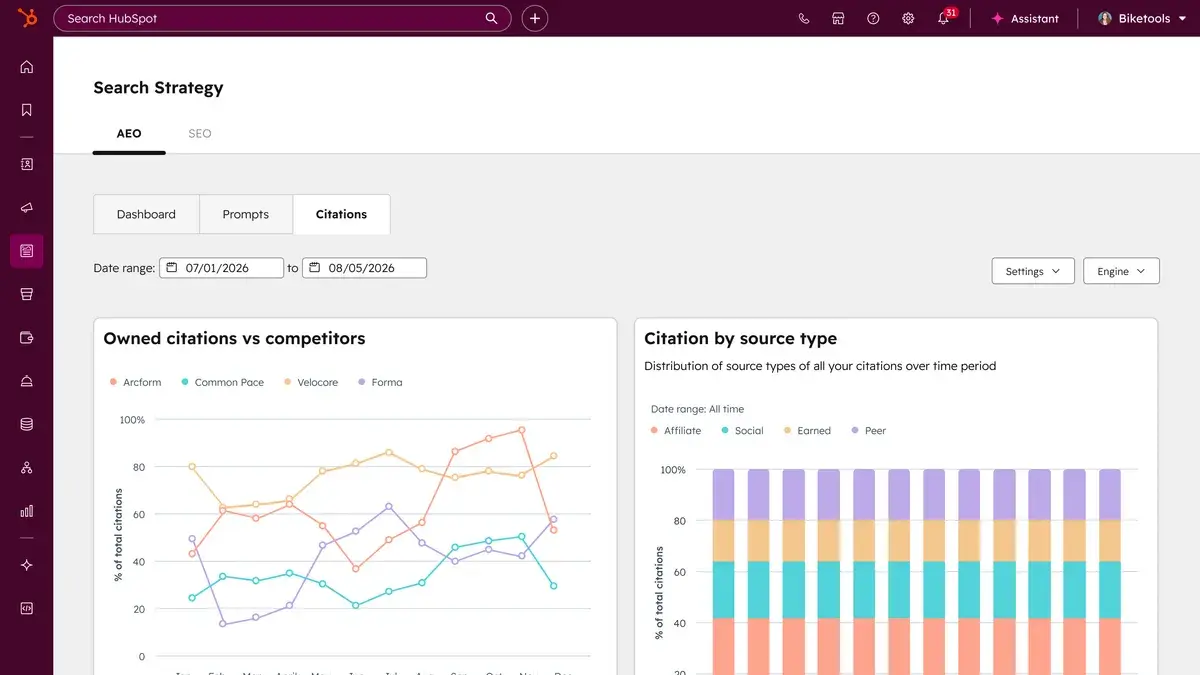
Best for: Marketing teams, brand managers, and content strategists who need to measure and improve how AI answer engines characterize and recommend their brand, with CRM-integrated recommendations for closing visibility gaps.
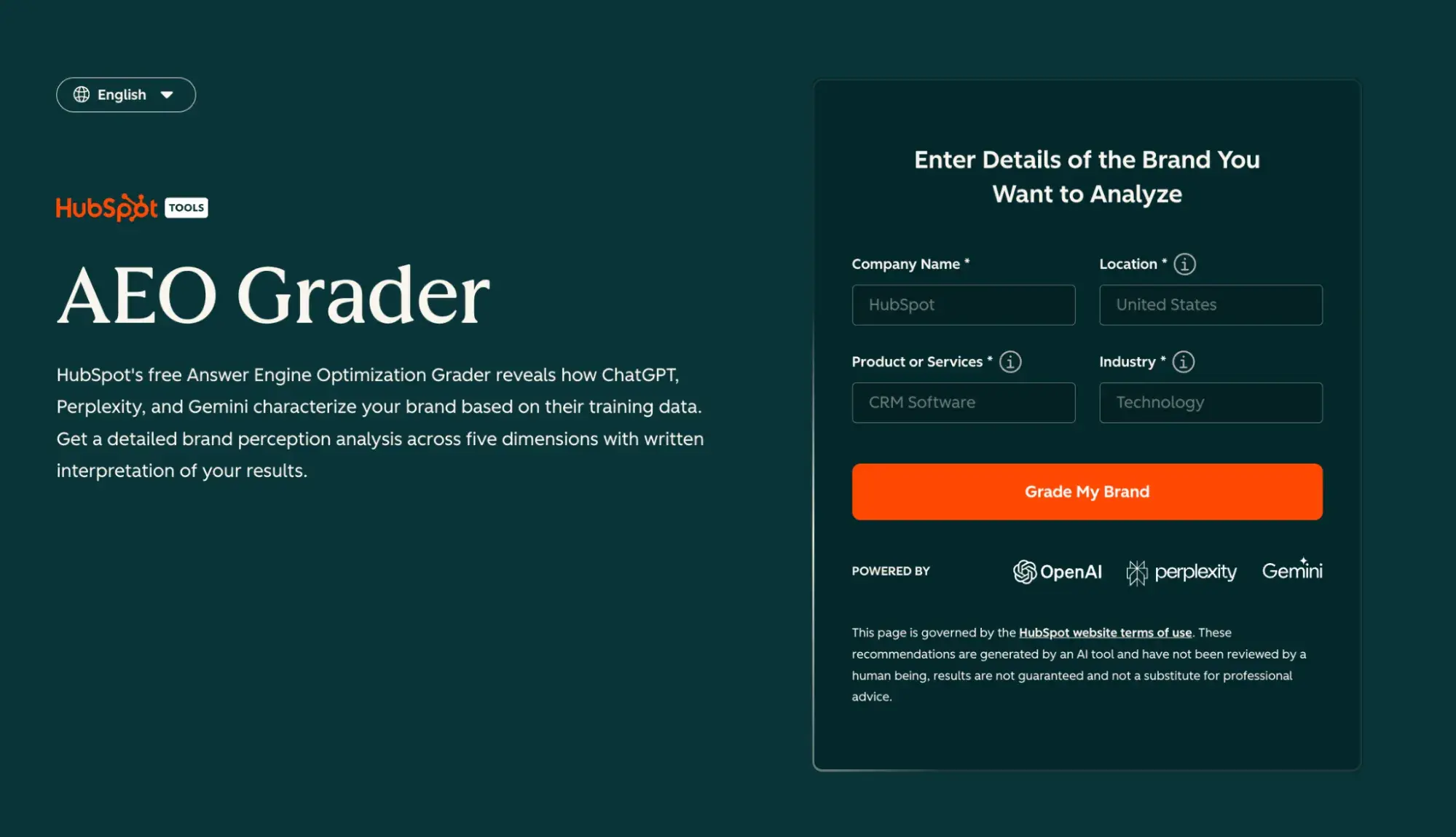
HubSpot AEO is HubSpot’s dedicated Answer Engine Optimization (AEO) tool that tracks how your brand appears in AI-generated answers across ChatGPT, Perplexity, and Gemini. It monitors brand visibility week over week across the prompts your buyers are actually asking, measures sentiment and share of voice in AI responses, and delivers prioritized recommendations connected to your CRM data.
Additionally, HubSpot AEO is a brand visibility measurement and optimization tool built for the AI-first search era. It also includes a free companion tool (the AEO Grader), which provides a one-time brand perception analysis scored out of 100 across five dimensions:
- Sentiment
- Presence quality
- Brand recognition
- Share of voice
- Market competition
HubSpot AEO’s pricing:
- $50/month ($45/month annually)
- Free trial available (28 days)
HubSpot AEO’s core features:
- Brand visibility score. Tracks what percentage of your monitored prompts return AI-generated responses that mention your brand (updated daily across ChatGPT, Perplexity, and Gemini).
- Sentiment scoring. Measures how positively or negatively answer engines characterize your brand on a -100% to +100% scale.
- Prompt tracking. Shows your visibility at the individual prompt level with the exact response each AI engine returned, filterable by buyer journey phase and product relevance.
- Citation analysis. Breaks down which domains and content types are driving AI mentions for your brand and competitors, categorized by source authority.
- Prioritized recommendations. Turns visibility data into action, like creating a specific blog post, updating a page, or publishing a LinkedIn post, informed by your CRM data.
- Competitor comparison. Tracks competitor visibility and share of voice across the same prompts.
HubSpot AEO’s limitations to consider:
- Currently monitors three AI engines (ChatGPT, Perplexity, Gemini). It does not yet cover Claude, Copilot, or DeepSeek.
- The free AEO Grader is a one-time diagnostic. Ongoing brand mention tracking requires the paid HubSpot AEO subscription.
6. Brand24
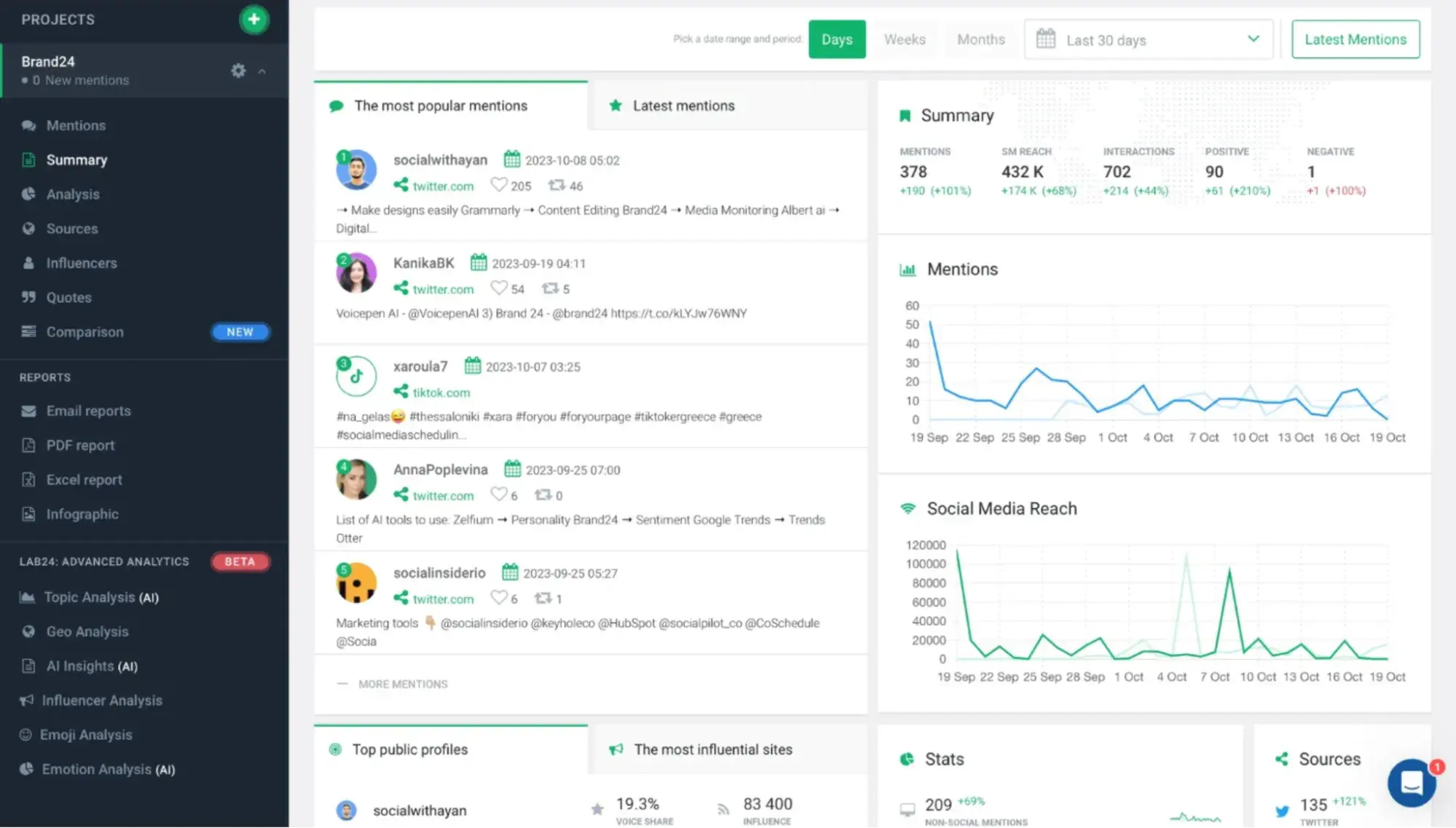
Best for: Small to mid-sized businesses, marketing agencies, and PR professionals who need reliable brand monitoring with AI-powered analytics at an accessible price point.
Brand24 is a social media monitoring and analytics tool that tracks brand mentions in real time across social media, news, blogs, forums, podcasts, review sites, and newsletters. It’s known for a clean interface, fast setup, and strong AI-driven features, including anomaly detection, topic analysis, and automated summaries, that help lean teams interpret mention data without manual analysis.
Brand24’s pricing:
- Individual: $249/month (3 keywords, 2K mentions)
- Team: $349/month (7 keywords, 10K mentions)
- Pro: $499/month (12 keywords, 40K mentions)
- Business: $699/month (25 keywords, 100K mentions)
- Enterprise: $1499/month (Custom keyword count, custom mentions)
- Free trial, 14 days (see here)
Brand24’s core features:
- Multi-source monitoring. Tracks mentions across social platforms (X, Facebook, Instagram, TikTok, Reddit, LinkedIn), news, blogs, forums, review sites, podcasts, and newsletters.
- AI-powered analytics. Anomaly detection, topic analysis, AI-generated summaries, and sentiment analysis reduce the time required to interpret brand-mention data.
- Influencer identification. Discover the most influential profiles and sites mentioning your brand, sorted by reach, share of voice, and influence score.
- Presence Score. A proprietary metric that tracks your overall online visibility as a single trend line.
- Slack integration and automated reports. Real-time Slack alerts and scheduled PDF reports that can be shared with stakeholders automatically.
Brand24’s limitations to consider:
- Historical data access is limited on lower-tier plans. This could restrict your ability to build a long-term historical trend analysis.
- Sentiment analysis can be inconsistent with industry-specific language or informal phrasing. With this in mind, it might be worth manually spot-checking flagged mentions to verify sentiment accuracy before routing them into response workflows or reporting dashboards.
- AI search engine monitoring (ChatGPT, Perplexity, etc.) is not included as a native feature. For most teams building out an AEO strategy, this could be a significant gap that requires pairing Brand24 with a dedicated AI visibility tool like HubSpot AEO or Peec.ai to cover the full monitoring stack.
7. Peec.ai
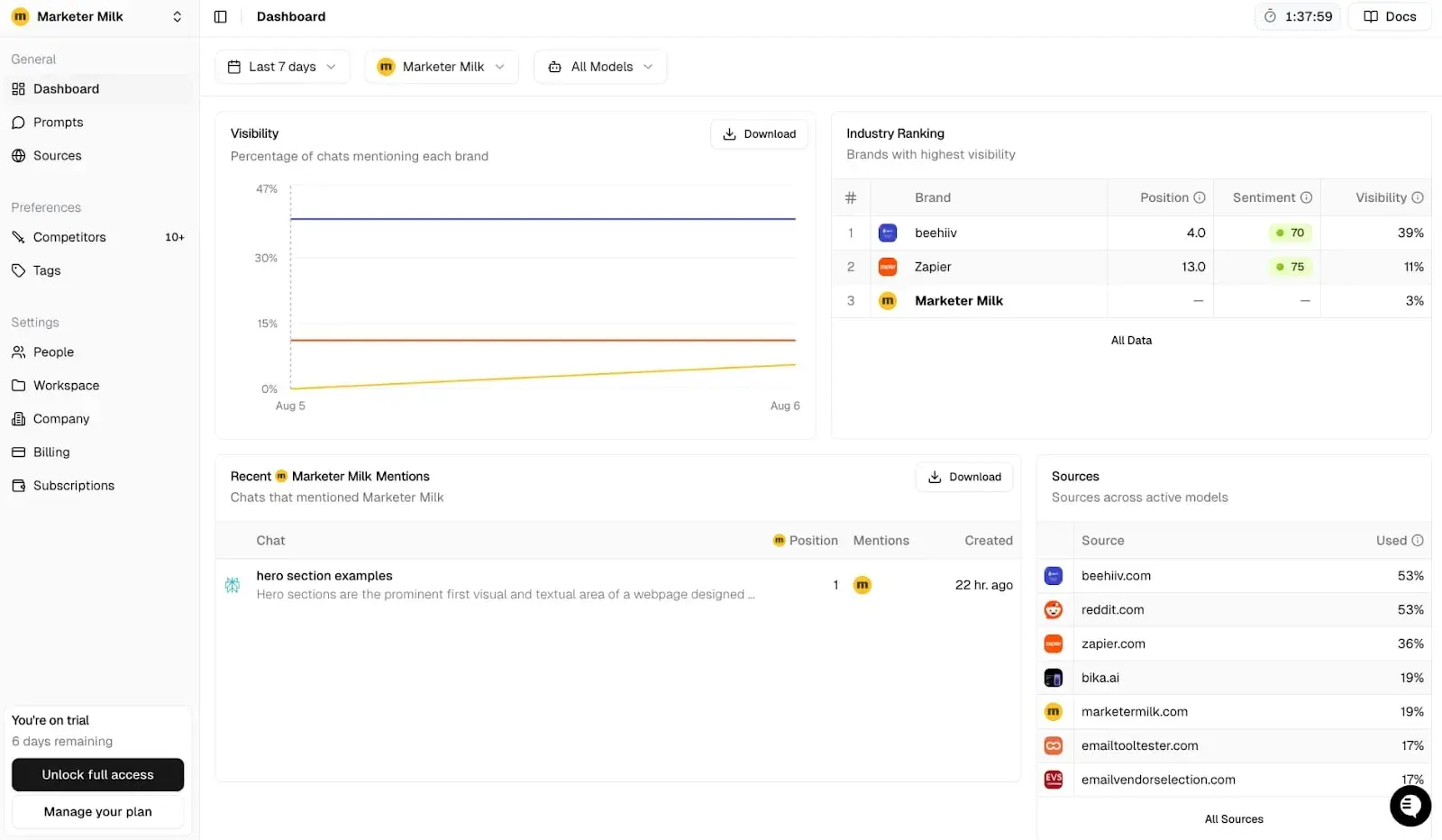
Best for: Marketing teams and agencies that want clean, focused AI visibility analytics with a strong UX and Looker Studio integration for custom reporting.
Peec.ai is a pure-play AEO analytics platform; it tracks visibility across ChatGPT, Perplexity, Google AI Overviews, Copilot, Gemini, and Google AI Mode. This focus keeps the interface simple and the data clean, which teams that already have separate content workflows tend to prefer.
Peec.ai’s pricing:
- Starter: $95/month
- Pro: $245/month
- Advanced: $495/month
- Enterprise: Custom pricing only (see here)
- Free trial available (7 days)
Peec.ai’s core features:
- Prompt-level visibility tracking. Peec.ai offers position data across six AI models.
- Sentiment analysis. Peec.ai’s AEO tracking tool breaks down positive, neutral, and negative brand characterizations.
- Competitor benchmarking. AEO citation tracking tools provide regional visibility breakdowns for multi-market brands.
- Looker Studio integration. Peec.ai integrates with Looker Studio for custom reporting dashboards.
- Multi-language and multi-region support. Available in multiple countries with Peec.ai.
Peec.ai’s limitations to consider:
- Full multi-engine coverage gets expensive. Adding Claude, Gemini, and DeepSeek to the Starter plan can push the effective cost to $170-$200+/month.
- The platform is monitoring-only. Peec.ai doesn’t provide content optimization or generation tools.
8. Google Alerts
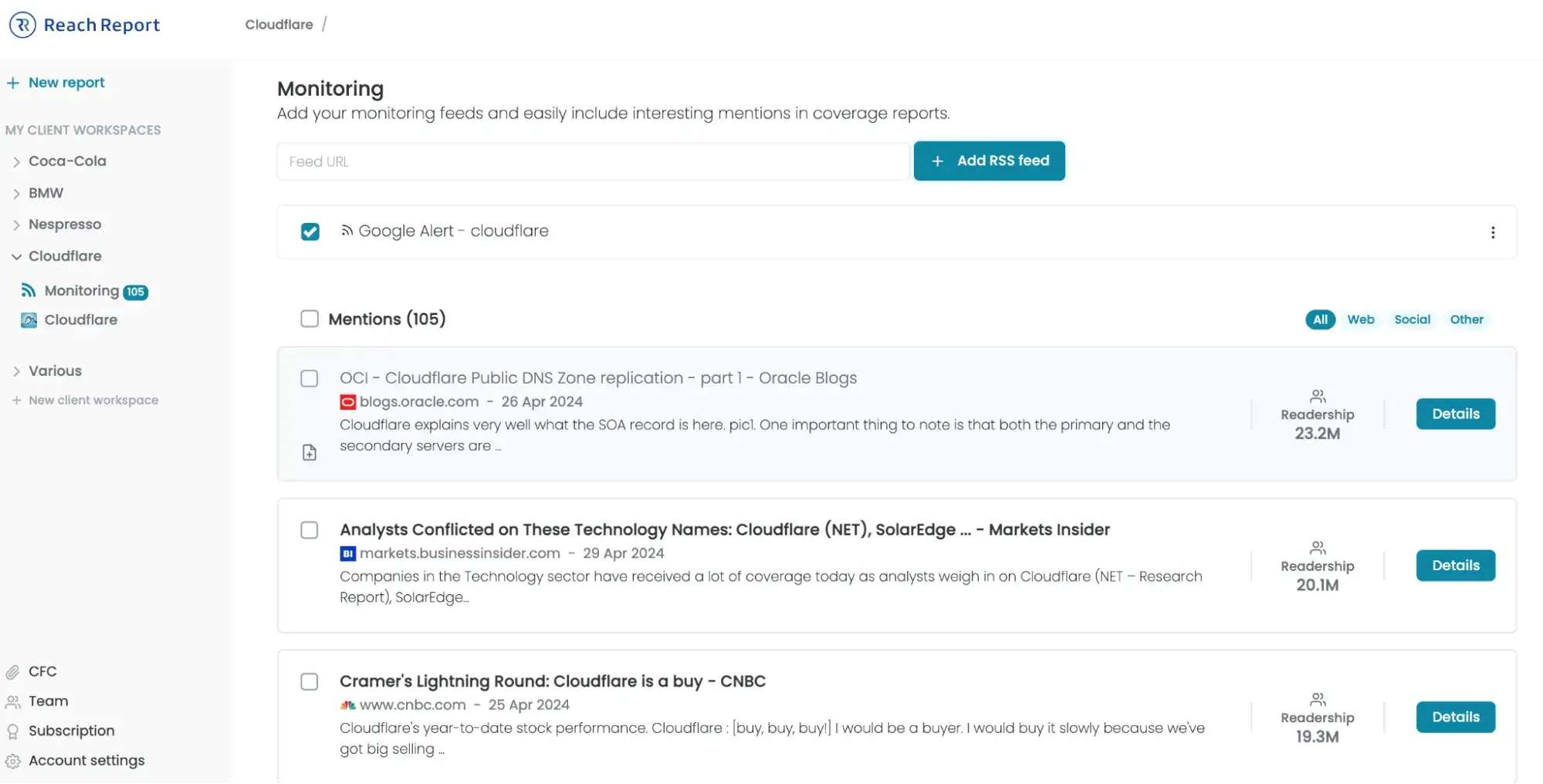
Best for: Any team or individual that wants a free, zero-setup baseline layer for web brand monitoring (especially as a supplement to paid brand monitoring tools).
Google Alerts is Google’s free notification service that sends email alerts whenever new content matching your specified keywords appears in Google’s web index. It’s the simplest brand monitoring tool available and costs nothing, making it the default starting point for teams building a layered monitoring stack.
Google Alerts’ pricing:
- Free (no limits on alerts, no account upgrades, no hidden costs)
Google Alerts’ core features:
- Unlimited alerts. Create as many keyword alerts as you need (i.e., brand name, product names, executive names, competitor names, common misspellings).
- Customizable delivery. Choose delivery frequency (as-it-happens, daily digest, weekly digest) and filter by source type, language, and region.
- Web coverage. Monitors content indexed by Google, including news articles, blog posts, and web pages.
Google Alerts’ limitations to consider:
- Does not monitor social media at all. No Facebook, X, LinkedIn, Reddit, Instagram, TikTok, or any social platform.
- No sentiment analysis, no share-of-voice metrics, no competitive benchmarking, no dashboards. These metrics matter for teams that need to measure brand health over time, benchmark against competitors, or report on campaign impact (which is why Google Alerts works best as a supplementary layer, not a primary brand monitoring tool).
- Does not distinguish between linked and unlinked brand mentions. This might be a dealbreaker for SEO teams whose primary goal is converting unlinked brand mentions into backlink outreach opportunities, since you’d need a separate tool like Ahrefs to identify which mentions lack hyperlinks.
- Does not monitor AI-generated answers, review sites, forums, or podcasts. In the AEO era, these sources increasingly matter. AI engines pull from reviews, forums, and cited web content to shape the answers buyers see, so gaps in monitoring here mean gaps in your AI visibility strategy.
- Coverage is limited to what Google indexes. This alone misses a significant portion of the online conversation landscape, particularly social media, where the majority of real-time brand conversations happen.
How to turn brand mentions into compounding value
As I’ve already explained, reader, brand mentions influence:
- Brand awareness
- Trust
- SEO value
- Reputation
But only if you treat them as inputs to a system, not just metrics on a dashboard. The teams that get the most from brand monitoring are the ones converting passive mentions into active assets: backlinks, content, relationships, and AI citations that compound over time.
1. Convert Unlinked Brand Mentions to Backlinks
An unlinked brand mention is one that does not include a backlink to the brand’s site. Every unlinked mention sitting on a live web page is a backlink you’ve already earned in spirit but haven’t captured yet.
You see, unlinked brand mentions can become backlink outreach opportunities, and they convert at significantly higher rates than cold link building because the author has already chosen to reference you.
But, alas, not all unlinked mentions are worth the outreach effort. Prioritization is what separates teams that close 2 to 3 backlinks a month from teams that close 20.
Here’s how to prioritize outreach targets:
- Domain authority first. A backlink from a DA 70 news site carries exponentially more brand mentions SEO value than one from a DA 15 personal blog. Sort your unlinked brand mentions list by the referring page’s domain authority before doing anything else.
- Page traffic second. A linked mention on a page that gets 5,000 monthly organic visits sends referral traffic and signals authority to search engines. A linked mention on a page with zero traffic does almost nothing. Use Ahrefs, Semrush, or similar brand monitoring tools to estimate page-level traffic.
- Context and sentiment third. Prioritize mentions where your brand is discussed positively and substantively. A paragraph-length recommendation converts better than a passing name-drop in a list of fifty alternatives. (Also, deprioritize pages with negative mention context; asking for a link on a complaint post isn’t a good look. Trust me.)
- Recency fourth. Authors and editors are more responsive to outreach on content published in the last 6 to 12 months. Older content has often changed hands editorially, and the person who wrote it may not have access to update it.
Then, use this outreach workflow, step by step:
- Run a weekly scan for new unlinked brand mentions using your backlink tool of choice.
- Filter by domain authority (DA 40+ is a reasonable starting threshold for most brands) and page traffic.
- Identify the author or editor. Use LinkedIn, site byline, or a contact-finding tool like Rocket Reach.
- Send a short email (under five sentences). Thank them for the mention, point to the exact line, and suggest a specific URL that adds value for their readers (i.e., a relevant tool, guide, or resource, not just your homepage).
- Follow up once after 7 to 10 days. After that, move on. Typical conversion rates for unlinked brand-mention outreach range from 5% to 15%.
- Log every outreach attempt and outcome in your CRM. This way, you can track conversion rate, average response time, and total backlinks acquired per month.
Pro Tip: Don’t just track whether outreach succeeded. Track which brand mentions sources produce the highest conversion rates over time. Historical trend analysis shows how brand mentions change over time by source, sentiment, and campaign.
2. Repurpose User-Generated Content for Email, Social, and Web
Read this sentence once, then again: Every positive brand mention is a piece of user-generated content (UGC) you didn’t have to create, and it carries more credibility with your audience than anything your marketing team writes about itself.
The compounding value comes from systematically repurposing these mentions across channels instead of letting them sit in a monitoring dashboard.
Here’s where to repurpose this content effectively (and how):
- Social proof on your website. Pull direct quotes from positive reviews (G2, Capterra, Trustpilot), social posts, and community threads onto landing pages, product pages, and case study sections. (A customer’s words always convert better than your copy. Always attribute and link back to the original source when possible.)
- Email campaigns. Feature customer quotes, review highlights, or community shoutouts in nurture sequences, newsletters, and onboarding emails. A real user saying “this tool cut our reporting time in half” carries way more weight than a bullet point in a feature list.
- Social media content. Screenshot and reshare positive brand mentions (with permission or attribution) as social posts. This is especially effective on LinkedIn and Instagram, where social proof performs well organically. (Be sure to tag the OG author, too — it strengthens the relationship and often triggers additional engagement.)
- Sales enablement. Route high-quality brand mentions into your CRM as sales assets. When a prospect is evaluating you against a competitor, a rep sharing a recent third-party endorsement from a trusted industry source is more persuasive than another product slide.
- Ad creative and retargeting. Customer quotes and UGC pulled from brand mentions can be tested as ad copy and creative. UGC-based ads consistently outperform brand-produced creative in engagement and click-through benchmarks.
Pro Tip: Set up a tagging system in your CRM or brand monitoring tool. When a mention comes in, tag it by sentiment (positive, neutral, negative), format (quote, review, long-form, social post), and potential use (social proof, email, ad creative, sales enablement). This turns a flat mention feed into a searchable content library.
3. Nurture Journalist and Creator Relationships in CRM
The most valuable brand mentions don’t come from one-off coverage; they come from ongoing relationships with:
- Journalists
- Bloggers
- Podcasters
- YouTubers
- Industry analysts who reference your brand repeatedly
Each repeat mention builds cumulative SEO authority, audience trust, and (increasingly) AI visibility, since AI systems weigh frequency and consistency of citations when deciding which brands to surface.
However, the problem most teams have isn’t with getting the first mention. It’s with turning a single mention into a sustained relationship, and, truth be told, that’s a CRM problem, not a PR problem.
Here’s how to build a CRM-tracked media and creator relationship workflow:
- Create a contact record for every journalist or creator who mentions your brand. Tag them by beat, outlet, audience size, and past mention history. This is the foundation — if you can’t search “who has mentioned us in the last 90 days and covers our category,” you’re starting from scratch every time.
- Track every interaction. Log outreach emails, responses, quotes provided, data shared, interviews given, and coverage published. (When a journalist reaches out six months later to request a source for a new story, your team should be able to see the full relationship history in seconds, not dig through someone’s inbox.)
- Proactively provide value. Don’t wait for journalists to come to you. Share original data, proprietary research, expert quotes from your leadership team, and early access to product news. Create a source materials library in your CRM (i.e., pre-approved quotes, stat packages, product one-pagers, executive bios) that PR and comms can pull from instantly when a media opportunity appears.
- Set re-engagement cadences. If a journalist covered you once and you never followed up, that relationship is decaying. Set CRM reminders to share relevant updates with past contacts quarterly — a new data report, a product milestone, an industry trend your executives have a perspective on. (The goal is to become a reliable source they return to, not a brand that pitches once and disappears.)
- Connect creator relationships to AI visibility. AI visibility improves when brand information is consistent, cited, and easy for systems to interpret. Journalists and creators who link to your content and cite your data in authoritative publications are feeding the exact signals AI models use to decide which brands to recommend. (The best ways to track brand mentions in AI search start with understanding which sources AI engines are pulling from, and then investing in relationships with those sources.)
Pro Tip: Use HubSpot’s AEO Grader to identify which AI search engines currently cite your brand and which queries surface you.
Then, cross-reference those results with your CRM’s media contact list to see which journalist and creator relationships are driving AI citations, and which gaps in your AI visibility map are missing relationships you haven’t built yet. That connection between media relationship investment and measurable AI visibility is where monitoring ChatGPT brand mentions tools and CRM-centered workflows converge.
How and Why This Stuff Actually Compounds
Each of these three motions (backlink conversion, UGC repurposing, and relationship nurturing) feeds the others:
- Backlinks from converted unlinked brand mentions strengthen your domain authority, which improves search rankings, which generates more brand mentions.
- Repurposed UGC builds social proof, which earns trust, which leads to more organic mentions.
- Nurtured creator relationships produce repeat coverage, which builds citation frequency, which improves AI visibility.
As I’ve previously stated, brand mention KPIs include:
- Total mentions
- Reach
- Sentiment
- Share of voice
- Conversions
However, the compound value always appears on the trend lines. When your historical trend analysis of AI brand mentions shows steady upward movement, when your backlink acquisition rate climbs quarter over quarter, and when your UGC library grows faster than your content team can use it, that’s when brand monitoring finally stops being a reporting function and starts being a growth engine.
Frequently asked questions (FAQ) about brand mentions
How often should you check brand mentions?
It depends on the channel. Real-time social platforms (X, Reddit, TikTok, LinkedIn) need near-continuous monitoring — or, at a minimum, automated alerts that flag volume spikes and negative sentiment shifts as they occur.
A crisis can build in hours on social, and a delayed response makes it worse. For other channels, here’s a practical cadence to follow:
- News and media mentions: Daily. Set automated alerts through your brand monitoring tools so coverage hits your inbox the morning it publishes.
- Review sites (G2, Capterra, Trustpilot, Yelp): Two to three times per week. Reviews accumulate more slowly, but unanswered negative reviews compound reputational damage.
- Forums and communities (Reddit, Quora, niche forums): Weekly, with alerts for high-volume threads. Forum conversations are long-lived and often surface in search results.
- Unlinked brand mentions: Weekly. Run a scan in your backlink monitoring tool to identify new unlinked brand mentions that could become backlink outreach opportunities.
- AI-generated answers: Weekly to biweekly. Run your priority queries through ChatGPT, Perplexity, Gemini, and Google AI Overviews to log where your brand appears, and where it doesn’t.
Pro Tip: The right cadence matters less than having one at all. Most teams monitor reactively (something blows up, they scramble) instead of proactively. Build your brand mention workflow with defined check-ins by channel, assign owners, and track response SLAs.
A brand mention workflow includes term lists, alerts, routing, SLAs, and response playbooks; the cadence is just the clock that keeps it moving.
What is the difference between brand monitoring and social listening?
Brand monitoring tracks mentions across web, social, reviews, forums, media, and AI systems — anywhere your brand name, product, or spokesperson is referenced. It answers the question: “Where and how often are people talking about us?”
Social listening is broader. It tracks conversations, themes, sentiment, and trends across social platforms — including topics your brand isn’t directly named in. It answers the question: “What is our audience talking about, and how do they feel about our category?”
Here’s where the two overlap and where they diverge:
- Brand monitoring focuses on your brand specifically. It catches direct mentions, unlinked brand mentions, competitor comparisons, and AI mentions. The output feeds SEO (backlink outreach), PR (media tracking), and customer success (review response).
- Social listening focuses on the conversation landscape. It tracks category keywords, competitor sentiment, emerging pain points, and audience trends — whether or not your brand is mentioned. The output feeds content strategy, product development, and campaign planning.
Most teams need both, but they serve different workflows. Brand monitoring is operational (find the mention, route it, respond). Conversely, social listening is strategic (i.e., understanding the market, spotting opportunities).
Brand monitoring tools like Mention, Brand24, and Brandwatch often include social listening features, but the two functions should be measured against different KPIs.
How do you ask for a backlink from an unlinked brand mention?
An unlinked brand mention is one that does not include a backlink to the brand’s site. Converting these into linked mentions is one of the highest-ROI outreach tactics in brand mentions SEO because the author already knows your brand and chose to reference it, you’re not pitching cold.
Here’s a step-by-step workflow to utilize:
- Step 1: Find the mentions. Use a backlink scanner (Ahrefs, Semrush, or Moz) to identify pages that reference your brand name without linking to your site. Filter for pages with meaningful domain authority. Those are your highest-value targets.
- Step 2: Verify context. Read the page. Confirm whether the mention is positive or neutral, and whether a link would make editorial sense for the reader. Don’t pitch a backlink for a passing reference buried in a list of fifty names.
- Step 3: Find the right contact. Identify the author or editor. LinkedIn, the site’s about page, or a tool like Hunter.io usually gets you there.
- Step 4: Send a short, specific email. Thank them for the mention. Point to the exact line where your brand appears. Suggest a specific URL that would add value for their readers (not just your homepage — link to a relevant resource, tool, or guide). Keep it under five sentences.
- Step 5: Follow up once. If you don’t hear back in 7 to 10 days, send a single follow-up. After that, move on.
Pro Tip: Prioritize pages that rank well in search. A backlink from a page that already gets organic traffic carries more SEO value and sends referral visitors. Sort your unlinked brand mentions list by the page’s estimated traffic or domain authority before starting outreach.
How can you monitor brand mentions in ChatGPT and other AI tools?
This is the fastest-evolving area in brand monitoring, and most traditional brand monitoring tools weren’t built for it. AI mentions don’t live on static URLs; they’re generated dynamically per query, which means the detection methods are fundamentally different from web or social monitoring.
Here are the best ways to track brand mentions in AI search right now:
- Manual prompt auditing. Build a list of 15 to 25 priority queries your audience asks that should surface your brand (e.g., “best CRM for small businesses,” “top email marketing tools,” “how to set up lead scoring”). Run these queries in ChatGPT, Perplexity, Gemini, Copilot, and Google AI Overviews on a weekly or biweekly schedule. Log which engines mention your brand, whether they cite a source, and what competitors appear alongside you.
- Dedicated AI monitoring tools. A growing category of monitoring tools for ChatGPT brand mentions (including Otterly, Peec AI, and Profound) automate this process by running scheduled queries across multiple AI engines and tracking your visibility over time.
- Historical trend tracking. Whether you use manual or automated methods, the real value comes from building a historical trend analysis of AI brand mentions. Track your AI visibility score monthly to see whether optimization efforts (content updates, structured data improvements, citation building) are moving the needle.
The key principle behind all of these approaches: AI visibility improves when brand information is consistent, cited, and easy for systems to interpret. Monitoring alone won’t fix gaps, but you can’t fix what you can’t see.
Pro Tip: To establish your AI visibility baseline, use HubSpot’s AEO Grader. It analyzes how your brand appears across AI-generated search results, showing which queries surface your brand, which AI engines cite you, and where gaps exist.
When should legal or PR handle a negative brand mention?
Not every negative mention requires escalation. A one-star review about shipping speed is a customer success issue. A Reddit thread complaining about a feature gap is product feedback. Route those to the teams that can actually resolve them.
That said, legal or PR should step in when a negative brand mention meets one or more of these criteria:
- Defamatory or factually false claims. A review or article that contains verifiably false statements about your product, company, or leadership. Legal assesses whether a takedown request, formal correction, or cease-and-desist is appropriate.
- Potential brand crisis. A single mention that’s gaining rapid traction (i.e., high engagement, cross-platform sharing, media pickup). PR should own the response strategy before the narrative sets.
- Regulatory or compliance risk. Mentions that allege legal violations, data breaches, safety issues, or regulatory non-compliance. Legal needs to review before anyone responds publicly.
- Impersonation or trademark misuse. Fake accounts, unauthorized use of your brand name or logo, or competitor content that creates customer confusion. Legal handles enforcement.
- Coordinated negative campaigns. A sudden spike in negative brand mentions from bot-like accounts, review bombing, or organized efforts to damage your reputation. PR and legal coordinate the response.
Everything else routes to customer success, social, or product. Brand mention KPIs include total mentions, reach, sentiment, share of voice, and conversions, but your escalation criteria should be based on risk severity, not volume alone.
Pro Tip: Define escalation criteria before a crisis hits, not during one. Build a simple decision tree into your brand-mention workflow: if a negative mention is factually false, gaining traction quickly, or involves legal/regulatory risk, it routes to PR or legal with a defined SLA.
Brand mentions are just the beginning of your AEO strategy
Brand mentions tell you where your brand shows up today — across social, news, reviews, forums, and AI-generated answers. But tracking them is only the starting line.
The real value comes from what you do with that data, which is:
- Converting unlinked brand mentions into backlinks
- Building a historical trend analysis of AI brand mentions that proves what’s working
- Connecting brand monitoring to pipeline through your CRM
- Using brand monitoring tools to route every mention to the right owner with a clear response playbook
And the landscape is shifting fast. The best ways to track brand mentions in AEO didn’t even exist two years ago, and monitoring ChatGPT brand mentions tools are still a new category most teams haven’t adopted.
But, if I’m being honest here, you and your team can get ahead of this shift right now. It’ll take layering social listening, backlink scanning, review tracking, and AI visibility monitoring into a single CRM-connected workflow to make it happen, but it’s more possible than you think.
Ready to see how AI engines actually talk about your brand? Get started with HubSpot AEO.