
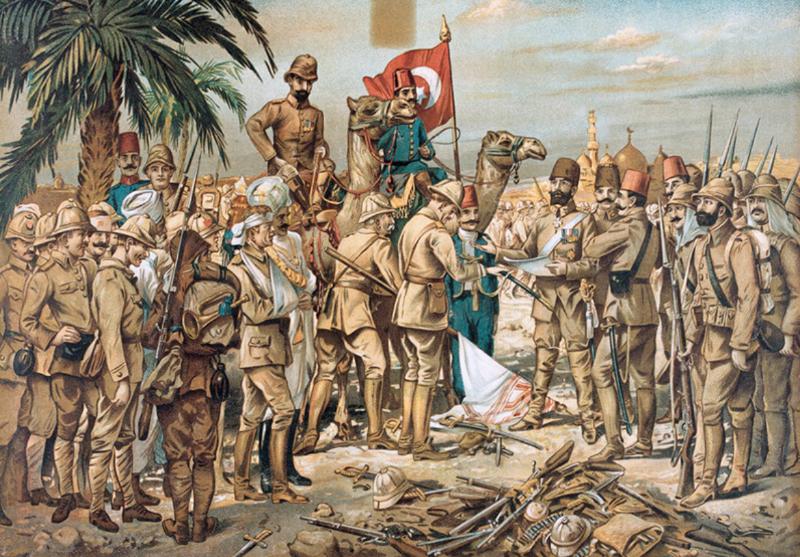
A look at the Ottoman Empire’s rare and dramatic victory over the British at the 1916 siege of Kut, and what it reveals about colonial ambitions and Muslim resistance.
By Ibrahim Moiz for MuslimMatters
A Rare Ottoman Victory
The First World War was a seminal moment in modern Islamic history, setting off a chain of events that led to the collapse of the longstanding Ottoman Sultanate, which theoretically claimed leadership over the world’s Muslims as a caliphate, and the imposition of colonial rule in much of the Near East, with administrative structures and borders that have long outlasted the actual colonies.
Keep supporting MuslimMatters for the sake of Allah
Alhamdulillah, we’re at over 850 supporters. Help us get to 900 supporters this month. All it takes is a small gift from a reader like you to keep us going, for just $2 / month.
The Prophet (SAW) has taught us the best of deeds are those that done consistently, even if they are small.
Click here to support MuslimMatters with a monthly donation of $2 per month. Set it and collect blessings from Allah (swt) for the khayr you’re supporting without thinking about it.
The war also saw the encroachment of Western European, namely British and French, power in the region for the first time since the medieval era, with Britain in particular playing a major role in establishing a regional dominance unmatched by any non-Muslim power until the United States displaced and inherited its hegemony later in the twentieth century.
Yet at the outset of the war British success was far from certain, and stiff opposition, whether by Ottoman forces or local Muslim militants, continued for decades. This month marks eleven decades since a rare Ottoman victory against the British Empire, at the siege of Kut in central Iraq during the spring of 1916, which will be the subject of this article: the first of several examining key moments in the colonization of the Muslim world’s centre during these years.
Background and Build-Up
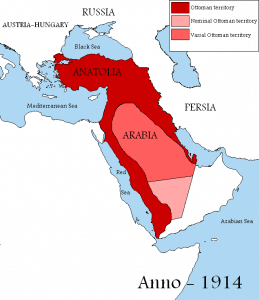
The Ottoman Empire just before World War I
British relations with the Ottomans had begun in the sixteenth century, and apart from a period of hostility in the early 1800s, where Britain backed the secession of Greece, had been more or less cordial for most of the nineteenth century.
Over this period Britain came to rule probably the single largest amalgamation of Muslim populations in the world, including such far-flung regions as Egypt and India, which became the regional bases for British policy toward the Middle East. Generally Britain maintained a legal fiction of simply “protecting” its vassals, such as various nobles in India and sheikhs in Arabia, as well as former enemies such as the former caliphal aristocracy of Sokoto and the religious orders of Sudan, which Britain had defeated at the turn of the twentieth century.
In practice, however, it held the whip hand. This was demonstrated in late 1914, shortly after the outbreak of the World War; when Cairo’s nominally independent government supported the Ottomans, its British “protectors” simply replaced it.
The British elite’s stance towards Muslims was mixed; parts of the imperial elite were outright hostile, while others, particularly the so-called “Arabists”, were fascinated, and a handful even embraced Islam. Circles within this elite had tended to favor Ottomans as a check against the powerful Russian Empire; others, particularly liberals, caricatured the “Turks” as oriental tyrants and, for either racial or religious reasons, sympathized with the Russian policy of trying to foment Christian minorities against the Ottomans.
It was not until the early twentieth century that Britain put this policy into practice.
Epitomized by Horatio Kitchener—the ruthless defense minister legendary throughout the British Empire for his exploits in Sudan, South Africa, and the Indo-Afghan borderland—the British elite had long feared that the Ottoman sultanate might incite an international jihad by the Muslims under or around their rule. When the Ottomans joined the World War and did just this, they found takers aplenty.
Muslim discontent in India, overlapping with calls for independence, was high, and many Muslim soldiers deserted the British army. Cairo had to be subdued from joining the Ottomans; the governments of Iran (then Persia) and Afghanistan formally declared neutrality despite severe pressure, and the Afghan regime at least hosted a largely Muslim “Free Indian” government in exile and intermittently supported Pashtun raids on the Indian frontier.
In Africa the Darfur sultanate, the Sanousi order in Libya, and the Dervish emirate in Somalia also lent support to the Ottomans. These were too scattered to change the war’s eventual outcome, but they did create a major headache for the British empire.
Under the rule of the energetic but heavy-handed “Young Turk” junta, the Ottomans in their core territories had managed to antagonize considerable proportions of their ethnic and religious minorities over the 1910s. Yet among at least its Muslim subjects support for the Ottoman cause remained extraordinarily high: only a small minority of Arabs and Kurds defected, many thousands instead fighting and dying under Ottoman colors in such arenas as Libya, eastern Anatolia, and the Dardanelles.
Messing with Mesopotamia
The strategically located and diversely ethnosectarian land of Iraq was one strategic arena: Britain had long suspected it to hold rich oil wealth, and it lay between three oil-rich regions—west of Persia, south of the Caucasus, and east of the Ottoman heartland on the Persian Gulf.
Britain would soon develop an obsession that Mosul was a hotbed of oil, but it was protecting their oil interests in Persia that were the first focus of their campaign. Britain had an arrangement with an Arab chieftain in the Ahwaz region of southern Persia, Khazal Jabir, to protect their pipeline and wanted to prevent its interception by the Ottomans.
For their part, despite a history of dissent in Iraq the Ottomans were able to rally widespread support; their commander in Iraq Hasan Cavit was even able to rally Shia clansmen and gain the support of the Shia cleric Kazim Tabatabai, who had a generally accommodationist attitude toward authority and would lose his own son in the war.
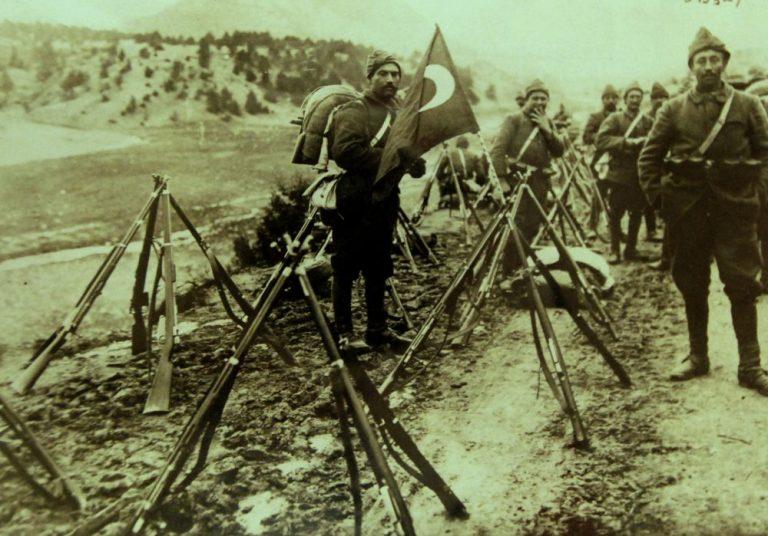
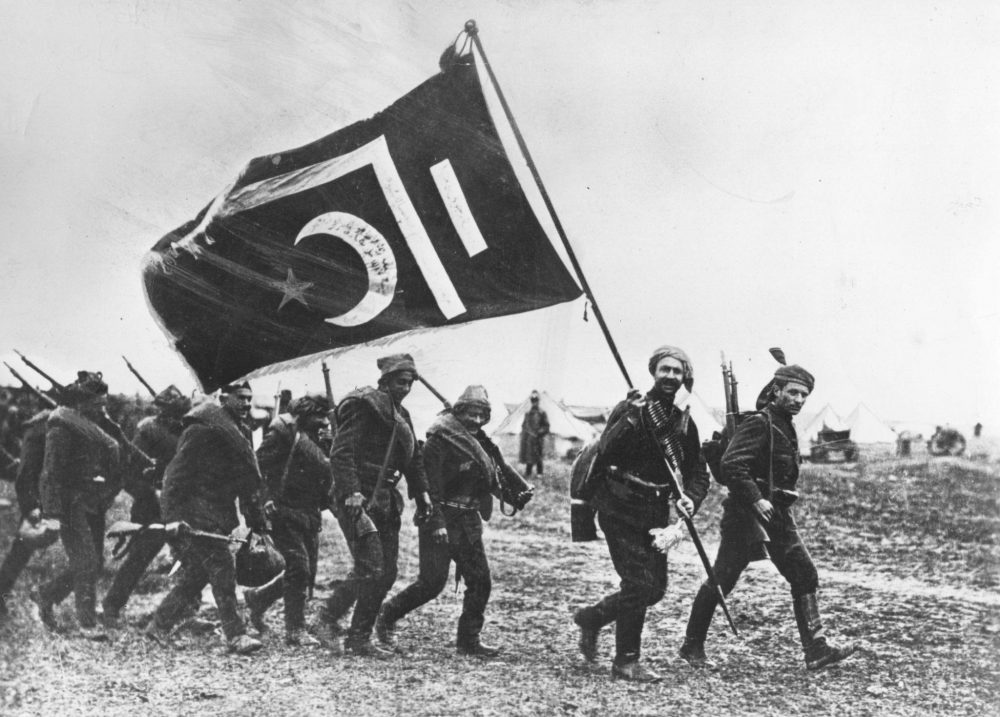
Ottoman soldiers
A British expedition, led by Arthur Barrett, landed in the Basran delta in autumn 1914 and after hard fighting managed to push back Cavit’s lieutenant there, Suphi Bey. Thousands of Arab clansmen, led by sheikhs Ajaimi Saadoun and Umran Saadoun, assembled a riverine fleet to sail to the coast to fight.
Meanwhile the Lami clan led by Ghadban Bunayya, a rival of Khazal, sabotaged the British pipeline at Ahwaz and ambushed the British reinforcements that arrived in response. In turn the British army, led by George Gorringe, ravaged the marshlands of southeast Iraq, his heavy bombardment killing hundreds in an attempt to dissuade Arab clansmen from joining the Ottomans.
By this point Britain was in some consternation after its early hopes of conquering Istanbul by sea had been shattered at the Battle of Gallipoli. Their new commander Eccles Nixon now set his sights on conquering Iraq.
In April 1915 he was encouraged with a major success at Shuaiba. The Ottoman army, usually based in Baghdad, was already overstretched, and relied heavily on the volunteering Arab clansmen under Muntafiqi chieftains Saadouns Abdullah and Ajaimi. Despite their courage, they were routed and their field commander Suleiman Askeri committed suicide.
The new Ottoman commander Mehmet Nurettin—known as “Bearded Nurettin” as the only Ottoman general to sport a beard—would earn a reputation as a ruthless, even fanatical, soldier; but, contrary to racialized British ideas of “oriental” incompetence that should have been put to bed at Gallipoli, he could fight.
The Ottomans had often relied on their German allies to provide military advice, if not outright command, as at Gallipoli, and much European opinion assumed that in the absence of German officers the “Turks” made good soldiers but poor commanders. Their overconfidence soared when by the summer the British army took the cities of Nasiria and Kut: Charles Townshend, commanding the British vanguard, dreamt of becoming “governor of Mesopotamia”.
Kut Cut Down to Size
Something of a vainglorious maverick, known for playing ribald songs on a banjo and bursting into bouts of spontaneous French, Townshend was already famous as “Chitral Charlie” in Britain for having led a besieged garrison in the highlands of the Indian frontier, now in northern Pakistan, against an Afghan siege twenty years earlier.
Nixon now ordered him to march all the way up to Baghdad. Though he romanticized about the fabled city, Townshend realized that his army might be overstretched. He preferred to stay at Kut, the Tigris town upriver of Baghdad. But despite his objections he was ordered forward.
By then, the British army had telegraphed its intention long enough for Nurettin to make thorough preparations.
The armies met in November 1915 at the site of the former Sassanid capital Ctesiphon, once the world’s largest city known as “Madain”, or metropolis, by the early Muslims, but now a backwater of Baghdad. It was an appropriate stage for a climactic battle, where the advantage tilted one way and another and nerves frayed.
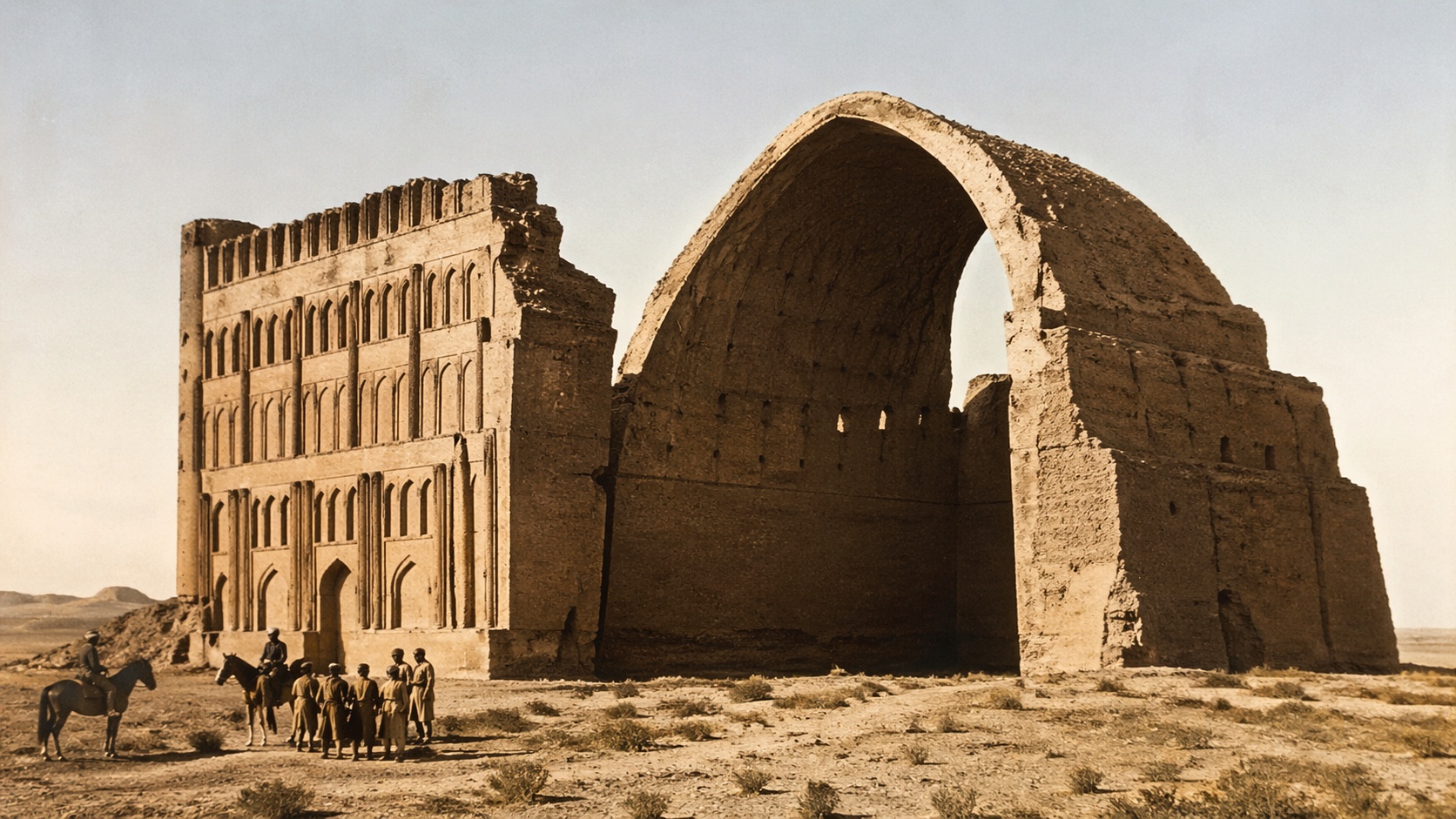
Rendering of the Ctesiphon arch as it would have appeared in 1916.
At various stages both Townshend and Nurettin contemplated retreat as thousands were killed. However, it was the British army that buckled first, and Townshend fought his way out back to Kut with Nurettin in hot pursuit.
The British garrison in Kut was surrounded and a long siege set in over the winter as British supplies dwindled.
It was a rare moment of Ottoman advantage over Britain, and the Ottoman defense minister Ismail Enver, who had planned the Ottoman coalition against Britain’s Entente the previous year, arrived to soak in the moment.
Enver had spent much of the previous year in a bitter, bloody, and costly war to the north against Russia, whose main “achievement” had been the destruction of the Armenian community in response to a Russian-backed Armenian insurgency. He now replaced Nurettin with veterans of that campaign: firstly his uncle Halil, and secondly an experienced Prussian general recalled from retirement by Germany to help the Ottomans, Colmar Goltz.
If Nurettin had a reputation as a hard man, Halil was positively remorseless in the massacres against the Armenians. But he was tenacious; he had ridden on horseback to Iraq ignoring a serious, untreated injury, and his commitment to the cause was undoubted.
Goltz, for his part, had been advising the Ottoman military for decades, and though he had threatened to resign in order to stop the anti-Armenian slaughter, he was also committed to the Ottoman military, whom he saw as the engine to recover Turkish prestige.
Halil and Goltz took over just as the British army was preparing to counterattack in the new year. In early 1916 the British commanders, Fenton Aylmer and Gorringe, made three enormous attacks on Ottoman lines east of Kut; each one was repelled with thousands of soldiers slain.
Morale in the British army, both inside and outside Kut, sank; the Ottomans helpfully incited Muslim soldiery to defect from the British ranks to join their fellow Muslims; and Townshend, rotting inside Kut, blamed Nixon for ever having sent him toward Baghdad.
Indeed Nixon, whose nerves were shot to pieces, resigned, but his replacement Percy Lake had no more luck in relieving Kut.
Surrender and Aftermath
Even the death of their German taskmaster Goltz, who had spent much of his seventy-odd years with the Turks, did not dampen Ottoman spirits; it was an upbeat Halil and a glum Townshend who met on the Tigris river to arrange the terms of surrender in April 1916.
In the tradition of Ottoman soldiery, Halil was a sporting enemy—he congratulated Townshend on his heroic defense—but quite determined not to let his prey go. Townshend suggested a large financial sum in return for letting the garrison evacuate Iraq, but Halil cheerfully refused what he regarded as a bribe.
Similarly his nephew Enver, still relishing his checkmate of the infamous Kitchener, dismissed the British defense minister’s offer of payment in return for evacuation. When news of these offers spread, it embarrassed Britain greatly; Arnold Wilson, then a soldier and later to hold high office, bitterly complained about “our incredibly stupid attempt to secure by British gold what British military virtue was unable to compass.”
Kitchener would be killed two months later, in the summer of 1916, just before the bloodiest battles of the World War’s Western front. He left a long shadow that loomed not least over the Muslim world and Britain’s conquests therein, among his last experiences the humiliation against a Muslim army at Kut.
Halil would thereafter adopt the town’s name, Kut, as his personal surname. Its British garrison was captured and marched off to Anatolia, many soldiers dying on the route; however, Townshend was given a comfortable imprisonment at Istanbul and, much impressed with his captors’ gentlemanly treatment, would become a firm advocate for an arrangement with the Turks.
That came after Britain, “Kut” down to size by its experience in Iraq, resorted to subterfuge to undermine their Ottoman opponents, an episode that will be the next article in this series in sha Allah.
Related:
Part I | The Decline of the Ottoman Empire
Nationalism And Its Kurdish Discontents [Part I of II]: Kurds In An Ottoman Dusk