
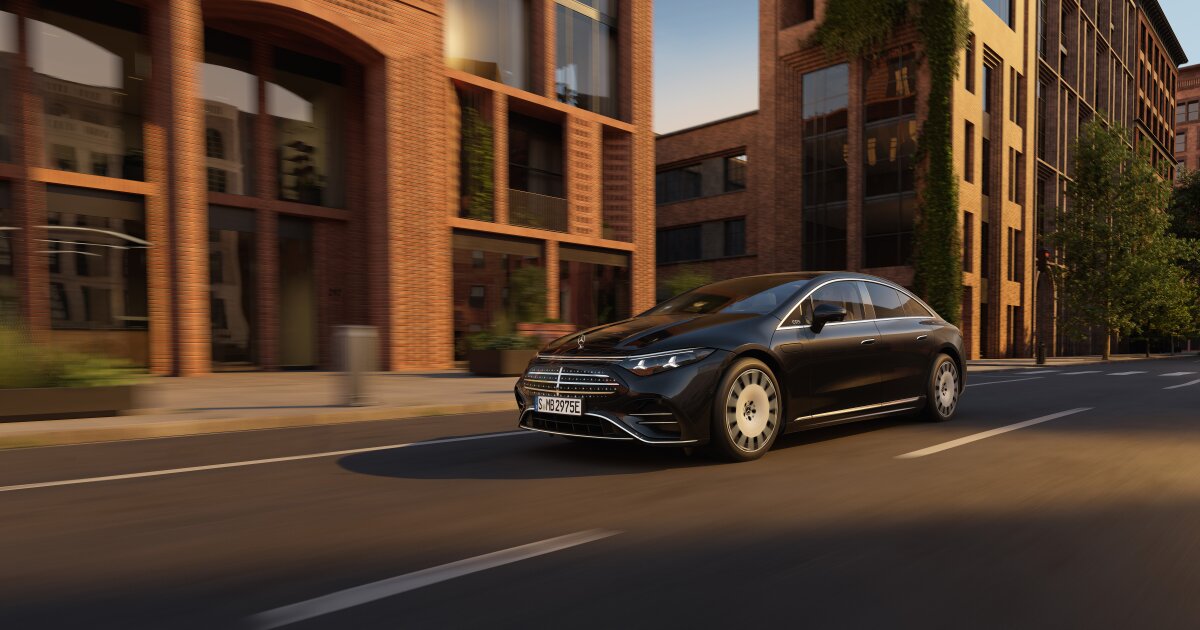
Mercedes has given its poshest electric saloon, the EQS, a mid-term refresh – showing exactly where the auto world’s current battleground is focused. Forget style, power, speed. Selling big EV sedans is now all about range.
That’s why Mercedes has pulled out all the stops to beef up the battery and voila: the EQS is now the mileage marathon marvel of the electric super-saloons with a hefty 575-mile (926-km) WLTP range.
Industry insiders also note that it’s no coincidence the EQS revamp was announced shortly before its main rival is unveiled, the new BMW i7. Its current maximum range is 387miles. What range will the revamp offer?

Mercedes
Like any model update, Mercedes trumpeted a long list of high-tech upgrades from a cloud-based damper system to electronic steering but it’s the headlines that Mercedes was after. That eye-popping 574-mile range figure has certainly got those. The UK’s AutoExpress magazine already crowned it ‘the EV range king.’
The updated EQS significantly boosts the capacity of its predecessor from a maximum of 511 miles to up to 575 miles (926 km). The inevitable small print then reveals that this is on the more liberal European WLTP cycle not USA’s more stringent EPA rating (or China’s CLTC which is considered madly optimistic), and it’s only for the special long-range EQS 450+ model.
Nevertheless, that range figure is what buyers will jump at. It’s the chance to drive from Chicago to Nashville or Paris to Munich without recharge.
After that, the second key fact to jump out at potential buyers will be charging up to 198 miles (~320 km) worth of range in just 10 minutes at a 350-kW charging point. Moving on through the marketing materials, and the rest seems just details. That’s a pity because there’s some good tech stuff in the new EQS too.
It’s the first German production car with a completely electronic non-mechanical steer-by-wire system and offers luxury gadgets like heated seat belts (yes really), headlights so bright they could illuminate six football pitches, and suspension damping that adjusts to smooth out speed bumps by monitoring them in advance via the cloud.

Mercedes
The EQS actually offers a choice of five versions. First up is new entry level, single motor, rear-wheel-drive variant called the EQS 400 that has a 112-kWh battery for a still-commendable 507 miles (816 km) per charge. As mentioned, it’s the EQS 450+ that offers the longest range with a 122-kWh battery (up from the old model’s 118 kWh). The EQS 500 4MATIC is a dual-motor all-wheel-drive version with more power (443 hp) deployed for superior traction but still an impressive 544-mile (875-km) range. An EQS 580 4MATIC is a higher-performance dual-motor AWD cruiser with all the luxuries and tech and a 544-mile range. And the AMG EQS 53 4MATIC+ is the performance flagship (751 hp) with upgraded electric motors and suspension tuning. As a demonstration of how performance costs range, that hot EQS can only offer a maximum range of 358 miles (580 km).
The EQS launched in 2021 as the brand’s first all-electric luxury saloon, and we compared the first three EQ models in January 2023. The EQS made headlines back then because it featured the world’s best aerodynamic credentials for production cars. The new model has a drag coefficient of only 0.20, among the most aerodynamic car ever built. Sadly nobody cares about that anymore. It’s all about range, range, range.
Also, the EQS was the model to introduce Mercedes’ high-tech display system ‘Hyperscreen.’ The latest models, with a huge 55-inch display, take the tech much further. The Mercedes‑Benz Operating System uses its built-in supercomputer to work with 27 external sensors, AI and constant over-the-air updates. This enables clever stuff like a faster, more versatile parking assist or using the battery to power your home while the car is parked outside.

Mercedes
One new feature though seems a step back into old school mechanical solutions. Borrowing an idea from the Porsche Taycan, the EQS drive architecture now includes a two-speed transmission on the rear axle. In first gear, acceleration from a standing start is rapid. The long-ratio second gear is designed for power at high speeds for high efficiency, range and comfort. Top speed is also reached in second gear. EVs with real gearboxes? Whatever next.
Minor details like prices and launch dates aren’t available yet.
Source: Mercedes