
Is life really out there? The Fermi Paradox famously presents a compelling statistical argument as to why life should be abundant throughout the cosmos.
Now, a team of scientists from the University of California, Riverside, has devised a new statistical method that could serve as more than a cosmic thought experiment, potentially providing answers to the age-old question.
The team discovered that life depends not only on specific molecules, but also on a hidden order that links them. They claim they can statistically detect this organizational principle, potentially allowing them to sniff out signs of alien life from samples of organic chemicals.
“Our work demonstrates that life produces molecular mixtures with characteristic patterns that differ from non-life,” Fabian Klenner, UC Riverside assistant professor of planetary sciences and co-author of the study, told Refractor in an interview. “These patterns can clearly be detected using our statistical approach.”
Crucially, the UC Riverside team’s method can even be applied to existing datasets, meaning scientists may already be sitting on a treasure trove of existing information that could reveal we are not alone.
Narrowing the search parameters for alien life
For decades, scientists have looked for biosignatures in the form of molecules that could provide hints regarding the existence of extraterrestrial life. On Mars, for example, NASA’s Perseverance and Curiosity rovers are analyzing rock samples and atmospheric data for organic compounds and other potential signs of ancient microbial life.
A new method recently published in Nature Astronomy highlights the significance of molecule order.
Specifically, the researchers found that amino acids are consistently more diverse and more evenly distributed when created by a living thing. For fatty acids, the reverse was true. They are less diverse and less evenly distributed when created by life. This “molecular diversity” could serve as a detectable biosignature, the scientists argue.
To pinpoint the organizational principle underpinning life, the team “analyzed the diversity of molecular mixtures,” Klenner explained. “Essentially, we asked how many different molecules are present and how evenly they were distributed.
“We found that biological systems (life) organize molecules differently than abiotic systems (non-life),” he continued. “The patterns that biological systems produce reflect fundamental principles of life.”
Importantly, detecting this molecular order doesn’t require any special instruments. According to Klenner, the team’s findings “could be applied to existing or upcoming missions, providing that these missions detect meaningful relative abundances of related organic molecules.”
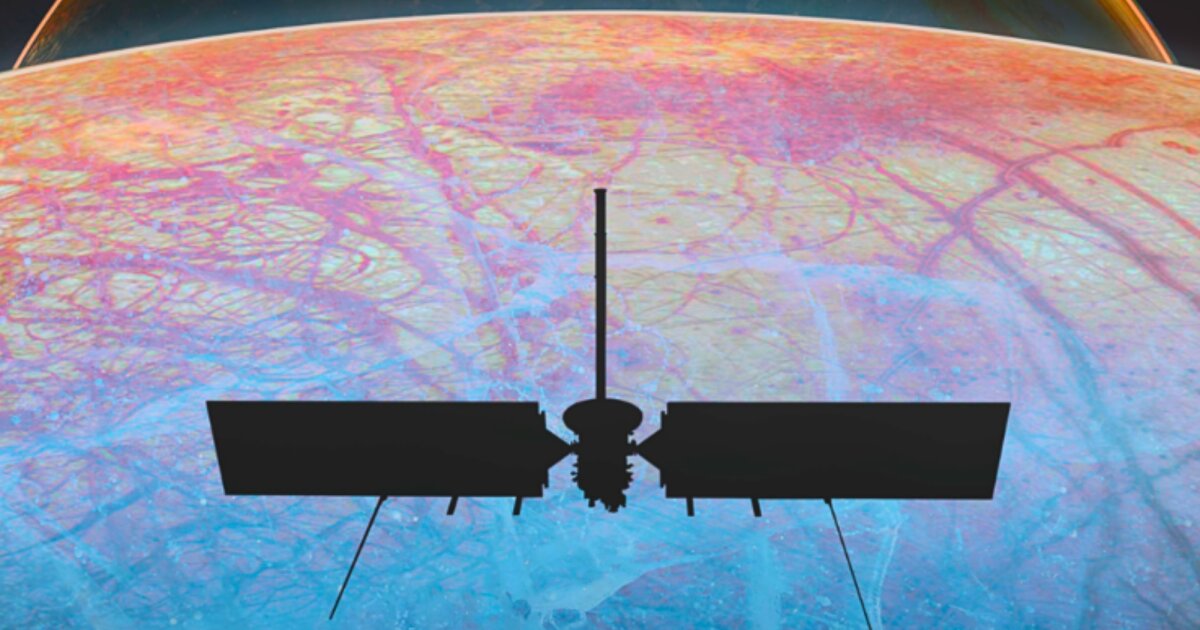
One mission with the potential to provide such data is NASA’s Europa Clipper, which is bound for Jupiter’s moon Europa. The Europa Clipper spacecraft is due to perform the first of several flybys of Europa in 2031. Once there, it could shed light on Europa’s vast subsurface ocean, which could harbor alien life.
“The Surface Dust Analyzer (SUDA) instrument aboard Europa Clipper is capable of detecting abundances of organic molecules,” Klenner told Refractor. “If this instrument detects sufficiently rich suites of organic molecules and their relative abundances, then our approach could test whether those molecular patterns look more consistent with biological or abiotic organization.”
Detecting ‘unfamiliar forms of biology’
It’s worth noting that the UC Riverside team’s approach won’t single-handedly confirm the existence of alien life. “Our approach is part of a broader biosignature framework,” Klenner said. “No single signature is likely to be definite proof on its own when it comes to the detection of potential life beyond Earth.”
Still, the method could allow scientists to cast a wider net, enabling the discovery of forms of alien life that may have otherwise remained undetected. This is down to the fact that the method focuses on the order of molecules, rather than the specific types of molecules typically associated with life.
“Our approach focuses on the organizational structure of molecules,” Klenner said. “In principle, this could make the method more sensitive to unfamiliar forms of biology, providing that they also organize molecules in ways that differ from abiotic processes.”
As it takes a statistical approach, the method could also be applied to vast amounts of archival data. As Klenner noted, the approach is “computational and does not require a dedicated new instrument. If existing datasets contain sufficient molecular abundance information, then our diversity-based approach could be applied.” This in itself greatly increases the likelihood of the method successfully detecting life, as it can draw from a wealth of existing data.
With the UC Riverside team’s new method, the chances of making a seismic discovery – whether through James Webb, SETI, or Europa Clipper data – are now incrementally higher. We may be one important step closer to finally proving we are not alone.
This research was published in Nature Astronomy.
Source: University of California, Riverside
Fact-checked by Mike McRae