
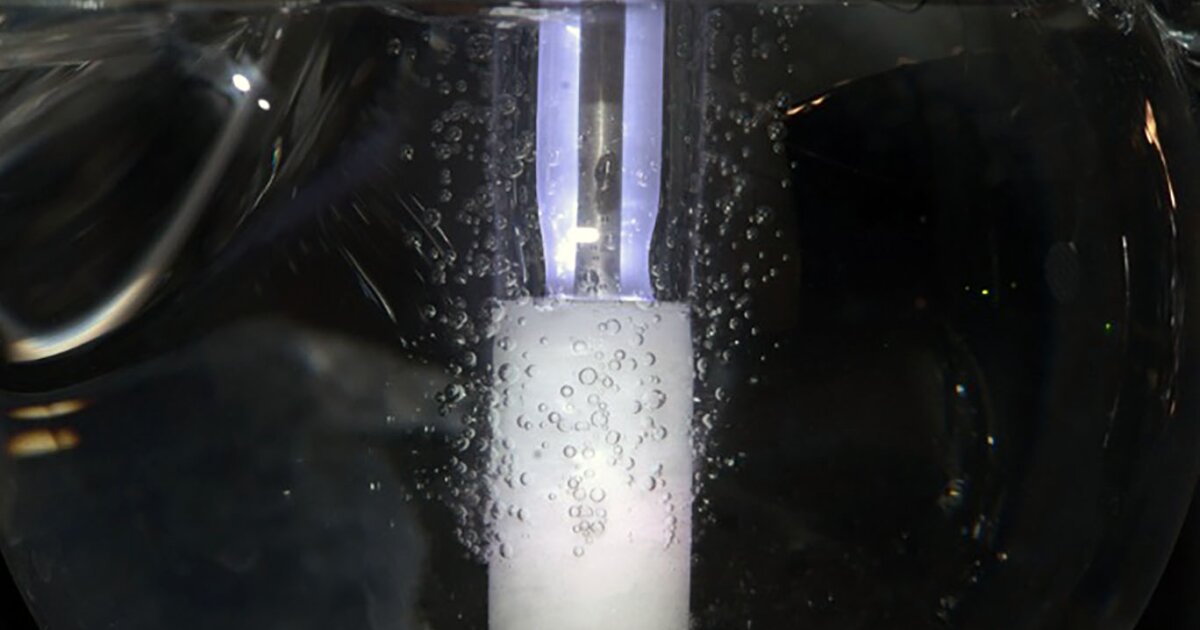
People often muse over catching lightning in a bottle, and what an amazing feat it would be. But have you ever wondered what comes next if we do it? Well, researchers at Northwestern University have bottled lightning and are using it for something just as remarkable: clean fuel. Their technology uses plasma in glass tubes to produce methanol from methane gas, a process that typically requires enormous amounts of energy.
Methanol is a widely used chemical with diverse industrial and everyday applications. It’s a vital ingredient for producing certain plastics and acids. It also serves as a clean-burning fuel for vehicles, marine vessels, and cooking stoves. Furthermore, it acts as an industrial solvent and is used in wastewater treatment.
For all its ubiquity, the current production method for methanol is an extremely energy-intensive, multi-step process that starts with methane gas. Steam at 800 °C (1,472 °F) separates methane into carbon dioxide (CO₂) and hydrogen (H₂). These gases are then recombined and catalyzed in a different structure under 200 to 300 times atmospheric pressure to form methanol molecules. The process works, but the energy required to generate the heat and pressure makes it far from sustainable. Then there are the multiple steps involved and the resulting CO₂.
Scientists have been on the hunt for a better alternative that is straightforward and energy-efficient, but methanol production presents yet another challenge. Apart from the extreme conditions required to break down methane, the methanol formed is extremely reactive and continues to react, rapidly degrading into CO₂. This brings us to the second challenge: getting the reaction to stop at the right moment.
To address both challenges, the researchers built a system that quite literally uses lightning in a bottle. Instead of relying on extreme heat and pressure, the researchers use short bursts of electricity to generate plasma, an energized state of matter often seen in lightning bolts, inside a water-filled reactor. Methane gas is fed through a porous glass tube coated with a copper-oxide catalyst. When high-voltage pulses are applied, the gas is briefly transformed into plasma, creating highly reactive fragments from both methane and water.
Bottled lightning makes a cleaner fuel
These fragments rapidly recombine to form methanol, which is immediately absorbed into the surrounding water. The rapid absorption is critical. It effectively “freezes” the reaction at the right moment, preventing the methanol from breaking down further into carbon dioxide, a key limitation of conventional processes.
To improve efficiency, the team also introduced argon gas into the system. Although normally inert, argon becomes reactive within the plasma, helping to stabilize the reaction and reduce unwanted byproducts. Under these conditions, the system achieved high selectivity for methanol, with smaller amounts of useful byproducts such as hydrogen and ethylene.
“We also ended up with ethylene, which is a precursor to plastic production, and hydrogen gas, which is an important commodity chemical and a zero-carbon fuel in its own right,” says Dayne Swearer, the study’s coauthor. “So, we took methane, which is a very abundant gas, and turned it into methanol along with ethylene, hydrogen and a bit of propane. These are all intrinsically more valuable products.”
All in all, the technology represents a big step forward. Eliminating the need for extreme heat and pressure is a major win by itself, as it significantly reduces the cost, energy demand, and environmental footprint of methanol production. The process is also inherently more streamlined, converting methane into methanol in a single step while minimizing unwanted byproducts.
For now, the setup is lab-scale. If successfully scaled up, it could enable distributed systems that convert methane at the source, such as at remote or leaking sites, turning an abundant, potent greenhouse gas into a valuable industrial chemical.
“We could treat stranded resources, like leaky well heads that naturally emit methane into the environment,” Swearer says. “Right now, the way to deal with leaked methane is to light it on fire to turn it into carbon dioxide, which warms the climate less than methane but is still clearly a problem. Instead, we could take a smaller scale reactor to the place that’s leaking methane and turn it into a transportable liquid fuel.”
For now, the team is focusing on further optimizing the system. They are also exploring ways to efficiently recover and separate methanol as a purified product. The study was published in the Journal of the American Chemical Society.
Source: Northwestern University