
Mexico City is trapped in a dangerous feedback loop.
As groundwater is pumped from beneath the city, the ground subsides, with some entire regions sinking far faster than others. This lopsided descent damages pipes, sewers, and wells, leading to leaks and water loss. To compensate, the city must pump even more groundwater, accelerating the sinking process even further.
Scientists have tracked this problem for years. The city’s subsidence was first identified by an engineer called Roberto Gayol in 1925.
Recently, though, NASA and the Indian Space Research Organization (ISRO) trained one of the world’s most powerful radar systems on the sinking metropolis.
The NASA-ISRO Synthetic Aperture Radar (NISAR) satellite can track changes in Earth’s surface with unprecedented precision. Trained on Mexico City, it revealed how the city’s subsurface was shifting, highlighting regions subsiding more than half an inch (2 cm) per month.
NASA’s $1.5-Bn NISAR telescope eyes sinking city
Mexico City, once known as the Aztec city of Tenochtitlan, was built on an island in Lake Texcoco in the 14th century. Though that lake was drained over centuries, Mexico City today still stands above an aquifer – a layer of porous rock saturated with water.
Since Mexico City’s subsidence problem was first identified in 1925, the capital city’s population has grown to more than 22 million. Unsurprisingly, more people mean more problems. Groundwater pumping has snowballed as demand for water has steadily risen, with one report stating it accounts for roughly 60% of the city’s total supply.
The problem is sharply illustrated in the new NISAR image. While the dark blue marks represent areas subsiding more than half an inch every month, the areas marked in yellow and red are likely “residual noise signals that are expected to decrease as NISAR collects more data.”

NASA / JPL-Caltech / David Bekaert
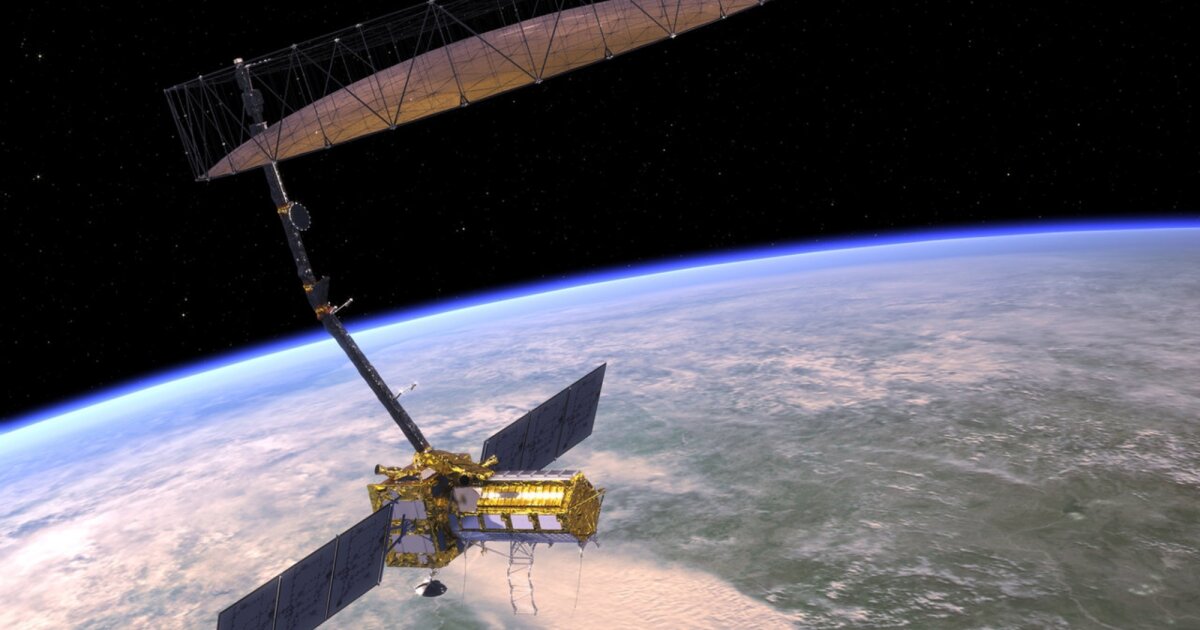
NISAR features a 39-ft (12-m) wide, unfolding radar antenna reflector, making it the largest NASA has ever sent to space. The satellite monitors the Earth twice every 12 days. It cost US$1.5 billion to build, making it the most expensive Earth-imaging satellite in history.
The new NISAR images, captured between October 2025 and January 2026, show that the Benito Juarez International Airport is located inside one of those dark blue spots.
“Images like this confirm that NISAR’s measurements align with expectations,” says Craig Ferguson, deputy project manager at NASA.
It’s far from being the only important transport infrastructure affected in the city. In 2021, an overpass collapsed resulting in 26 deaths. This was partly attributed to the effects of subsidence on the underground rail network – one of the busiest in the Americas.
Charting “differential subsidence” worldwide
In 2024, taps in Mexico’s capital city came within months of running dry. The feedback-loop intensified, and more groundwater was pumped to the surface. That same year, a study by Dario Solano-Rojas highlighted the problem of “differential subsidence” in Mexico City.
Solano-Rojas, a remote-sensing specialist at the National Autonomous University of Mexico, has been charting Mexico City’s highly uneven subsidence for years. His 2024 paper showed that while some regions were sinking at a rate of 50 centimeters per year, others were barely moving at all.
Such jagged sinking is incredibly dangerous, as large infrastructure systems often run through regions that are subsiding at different rates. A Metro tunnel, for example, could collapse if one stretch is constantly moving while the other remains steady.
Now, NASA and ISRO’s new data may help researchers find a fix for this serious issue.
Don’t be surprised to see a NISAR image of Jakarta in the near future. The Indonesian capital, which was built on a series of aquifers, is known as the fastest-sinking city in the world. It is also plagued by infrastructure instability caused by differential subsidence. Unlike Mexico City, Jakarta is coastal and low-lying, making the problem even more alarming. According to some estimates, roughly 40% of Jakarta sits below sea level.
“Mexico City is a well-known hot spot when it comes to subsidence, and images like this are just the beginning for NISAR,” says David Bekaert, a member of the NISAR science team. “We’re going to see an influx of new discoveries from all over the world, given the unique sensing capabilities of NISAR and its consistent global coverage.”
Venice is another city that is famously sinking, though comparing it to Mexico City and Jakarta puts things into perspective. While the Italian city is also affected by subsidence, groundwater pumping is largely controlled, limiting sinking to roughly 1 to 2 millimeters annually.
Still, anyone living in a sinking settlement will likely welcome precision readings from one of the most advanced radar systems ever built. It won’t stop the sinking, but it could save lives by highlighting some of the most unstable regions.
“NISAR’s long wavelength L-band radar will make it possible to detect and track land subsidence in more challenging and densely vegetated regions such as coastal communities where they may have the compounding effects of both land subsidence and sea level rise,” Ferguson says.
Source: NASA
Fact-checked by Mike McRae and Bronwyn Thompson