
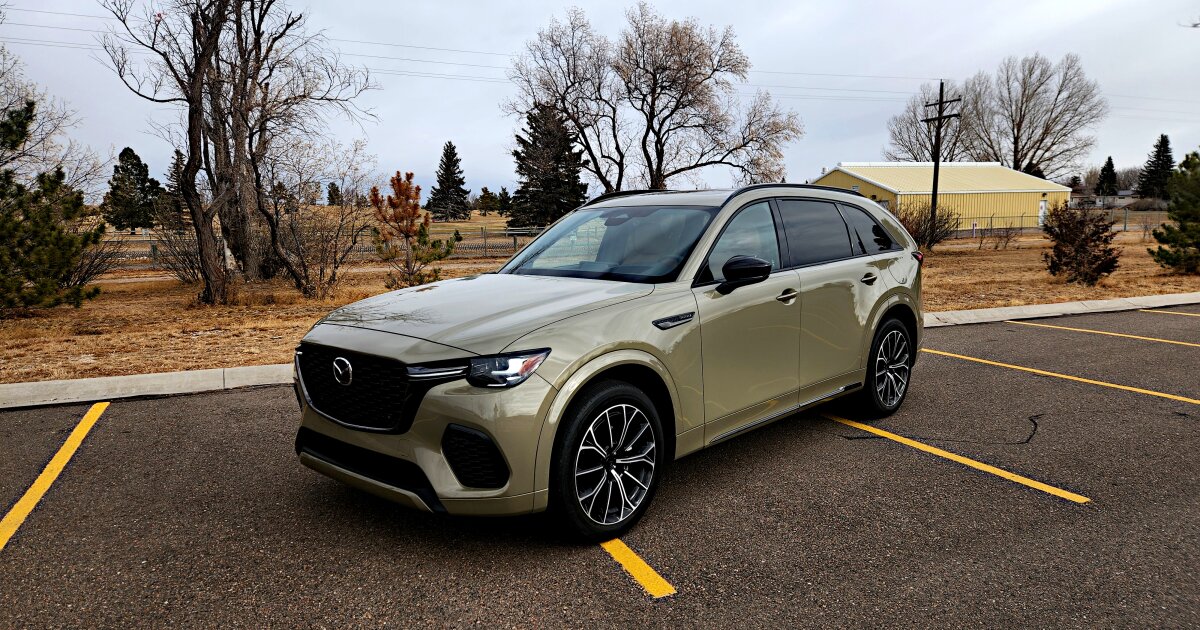
I bet that if Mazda had a dollar for every time someone said, “Wait, isn’t that just the CX-90 without the third row?” it could probably fund a Wankel comeback.
At a glance
- A CX-90 but without the extra seats
- Six-cylinder powertrain
- PHEV available
- Large cargo space
- Premium interior
The 2026 Mazda CX-70 is, in the most literal sense, that: take the brand’s flagship three-row, remove the back seats, shrink it just a tad, and call it a day. But sometimes, subtraction is addition. And in classic Mazda fashion, the result is far more interesting than it has any right to be. The 2026 CX-70 exists because not everyone wants to haul around extra seats they’ll never use. It’s a two-row midsize SUV built on the same bones as its slightly bigger sibling, sharing a platform, basic dimensions, and powertrains nearly wholesale.
That sounds lazy (and it kind of is), but it also solves a real problem. Three-row, mid-sized crossovers often carry the burden of compromise: cramped rearmost seats, limited cargo space, and ponderous handling. The CX-70 sidesteps all of that. The payoff is more usable cargo space, a cleaner interior layout, and a vehicle that feels purpose-built rather than obligation-driven. Mazda didn’t reinvent anything here. Others have done the same. But the CX-70 gets Mazda’s Zoom-Zoom too. At least a little bit.

Aaron Turpen / New Atlas
Mazda’s big moment is really with what’s under the hood. Instead of the usual turbo-four you’ll find in competitors, the CX-70 offers a turbocharged 3.3-liter inline-six. Yes, an inline-six. In a Mazda. In this economy. It’s genius.
Output ranges from 280 horsepower (206 kW) to a stout 340 hp (250 kW) in “S” trims, with a mild-hybrid system providing a little extra shove and efficiency. There’s also a plug-in hybrid variant, which leans more toward efficiency than excitement, offering roughly 30 miles (48 km) of electric-only driving for 2026. On paper, this is a knockout setup. In practice? It’s mostly great.

Aaron Turpen / New Atlas
The inline-six is smooth, refined, and sounds like it belongs in something wearing a German badge. It delivers power in a confident, linear way that makes merging feel like a polite suggestion rather than a desperate plea. But (there’s always a “but”) the transmission occasionally behaves like it’s still waking up from a nap. Low-speed shifts can feel hesitant or awkward, a trait that keeps popping up in Mazda’s newer rear-drive platform. It’s not a constant nor is it a death knell. It’s just … well … noticeable. Like that family photo on your coworker’s desk where nobody looks like each other.
Then there’s the SUV’s handling characteristics. This is where the CX-70 reminds you why Mazda exists. Despite its size, the CX-70 genuinely wants to be driven. Steering is precise, body control is tight, and there’s an underlying athleticism that most midsize crossovers abandoned years ago in favor of numb compliance. This is the engaging part of Mazda’s “Zoom Zoom” philosophy.

Aaron Turpen / New Atlas
On the inside, the CX-70 does its best impression of a luxury SUV, and it’s pretty convincing. Materials are excellent, with available Nappa leather, clean design lines, and a general sense of restraint that feels more Teutonic than mainstream. The cabin is spacious, thanks to the missing third row, and the cargo area is genuinely useful rather than theoretical. This is a vehicle built for people who carry things.
Tech-wise, Mazda continues its love-it-or-hate-it approach. A 12.3-inch display is standard, but the infotainment interface can feel overly complicated, occasionally requiring more clicks than necessary. It’s functional. It’s just not intuitive in the way your smartphone has spoiled you into expecting. It does eventually become easy to use, once that learning curve is surmounted.

Aaron Turpen / New Atlas
Pricing starts around US$43,780 (after destination) and climbs to the high-$50,000 range, depending on trim. That puts the CX-70 in an interesting position: it’s priced like a premium mainstream SUV but delivers a near-luxury experience. It competes with everything from the Jeep Grand Cherokee to the Volvo XC60, and somehow manages to feel like it belongs in both conversations.
That’s because the CX-70 does something most SUVs forgot how to do: it makes you feel … in a “maybe I’ll take the long way home” kind of way. And in today’s crossover-saturated world, that’s about as close to magic as it gets.
Product page: 2026 Mazda CX-70