
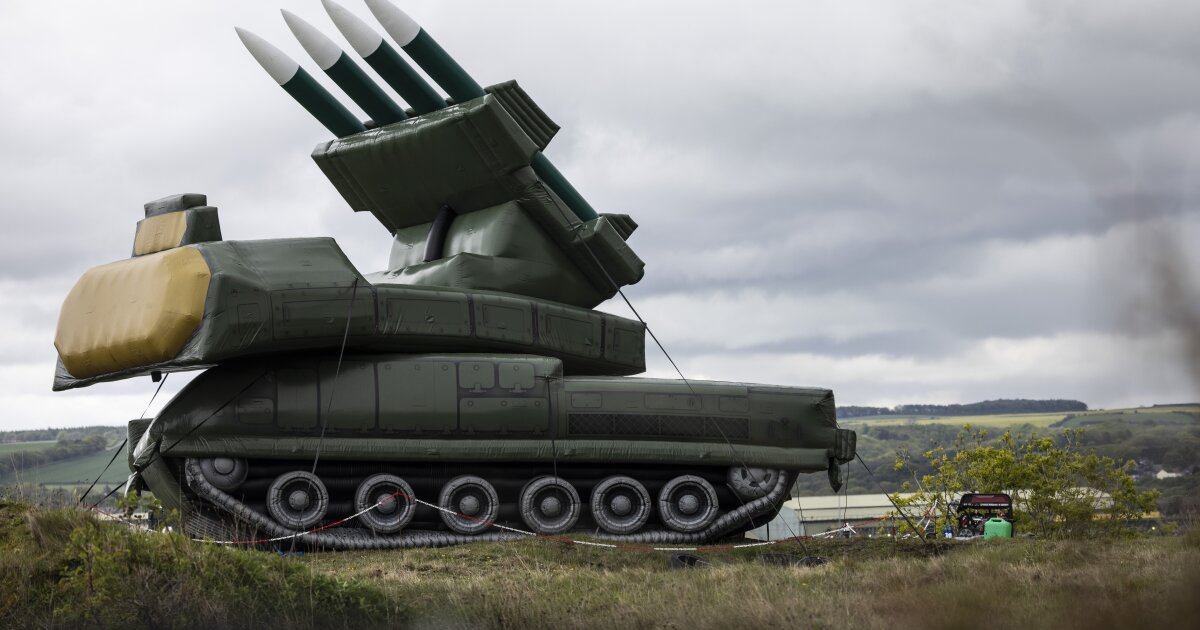
The RAF is buying inflatable missile batteries. It may seem daft, but these lookalike launchers aren’t a gag or a ludicrous cost-cutting measure. Part of the new Sting system, their job is to help train fighter pilots in taking out ground-to-air threats.
Military equipment that you can blow up in more ways than one has been around for a long time. During the Second World War, the Allies built thousands of inflatable tanks, trucks, Jeeps, artillery pieces, and airplanes. No, the soldiers weren’t bored – they were trying to confuse the enemy by setting up fake bases, depots, and even entire army battalions to keep the Axis powers from figuring out exactly what the Allies were up to until it was too late.
According to the RAF, Sting is a bit different. It has been designed and constructed in conjunction with defense contractor Draken to replicate sophisticated surface-to-air missile (SAM) systems and train pilots flying 4th- and 5th-generation combat aircraft, including the Eurofighter Typhoon FGR4 and Lockheed Martin F-35B Lightning II.

RAF
To achieve this, Sting is much more than a load of alarming balloons. The system generates live, realistic electronic threat signals that challenge the onboard sensors of modern fighter aircraft. This allows pilots to identify, react to, and defeat simulated enemy air defenses while operating in a live-flight environment.
During live exercises, pilots are challenged by Draken’s Phantom Sky range control system, which creates simulated air defenses that respond, adapt, and react to pilot inputs in real time. The rubber missiles aren’t just there for verisimilitude. The Air Force says that even in an age of electronic warfare, computer vision, and multi-spectrum sensors, the final attack often relies on the original Mark I Eyeball to hit the target.
The drive behind new systems like Sting comes from the RAF’s decision not only to upgrade but also accelerate pilot training to fill widening gaps caused by the current geopolitical situation. The aim is to produce crews capable of handling complex multi-domain battlespaces rather than isolated dogfights.
“The introduction of this capability marks a significant step in the RAF’s ability to respond to current and evolving threats, enabling our Combat Air Force crews to train against a credible adversary,” said Air Commodore Steve Berry, Commandant of the RAF’s Air and Space Warfare Centre.
“The introduction of this capability marks a significant step in the RAF’s ability to respond to current and evolving threats, enabling our Combat Air Force crews to train against a credible adversary,” said Air Commodore Steve Berry, Commandant of the RAF’s Air and Space Warfare Centre.
Source: RAF