

Secrets of cosmic evolution may lurk in this black hole’s ‘dancing’ jets
A first-of-its-kind observation shows how jets from voracious black holes can shape the growth of galaxies
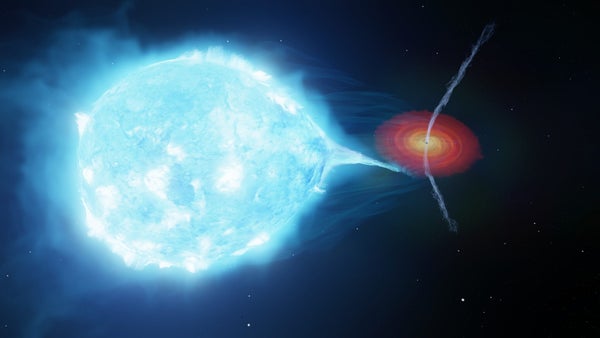
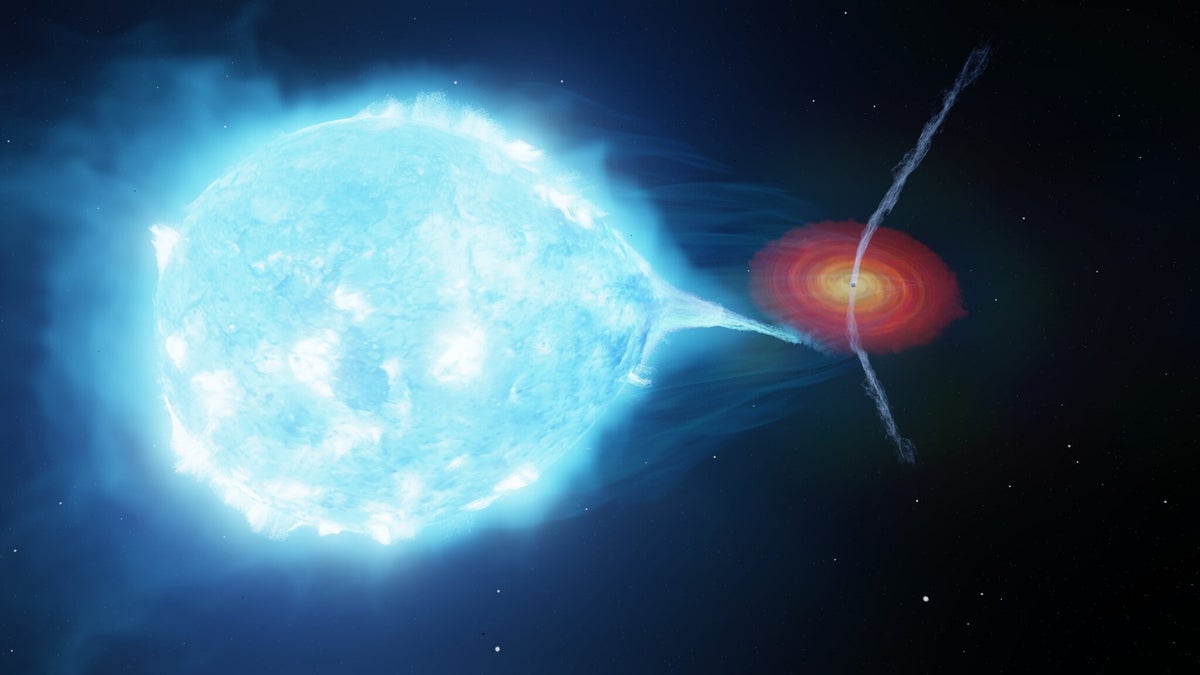
An artist’s impression of the Cygnus X-1 system, which contains a supergiant star (left) orbited by a black hole (right). The star’s strong stellar wind deflects the jets launched by the black hole, allowing astronomers to measure the jets’ power and speed.
International Center for Radio Astronomy Research
In a first for science, astronomers have observed how matter dances as it erupts from a black hole, shedding light on how this process shapes the structure of the universe.
Hungry black holes are the hidden architects of the cosmos. Nothing can escape their depths, but as matter funnels into them, a small fraction of it can rebel at the brink of oblivion and form twin jets of terrifying power near the black hole’s poles that beam out into space. Bigger black holes make bigger jets, and the biggest—supermassive black holes—can generate jets so immense that they influence entire groups of galaxies.
No direct hits are required; shock waves from a jet can ripple across hundreds of thousands of light-years to churn galactic gas into stars or to extinguish star formation entirely by expelling those gas reservoirs into intergalactic space. Even a glancing blow can make the difference between a galaxy filled with stars and no galaxy at all.
On supporting science journalism
If you’re enjoying this article, consider supporting our award-winning journalism by subscribing. By purchasing a subscription you are helping to ensure the future of impactful stories about the discoveries and ideas shaping our world today.
Until now, no one had ever managed to directly measure the might of these jets. Using data from two international networks of radio telescopes, researchers pinned down the energetics of jets erupting from a black hole in a system called Cygnus X-1, some 7,200 light-years from Earth. Their results, published today in Nature Astronomy, show that the black hole’s jets move at about half the speed of light and carry about 10 percent of the total energy released by infalling matter—equivalent to the power output of 10,000 suns.
“Cygnus X-1 is a particularly special system. It’s one of the best laboratories for studying how black holes behave,” says the study’s lead author Steve Prabu, an astrophysicist at the University of Oxford. The system holds the first confirmed black hole, a roughly 20-solar-mass object that blasts out jets as it orbits and siphons gas from a supergiant star.
By combining observations gathered across nearly two decades by the U.S. Very Long Baseline Array (VLBA) and the European VLBI Network (EVN), Prabu and his colleagues were able to reconstruct high-resolution images of the jets over time, watching as they were buffeted to and fro by intense stellar winds from the nearby star. “By combining all of these observations, we were able to piece together the ‘dancing’ motion of the jet and measure its properties in a way that hadn’t been possible before,” Prabu says. The team’s discovery of “black hole jet bending,” he says, “gave us a unique way to measure the jets’ power directly.”
James Miller-Jones, a co-author of the study and an astrophysicist at the Curtin Institute of Radio Astronomy in Perth, Australia, notes that the result likely applies to black holes of all sizes. “Because our theories suggest that the physics around [all] black holes is very similar, we can now use this measurement to anchor our understanding of jets, whether they are from black holes 10 or 10 million times the mass of the sun,” he said in a statement.
Previously, researchers inferred the strength of a black hole’s jets by observing how they affected their surroundings over thousands or even millions of years. These more piecemeal estimates have informed large-scale cosmic simulations that model the growth and evolution of galaxies.
“It’s a really cool result,” says Rob Fender, a University of Oxford astrophysicist, who was not involved with the study. “Calibrating the power in black hole jets is really the key measurement for understanding how these objects have helped shape the cosmos, near and far. This is notoriously hard to do, and the results depend on assumptions about the matter content of the jets, how fast they’re moving (harder to measure than you might think) and the density of the environment into which they’re plowing.”
All those assumptions, Fender adds, are minimized in the case of Cygnus X-1 because of just how much is already known about the black hole’s companion star and its winds. In fact, the team’s measurement “really isn’t possible for any other system we know in the entire universe,” he says.
It’s Time to Stand Up for Science
If you enjoyed this article, I’d like to ask for your support. Scientific American has served as an advocate for science and industry for 180 years, and right now may be the most critical moment in that two-century history.
I’ve been a Scientific American subscriber since I was 12 years old, and it helped shape the way I look at the world. SciAm always educates and delights me, and inspires a sense of awe for our vast, beautiful universe. I hope it does that for you, too.
If you subscribe to Scientific American, you help ensure that our coverage is centered on meaningful research and discovery; that we have the resources to report on the decisions that threaten labs across the U.S.; and that we support both budding and working scientists at a time when the value of science itself too often goes unrecognized.
In return, you get essential news, captivating podcasts, brilliant infographics, can’t-miss newsletters, must-watch videos, challenging games, and the science world’s best writing and reporting. You can even gift someone a subscription.
There has never been a more important time for us to stand up and show why science matters. I hope you’ll support us in that mission.