

See a Lincoln Memorial-sized asteroid pass within just 56,000 miles of Earth today
The asteroid will swing by Earth on Monday and be close enough to be visible using an amateur telescope
Getty Images/Erik Simonsen
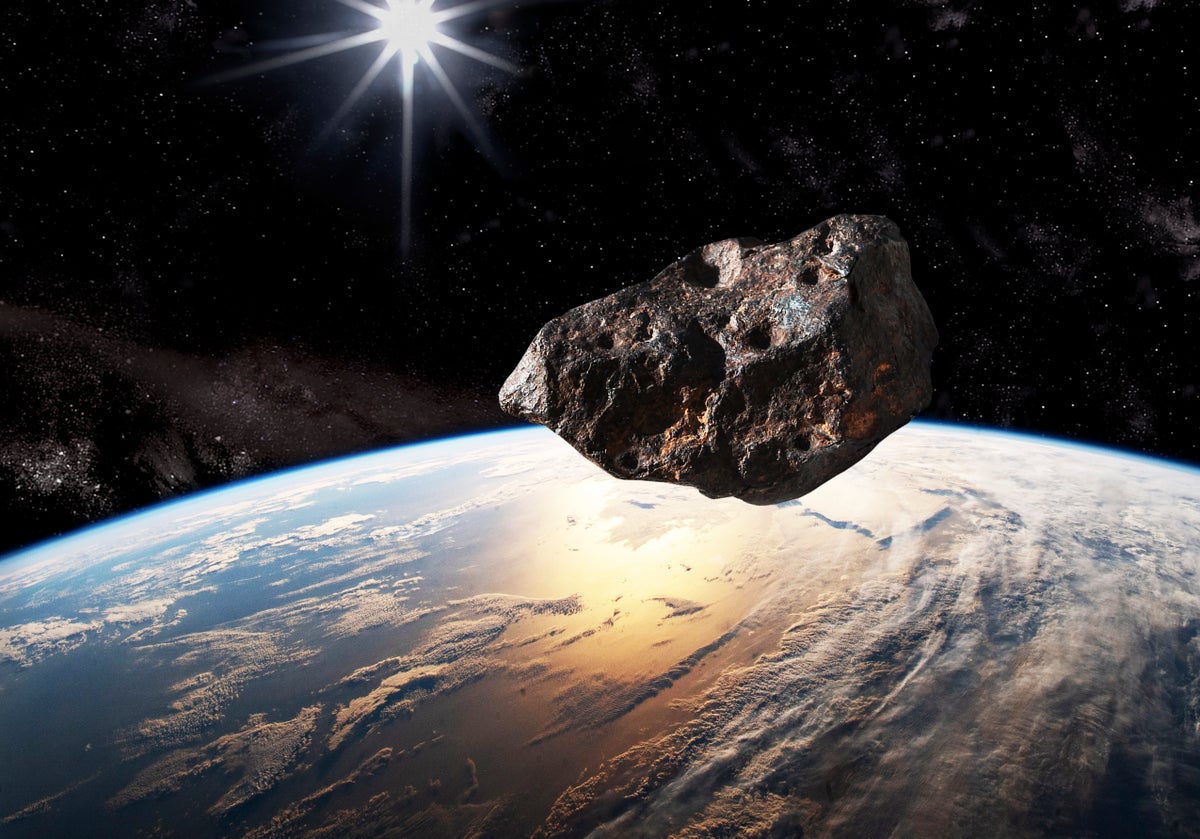
A newly discovered asteroid estimated to be about as long as the Lincoln Memorial is tall is set to fly between the moon and Earth today. Thankfully, scientists say there is no risk of a collision with our planet.
The space rock was first spotted on May 10 by astronomers at Tucson’s Mount Lemmon Survey, the same observatory that discovered a spectacular comet visible with the naked eye last year. The asteroid, called 2026 JH2, likely has a diameter of between 46 to 98.5 feet—for comparison, that’s between the height of the Parthenon (45 feet tall) and the Lincoln Memorial (99 feet tall).
At its closest approach around 5:23 P.M. EDT, the asteroid will be within about 56,700 miles from Earth—about 24 percent of the distance from our planet to the moon—and traveling at approximately 20,470 miles per hour relative to Earth. That distance means it will pass below the orbit of large space-based observatories like NASA’s Chandra X-Ray Telescope and above most commercial satellites. That proximity also means its trajectory will be visible to amateur telescopes. The Virtual Telescope Project will also live stream the near-miss starting at 3:45 P.M. EDT.
On supporting science journalism
If you’re enjoying this article, consider supporting our award-winning journalism by subscribing. By purchasing a subscription you are helping to ensure the future of impactful stories about the discoveries and ideas shaping our world today.
The asteroid is in Earth’s neighborhood for the moment, but its orbit will take it swinging out past Mars toward Jupiter’s orbital plane, according to NASA’s Jet Propulsion Laboratory. Each of the asteroid’s trips around the Sun takes about 1,374 days, but its next close-approach to Earth won’t come until 2090, according to the European Space Agency.
It’s Time to Stand Up for Science
If you enjoyed this article, I’d like to ask for your support. Scientific American has served as an advocate for science and industry for 180 years, and right now may be the most critical moment in that two-century history.
I’ve been a Scientific American subscriber since I was 12 years old, and it helped shape the way I look at the world. SciAm always educates and delights me, and inspires a sense of awe for our vast, beautiful universe. I hope it does that for you, too.
If you subscribe to Scientific American, you help ensure that our coverage is centered on meaningful research and discovery; that we have the resources to report on the decisions that threaten labs across the U.S.; and that we support both budding and working scientists at a time when the value of science itself too often goes unrecognized.
In return, you get essential news, captivating podcasts, brilliant infographics, can’t-miss newsletters, must-watch videos, challenging games, and the science world’s best writing and reporting. You can even gift someone a subscription.
There has never been a more important time for us to stand up and show why science matters. I hope you’ll support us in that mission.