
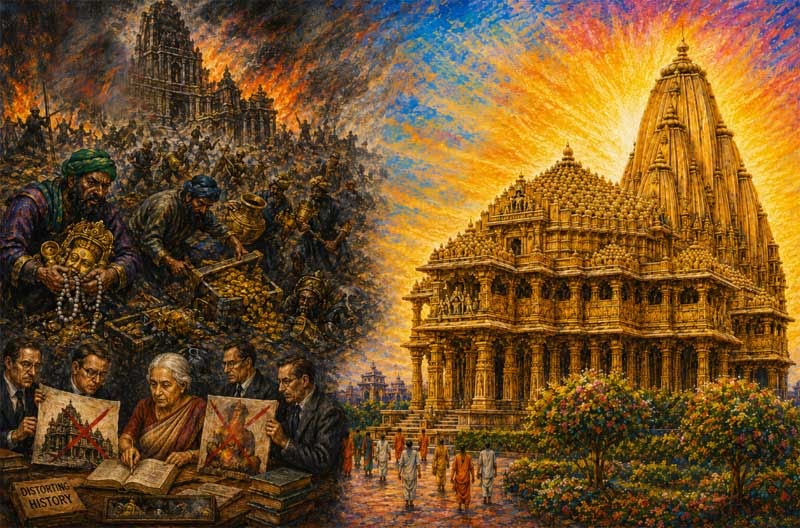
Somnath: The Eternal Flame That Invaders Could Never Extinguish
May 11, 2026 marks seventy-five years since that consecration. And 2026 also marks a thousand years since the first great assault on this sacred ground.
The history of Somnath Temple stands as one of the starkest chronicles of repeated destruction of a Hindu temple, massacre of thousands and thousands of Hindus, and relentless plunder in medieval India. Across centuries, invading armies descended upon Somnath not merely to seize wealth, but to shatter a sacred center of Hindu worship through terror and bloodshed. Contemporary and later historical accounts describe vast slaughter accompanying these invasions, with thousands of defenders, pilgrims, priests, and civilians killed during assaults on the temple town.
The repeated targeting of Somnath reflected not only the enormous wealth associated with the shrine, but also its immense symbolic significance. Time and again, the destruction was accompanied by mass death and the public humiliation of sacred icons, intended to project conquest through fear. Yet despite centuries of bloodshed and looting, the site continued to draw worshippers and rebuilders, making Somnath a powerful historical symbol of survival through devastation.
The physical destruction of Somnath by marauders was only the first blow; the second was the academic effort to downplay and distort that history by left liberal historians, scholars and politicians aided and abetted by successive governments that ruled center and state.

Somnath Temple
Long before the first stone of the great temple was laid,
the land of Prabhasa on the western shore of Saurashtra was already sacred. The
Shiva Purana and the Skanda Purana both speak of this place as the spot where
Chandra, the Moon deity, came to perform intense tapas under the grace of
Mahadev after being struck by a devastating curse.
The story is both cosmic and deeply human. Chandra had been
cursed by his father-in-law Daksha Prajapati for showing excessive attachment
to only one of his twenty-seven wives, Rohini, while neglecting the others. As
the curse took hold, Chandra’s radiance began to fade. The world plunged into
grief. Crops withered, tides faltered, and the rhythm of creation itself was
disturbed. Upon the counsel of divine sages, Chandra journeyed to Prabhasa and
surrendered himself in absolute devotion at the feet of Mahadev.
Shiva, the compassionate one, the destroyer of sorrow, was
moved. He could not fully undo a curse bound by cosmic law, but he granted
Chandra a boon — that the moon would wax and wane in a cycle, growing and
diminishing with each fortnight, never entirely lost. It is because of this
grace that we witness the Shukla Paksha and the Krishna Paksha every month, the
eternal rhythm of the moon’s renewal.
In gratitude, Chandra himself consecrated a Jyotirlinga at
this sacred shore. The linga came to be known as Somnath — the Lord of Soma,
the Protector of the Moon. The Shiva Purana declares: Somanthe cha Saurashtre —
In Somnath in Saurashtra, Shiva’s divine presence shines in its most luminous
form. The pradakshina of Somnath, according to tradition, is equal in merit to
the circumambulation of the entire earth: Prabhasam cha Parkramya Prithvi Kram
Sambhavam.
The Longest of Plunder Of Single Religious Structure
In the year 1025, Mahmud of Ghazni descended upon Somnath
with an army driven by the twin engines of greed and Islamic fanaticism. The temple,
which stood on the western coast as one of the wealthiest and most spiritually
radiant shrines in the world, was looted, desecrated, and reduced to rubble.
Thousands of devotees sacrificed their lives defending its sanctity. This was
not merely an attack on a building. It was a calculated assault on the
consciousness of a civilisation.
What followed over the next several centuries was a bitter
cycle — temples rebuilt with the blood of devotion, only to be torn down again
by successive waves of invasion by Islamic marauders.
1025 CE – Raid of Mahmud of Ghazni
- Marched from Afghanistan into western India with an army estimated between 25,000–30,000 cavalry.
- Contemporary Persian chronicles describe tens of thousands of defenders and pilgrims killed, with some later accounts placing deaths around 50,000 during the assault on Somnath Temple.
- The temple treasury was reportedly stripped of enormous wealth including gold, silver, diamonds, pearls, and precious idols accumulated over centuries.
- Some medieval sources claim loot worth millions of dinars and describe caravans carrying treasure back to Ghazni.
- The sacred Shivling was destroyed, and fragments were allegedly carried away as trophies.
1299 CE – Invasion under generals of Alauddin Khilji
- Forces led by Ulugh Khan and Nusrat Khan attacked Gujarat during the expansion of the Delhi Sultanate.
- Somnath was again looted and desecrated.
- Chronicles describe large-scale killings during the campaign.
- Vast quantities of temple wealth, gold ornaments, and valuables were seized and transported to Delhi.
14th Century – Repeated attacks during Sultanate conflicts
- Regional instability and military campaigns led to further destruction around Somnath and surrounding settlements.
- Hindu populations in temple towns reportedly faced massacres, enslavement, and forced displacement during successive invasions.
- Temple revenues and accumulated offerings were repeatedly confiscated.
1395 CE – Campaigns linked to the Gujarat Sultanate
-
Under rulers associated with the emerging Gujarat Sultanate, Somnath again suffered attacks and suppression.
-
Historical records mention destruction of temples and seizure of religious wealth.
1451 CE & 1490 CE – Further desecrations under Gujarat Sultanate rulers
- Accounts describe renewed destruction and rebuilding cycles.
- Sacred structures were damaged repeatedly, while local defenders and civilians suffered casualties during military actions.
1665–1706 CE – Orders under Aurangzeb
-
The Mughal emperor reportedly ordered the demolition of the rebuilt temple structure.
-
Contemporary records and later chronicles describe suppression of worship and renewed destruction in the region.
-
Religious property and valuables were confiscated.
Human Cost Across Repeated Assaults
Scale of Wealth Looted Across Centuries
Somnath was considered among the wealthiest temples in India due to:
- Donations from kings and merchants
- Gold-plated structures and jeweled idols
- Revenue from thousands of villages attached to the temple economy
Medieval writers described:
- Hundreds of kilograms of gold and silver ornaments
- Gem-encrusted pillars and ceremonial objects
- Large temple treasuries accumulated over generations
Exact casualty figures were destroyed and tampered with by left liberal historians for more than 50 years for political reasons. But the repeated violence and large-scale plunder are widely acknowledged historical realities.
Restoration And The Undefeatable Spirit Of Hindus
Yet each time the shrine fell, someone rose to
rebuild it. Chakravarti Maharaja Dharasena IV of Vallabhi rebuilt the temple in
an earlier era. Bhima Deva, Jayapala and Anandapala held the line with courage
against overwhelming force. Raja Bhoja contributed to reconstruction.
Kumarapala Solanki, the Pashupata Acharyas, Siddharaja Jayasimha and
Vishaladeva Vaghela each played their part in restoring what enemies had
shattered.
Veer Hamirji Gohil and Veer Vegdaji Bhil gave their lives in
the defence of the shrine. Their names are not found in the syllabi of colonial
education. But their sacrifice lives in the collective memory of a people who
have never entirely forgotten what was taken from them, and never stopped
trying to reclaim it.
Punyashlok Ahilyabai Holkar, whose three-hundredth birth
anniversary falls in this period, was perhaps the finest example of this
undying impulse. Denied political sovereignty, she channelled her energy into
the restoration of sacred sites across Bharatvarsha. At Somnath, even when full
reconstruction was not possible, she ensured that devotion did not die. A flame
kept burning because of her. The Gaekwads of Baroda protected the rights of
pilgrims when all seemed lost.
Sardar Patel and the Restoration of Dignity
When India emerged from colonial rule in 1947, the nation
turned its attention to the enormous task of building itself anew. But one
matter weighed heavily on Sardar Vallabhbhai Patel — the continued ruin of
Somnath. On 13th November 1947, standing among the dilapidated remains of the
temple with sea-water in his hands, he made a solemn declaration to the people
of Saurashtra and to the nation: Somnath would be rebuilt.
It was not merely a construction project. It was an act of
civilisational memory, a refusal to let the wound fester any longer. Shri K. M.
Munshi took up the cause with scholarly passion and administrative skill,
supported ably by the Jamsaheb of Nawanagar. On 11th May 1951, the restored
temple was consecrated by President Dr. Rajendra Prasad. In his address, he
said that the Somnath Temple proclaims to the world that what is held with
unparalleled faith and love cannot be destroyed. The mandir was not merely
stone. It was a statement.
The Undying Spirit of Sanatana Dharma
The Chandogya Upanishad speaks of the atman — the self — as
that which cannot be cut by weapons, burned by fire, wetted by water, or dried
by wind. This same quality, the indestructibility at the core of being, defines
the Hindu spirit that Somnath embodies. Invaders came with armies. They left
with gold. But they could not take what they were ultimately after — the
intangible, living devotion of millions who kept the sacred fires burning in
their hearts when no temple stood above ground.
The emperors who looted Somnath are remembered today only
because of Somnath — remembered with contempt, as a warning and not as a glory.
The civilisation they tried to break outlived them by centuries and continues
to breathe.
Dark clouds may obscure the sun for a moment. But the sun
does not cease to exist.
Along with condemning the marauders who looted Somnath, Hindus should also remember the left-liberal historians and scholars who attempted to distort, downplay, and erase the history of Somnath and its repeated waves of plunder. These historians, professors, and intellectuals—comfortably seated in universities and institutions funded by taxpayers’ money—were sustained in part by the taxes paid by the very Hindus whose history they sought to dilute or suppress.
A lamp burns before Somnath. It has always burned. It will
always burn. This is not a promise made by any government or any political will
alone. It is the covenant of a people with their past, their present, and their
eternity.
Har Har Mahadev.