


Research outcome is set to revolutionise the smartphone and wearable technologies. Traditional conductive polymers were not up to the potential.
Scientists at La Trobe University have produced a powerful electricity-conducting material that could transform the performance of smartphones, touchscreens, and wearable technologies.
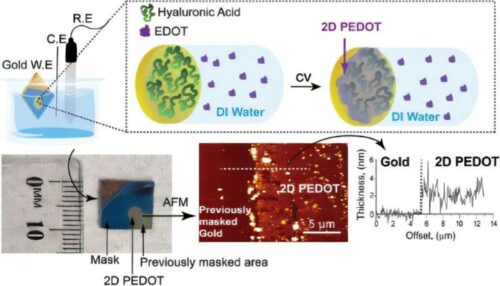
The innovative method involves applying hyaluronic acid, a compound widely recognised for its use in skincare, directly onto a gold-plated surface. It produces an ultra-thin, highly durable polymer film capable of efficiently conducting electricity.
The ‘tethered dopant templating’, as it is known is a robust way of making a conductive polymer having flexibility, durability, scalability, and electricity and metal conduction, and also can be reproduced as and when needed. 2D PEDOT (the resulting material produced) is not visible to the naked eye, but it is powerful. Scientists took total control over the material’s conductive properties, its shape, and appearance by applying hyaluronic acid directly onto gold. The technique is ideal for applications in biosensors and advanced electronic devices.
By improving both performance and manufacturing efficiency, the technique could pave the way for smarter, more reliable, and cost-effective electronics in the near future. The research can find its strong applications in smart, sensor-based devices.
The research carried out by the method proves that hyaluronic acid can be applied directly and dismantles the old belief that to create conductive polymers, hyaluronic acid must be added to a mixture of water and polymer-forming particles.
According to Associate Professor Wren Greene, who led the study, “The breakthrough has the potential to significantly enhance the functionality, affordability, and ease of use of devices ranging from medical wearables to interactive displays.”
Conductive polymers have been present for nearly 50 years, and despite being exciting, they are not up to the potential needed now, and have shortcomings that need improvement. They are difficult to fabricate due to the thin films, as they fail to conduct electricity very well, are not transparent, and can display highly variable properties.