
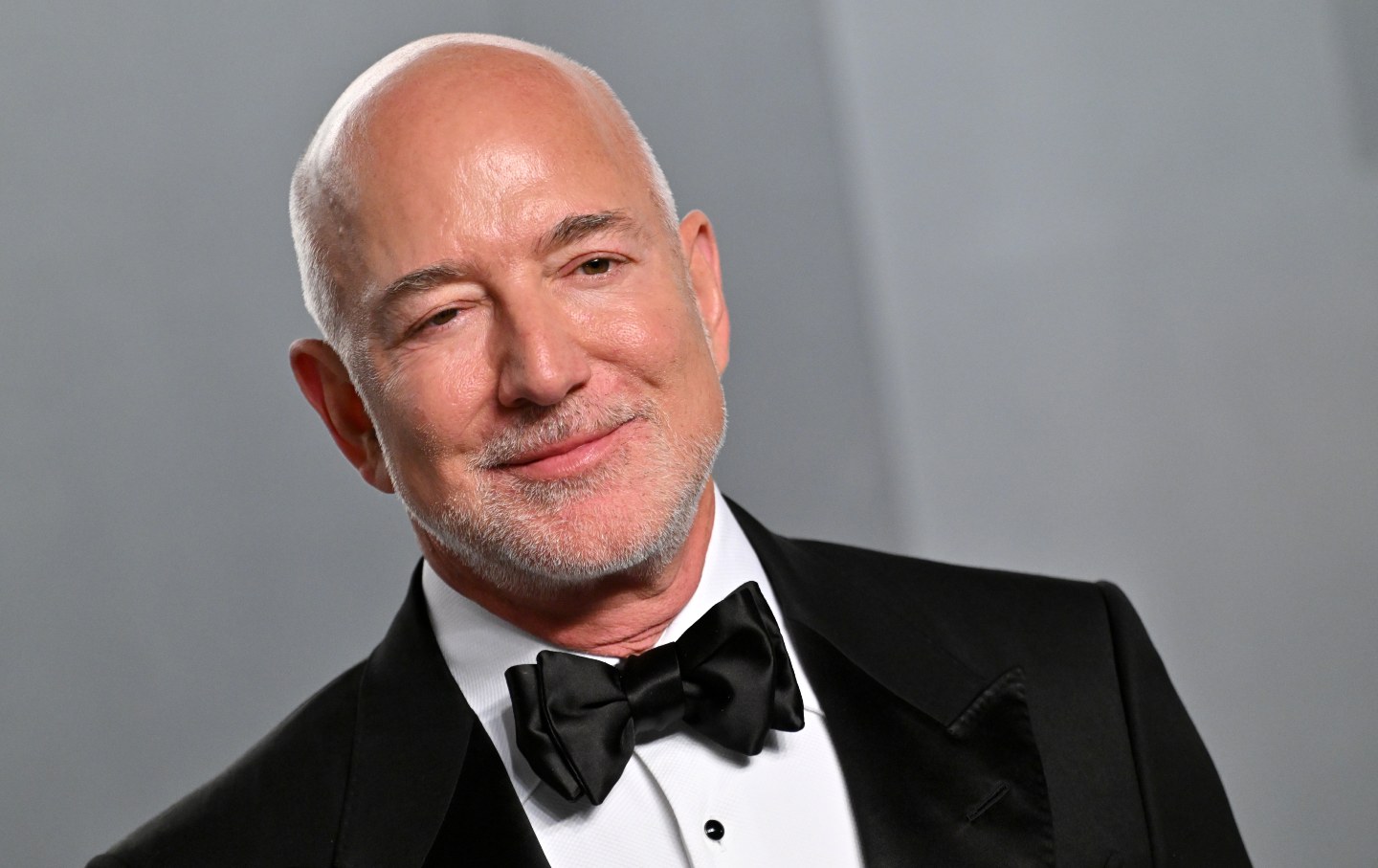
Jeff Bezos said The Washington Post would no longer publish opinion pieces critical of free markets. Recent editorials show just how seriously the paper has taken this mandate.
During his first 10 years as the owner of The Washington Post, Amazon founder Jeff Bezos reportedly took a fairly hands-off approach to managing the paper, with the Columbia Journalism Review observing that he was “not inclined to spend his time on the phone haranguing Post editors about coverage decisions.” But that was then. Last year, Bezos publicly announced that there would be “a change coming to our opinion pages,” and that henceforth “we are going to be writing every day in support and defense of two pillars: personal liberties and free markets.” Viewpoints critical of these “pillars,” he said, would no longer be appearing in the Post.
A review of editorial board output over the last year shows the fruits of that policy. The paper, previously known as center-left, has become as hard-right on economics as The Wall Street Journal. In the last year, the Post editorial board has published editorial after editorial opposing greater taxation of the rich. The Post has weighed in on tax policy everywhere from Switzerland to Seattle, lambasting every attempt to reduce the grotesque inequality of our times. Washington State’s income tax on millionaires, for instance, is “ sabotage” and a “money grab.” Almost no tax on the rich around the world escapes the paper’s notice—one might wonder why capital gains taxes in the Netherlands are a priority for a DC paper.
Recent Post editorials have also opposed minimum wage increases, tenant protections, social housing, rent control, free buses, caps on credit card interest rates, caps on the prices of staple foods, congestion pricing, and even the Railway Safety Act, introduced in response to the catastrophic 2023 chemical spill in East Palestine, Ohio. Many of the articles are devoted to lambasting labor unions. For instance, the Post says public sector workers should have no right to strike, because they just “extract as much money from taxpayers as possible.” In every case, the paper repeats the usual dogmas: government ruins everything it touches, regulation is a burden on beleaguered businessmen, bureaucrats are bad and entrepreneurs are good, and so on and so forth. For the new Post, the worst thing you can be is a “ socialist” who practices “ class warfare.”
The paper is particularly aggressive in defense of building new AI data centers. Multiple editorials have attacked Bernie Sanders over his call for a moratorium on data center construction. The paper said it was his “worst idea yet,” that he is “economically illiterate,” and “Sanders should also be ecstatic about how much AI can help workers.” Sanders is “throwing sand into the gears of progress,” they wrote, comparing him to someone who opposed the invention of the lightbulb. Incidentally, last year Jeff Bezos launched a major new AI startup, and backs at least half a dozen more AI companies, whose success partly hinges on the construction of new AI data centers. The Wall Street Journal reported last month that Bezos is currently trying “to raise $100 billion for a new fund that would buy up manufacturing companies and seek to use AI technology to accelerate their path to automation.
Some of the paper’s editorials read almost like parodies of libertarian dogma, as if Scrooge McDuck has been appointed the opinion editor. They’ve written a defense of pharmaceutical industry advertising, a call to eliminate the Surgeon General’s office, and a celebration of the cutoff of US aid to Africa for supposedly driving reform. They have called for the makers of herbicide Roundup to be shielded from lawsuits over its health effects. They have called to privatize air traffic control and airport security and defended stock trading by members of Congress. Their take on Puerto Rican rapper Bad Bunny is that he is a “free market success story” and a “triumph of American capitalism.” (His Super Bowl halftime show in February was also a stinging criticism of US colonialism.) When a humanitarian aid convoy took much-needed medical supplies to Cuba during the US oil cutoff, the Post called them “useful idiots,” repeating the lie that the mission staged “parties” in Cuba, and repeating the US government’s baseless designation of Cuba as a “state sponsor of terrorism.”
As with many so-called “libertarians,” the Post editors’ opposition to government spending does not extend to the military. The paper has heartily endorsed Donald Trump’s plan to raise annual military spending to over a trillion dollars, saying that the US has underinvested in defense, an astonishing claim given the absolutely colossal size of the US military and the bloatedness of its existing budget.
Current Issue
The paper reserves a particular animus for New York City Mayor Zohran Mamdani, having published editorial after editorial heaping ludicrous attacks on him. His worldview is “centered around destroying the economic system that made his adopted country thrive.” He “defends eliminationist rhetoric about Jews.” Mamdani’s uplifting victory speech was, for the Post, “laced with identity politics and seething with resentment.” When Mamdani supported striking nurses in their demand for better pay, the paper weighed in to accuse him of “escalat[ing] tensions between business and workers.” After Mamdani proposed cutting the state’s exemption for estate taxes from the absurdly high $7 million to $750,000, the paper published an editorial called “taxing New York to death” demanding that the rich be able to pass on their estates tax-free.
The arguments in these pieces are sloppy. The Post says Mamdani’s politics is about attacking enemies and “isn’t about letting people build better lives for themselves,” even though all of his major initiatives are explicitly about improving quality of life and affordability. When they attack Sanders, the Post editors do not even bother to discuss the actual concerns about unsustainable energy use that are driving opposition to data center construction. In their repugnant editorial on the cutoff of aid to Africa, the Post points out that “sub-Saharan Africa’s economy as a whole grew by 4.1 percent in 2025” but does not discuss the horrific stories of people affected by the administration’s cruelty. Attacking the British National Health Service for its wait times, they claim that it shows “dark reality of single-payer and a cautionary tale for the third of Americans who mistakenly believe Medicare-for-all is a good idea.” In fact, two-thirds, not one-third, of Americans believe Medicare for All is a good idea, but more importantly, problems with the NHS show the perils of underfunding and understaffing government services, not having government services.
One could comb through the hundreds of editorials that the Post has published under the Bezos mandate and find endless examples of logical fallacies, cherry-picked statistics, and lazy rhetoric about “bureaucrats” and “red tape.” But in the time it would take to refute one or two articles, the Post would have published half a dozen more of these propaganda pieces. (Remember Brandolini’s law of bullshit: “The amount of energy needed to refute bullshit is an order of magnitude bigger than that needed to produce it.”)
It’s remarkable how brazen the paper is about shilling for the financial interests of its owner. Some of these headlines might as well read “Don’t Tax Jeff Bezos More,” “Don’t Let Unions Threaten Jeff Bezos’s Control Over His Workers,” “Don’t Stop Jeff Bezos From Building Data Centers in Your Town.” The result is an editorial page without any intellectual substance, that exists largely to make whatever arguments are convenient for the paper’s owner’s stock portfolio. It’s not just wrong but boring too, and one can see why readers have been fleeing the Post by the tens of thousands. The paper suffered the worst print circulation decline of any of the top 25 newspapers in 2025, tanking 21.2 percent in just six months.
This doesn’t matter to Bezos, of course, who is so wealthy that he can afford to push whatever line he likes. But given the Post’s storied history, those who value quality journalism can only see its as a tragedy that Bezos’s rule has ended in mass layoffs and the total intellectual debasement of its editorial page. The Post’s sad story is a further lesson in why we need to ensure that our major newspapers aren’t controlled by capricious billionaires more concerned about further adding to their own vast wealth than serving the public interest.
From illegal war on Iran to an inhumane fuel blockade of Cuba, from AI weapons to crypto corruption, this is a time of staggering chaos, cruelty, and violence.
Unlike other publications that parrot the views of authoritarians, billionaires, and corporations, The Nation publishes stories that hold the powerful to account and center the communities too often denied a voice in the national media—stories like the one you’ve just read.
Each day, our journalism cuts through lies and distortions, contextualizes the developments reshaping politics around the globe, and advances progressive ideas that oxygenate our movements and instigate change in the halls of power.
This independent journalism is only possible with the support of our readers. If you want to see more urgent coverage like this, please donate to The Nation today.