

The solar system’s first solids formed in a rush
Rather than slowly condensing over millions of years, the first building blocks of Earth and other planets may have formed rapidly in a chaotic disk at the dawn of the solar system
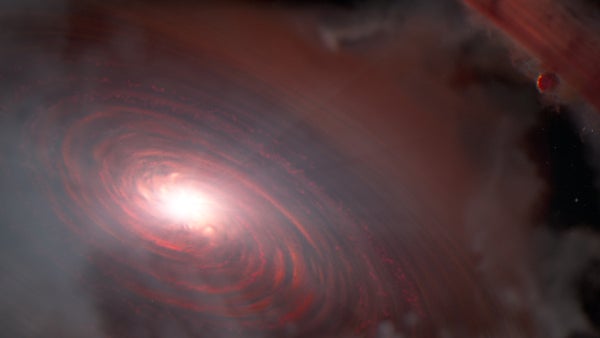
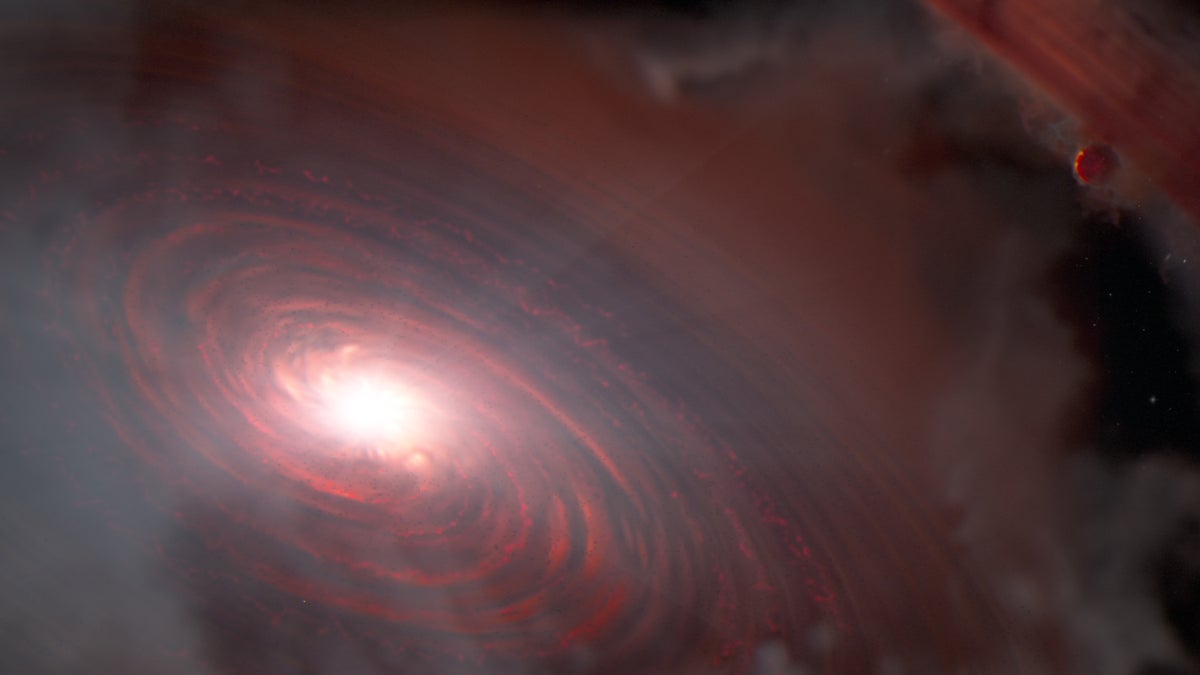
An artist’s concept shows the inner regions of a protoplanetary disk around a young star. Planets grow within the disk from smaller building blocks of material that rain out of the disk’s gas as it cools.
NASA/ESA/CSA/Joseph Olmsted/STScI
Some 4.6 billion years ago, when the solar system was born from a vast cloud that collapsed to form the sun and a surrounding disk of whirling gas, no planets yet orbited our star. Back then, besides stardust, no solid materials at all drifted through this natal disk. Only as the disk cooled did mineral grains condense from the gas to become the building blocks of space rocks that would eventually form Earth and other planets.
Scientists have long suspected this was a relatively peaceful process, with showers of primordial solids slowly raining out from the disk as it cooled over millions of years. Now, however, a study published today in Nature is challenging this sedate view, suggesting instead that the solar system’s first solids stormed into being much faster from sudden temperature shifts in the disk’s turbulent maelstrom.
“This is a real change of paradigm,” says Alessandro Morbidelli, an astronomer at the Côte d’Azur Observatory in France, who wasn’t involved with the new study. “It is a good idea, and the result has been quite surprising.”
On supporting science journalism
If you’re enjoying this article, consider supporting our award-winning journalism by subscribing. By purchasing a subscription you are helping to ensure the future of impactful stories about the discoveries and ideas shaping our world today.
The notion of a placid start for the solar system’s solids has prevailed for the past half-century. In the late 1960s researchers studying meteorites discovered that some held small granules called calcium-aluminum-rich inclusions (CAIs). These amalgams of minerals are considered the first solids of the solar system, and they formed when the disk’s temperature dropped just enough for them to condense out of the cooling gas. Based on the composition of CAIs, researchers assumed that their condensation reactions occurred across millions of years. That would allow sufficient time for these reactions to reach chemical equilibrium, meaning that at each successive stage of the disk’s chemical evolution, the distribution of elements in gaseous and mineral phases would stabilize.
But this model, known as equilibrium condensation, has limitations. It cannot explain clear composition variations in the most primitive types of meteorites, called chondrites. Chondrites are divided into three families—ordinary, enstatite and carbonaceous—with the key difference being how oxidized their iron-bearing minerals are, much like the difference between a shiny unoxidized iron nail and one that’s rusty from heavy oxidation. Enstatite chondrites are the least oxidized chondrites, carbonaceous ones are the most oxidized, and ordinary chondrites have an intermediate oxidation level.
Experts have long assumed this disparity among the chondrites means each variety originated in a different, chemically distinct area of the solar disk, but the details for how exactly this could yield the three known types have remained murky.
Now a team led by Sébastien Charnoz, a planetary scientist at the Paris Institute of Planetary Physics, offers a radically different explanation that was derived from computer simulations that modeled how minerals condense from a chemically uniform disk at a wide range of pressures and cooling rates. The simulations suggest that, if the disk was turbulent instead of placid, parts of it could cool so quickly that the resulting chemistry wouldn’t be in equilibrium at all. Rather than elements raining out as minerals in stately succession because of gradual cooling, the rapid plunge in temperature would outpace chemical reaction rates in the disk. This would leave some elements temporarily trapped in gaseous form, allowing more mixing and the simultaneous emergence of multiple minerals. Most importantly, Charnoz and his colleagues’ results clustered into three mineralogical families that closely resemble the composition of the three main chondrite types.
To better explain these dizzyingly complex processes, Charnoz compares the minerals raining out of a cooling disk to hungry diners at a dinner table. When cooling is slow, the earliest minerals to condense “eat” elements from the gaseous disk, sequestering and sweeping them from the “table” so that subsequent minerals that form at lower temperatures are starved. But when the cooling is fast and reservoirs of gas-trapped elements emerge, many different minerals can compete to eat the various elements all at once. It’s like they all “eat from the same plate,” Charnoz says. “They try to grab what they can.”
Oxygen proved to be a particularly potent arbiter of the disk’s chemical evolution in the simulations because its fluctuating levels dictate the oxidation state of the resulting minerals, ultimately yielding the three families that mirror the three chondrite varieties. The resemblance between real chondrites and the model’s results isn’t exact, however. But Charnoz argues this may merely reflect how the cooling process sets the basic mineralogy of these primitive meteorites, followed by later processes, such as heating, evaporation or water circulation, giving the final touches to their mineralogy.
“I think this paper is going to be really good for inspiring the community and for seeing whether we can fit our data into this framework” says Sara Russell, a planetary scientist at the Natural History Museum in London, who wasn’t involved with the new study.
Charnoz’s model also hints that the first solids may have formed much earlier than previously thought: before there was a disk at all, during the initial collapse of the giant gas cloud that birthed our star. “Here we are talking maybe in the first 10,000 or 100,000 years” of solar system history, Charnoz says, compared with millions of years in previous prevailing models. Recent observations from the James Webb Space Telescope showing bouts of rapid cooling and bursts of mineral formation around baby stars suggest that the same process is occurring elsewhere in the universe.
The new finding’s cascading implications could spark sweeping shifts in our understanding of the solar system’s early history. In particular, it changes where and how water could have formed. Reshuffling the order in which minerals emerged would create new opportunities for water’s constituent oxygen and hydrogen to combine, more readily forming hydrated minerals that, unlike ice, can endure close proximity to the blazing sun. This implies that the inner rocky planets—including Earth—could have been born with built-in water reserves rather than having most of their water imported via ice-rich asteroids and comets from the outer solar system.
“It is a quite complex study with many results,” Charnoz says. These results, he admits, don’t solve any problems definitively so much as open new avenues for further investigation. “It is a grand exploration,” Charnoz adds, “and we are just beginning to see where these new paths might lead us in understanding the origin of our solar system.”