
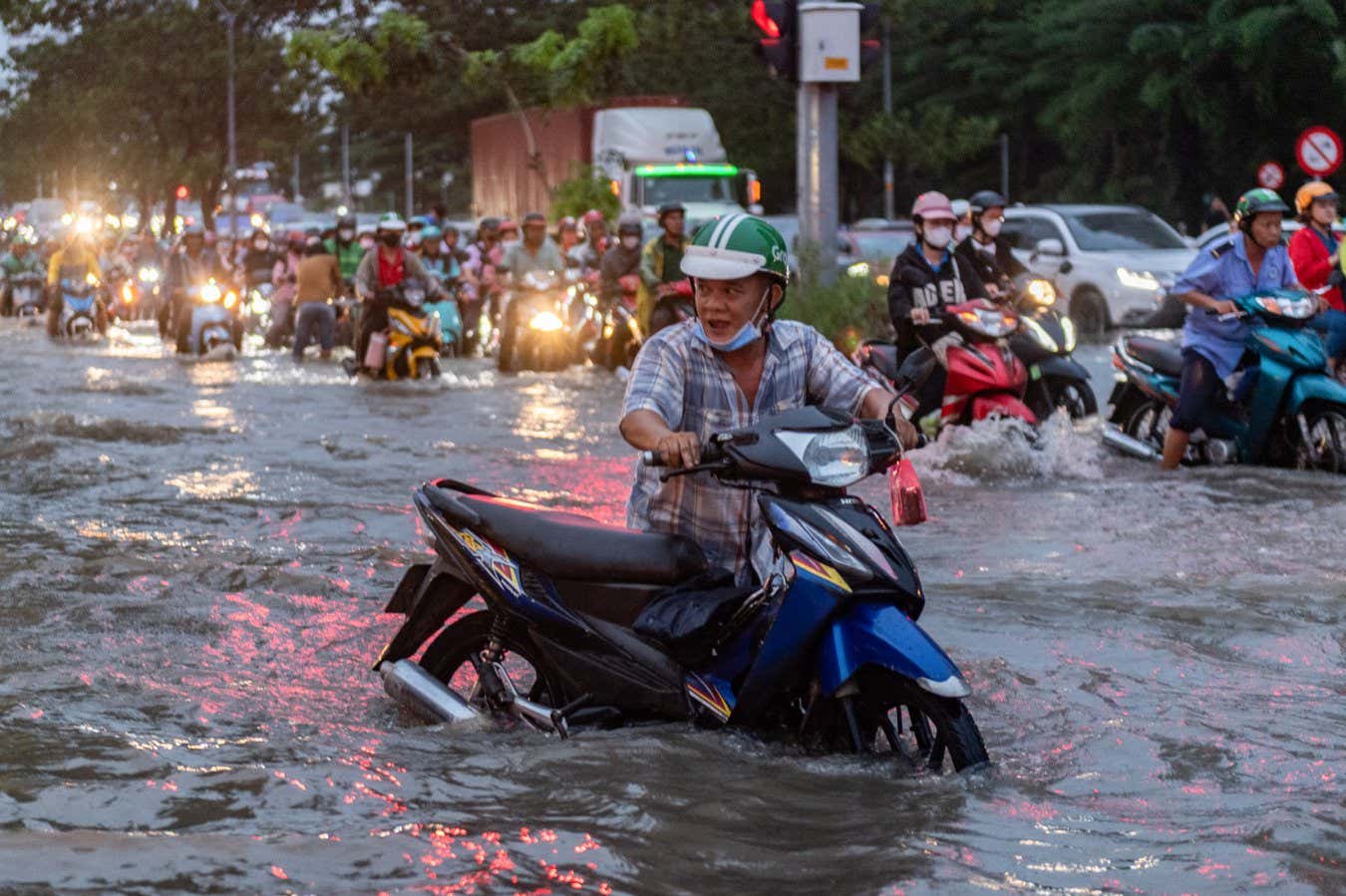

Ho Chi Minh City in Vietnam is increasingly vulnerable to flooding because of rising sea levels
Getty Images
There has been an abrupt change in the rate of sea level rise as measured by satellites. Around 2012, it suddenly accelerated and has remained higher ever since.
It is possible that the sudden jump is mainly due to natural variation. However, it could also be a response to the accelerating rate of global warming, says Lancelot Leclercq at the University of Toulouse in France.
The average global sea level has already risen by more than 0.2 metres over the past 15 years as a result of global warming. This has been caused by a number of factors: as well as increasing melting of mountain glaciers and the ice sheets of Greenland and Antarctica, the oceans are expanding as they warm.
Satellite measurements of sea level began only in the 1990s and the rate of rise was thought to have been fairly steady, at around 3.6 millimetres per year. But, as more satellite data has come in, Leclercq’s team has spotted a sudden step change around 2012, with the average rate jumping from 2.9 mm/year before 2012 to 4.1 mm/year since then.
“It’s not a huge signal,” says Jonathan Bamber at the University of Bristol in the UK, who wasn’t involved in the study. “We’re not talking about centimetres a year [of] difference or anything like that.”
That said, when the change in the trend in satellite data is viewed alongside tide-gauge data going back around a century, it is clear that the rate of sea level rise is accelerating, he says.
The team’s analysis suggests this jump is likely to be due to changing trends in several of the underlying causes of sea level rise, rather than just one. Not only are ice sheets melting faster, but less fresh water is being stored on land, meaning more is ending up in the oceans.
Since around 2010, the rate at which the planet is warming has also sped up, and this has been largely driven by falling levels of aerosol pollution from countries such as China. Aerosols have a cooling effect overall and high pollution has been counteracting the effects of rising carbon dioxide levels.
The acceleration of sea level rise could also be a result of this drop in air pollution, Leclercq told a meeting of the European Geosciences Union (EGU) in Vienna on 5 May.
“The trend change we found around 2012 seems to be linked with an increase in anthropogenic radiative forcing, resulting – at least partly – from a reduction of aerosols emissions,” says team member Anny Cazenave, also at the University of Toulouse. The findings were published earlier this year.
Another study presented at the EGU meeting suggests that ocean waters deeper than 2 kilometres have started to warm and expand in the past decade, which could also be contributing to this acceleration.
Before 2016, all the known causes of rising sea level added up to explain the observed rise in average global sea level, Chunxue Yang at the National Research Council in Italy told the meeting. But since then, these factors have no longer accounted for the whole observed rise.
That suggests we are missing something, said Yang, and the most likely candidate is the deep oceans – we don’t have systematic, ongoing measurements of sea temperatures more than 2 kilometres below the surface. There is a global array of nearly 4000 robotic probes that measure sea temperature at various depths, but these don’t descend below 2 kilometres.
Yang and her colleagues have used ocean models to show that warming of the oceans below 2 kilometres can explain the gap in the budget. Their findings suggest that much of this deep warming is occurring in the North Atlantic Ocean off the US East Coast.
“In our sea level budget study, we see emergence of deep ocean warming around 2016,” says Cazenave, who also worked on the research. “Further investigations need to be done to check whether there is a link with the early 2010s trend change.”
The team estimates that deep ocean warming is now adding 0.4 mm to sea level every year, which would mean it is now responsible for around 10 per cent of sea level rise.
Topics:
- climate change/
- sea level rise