
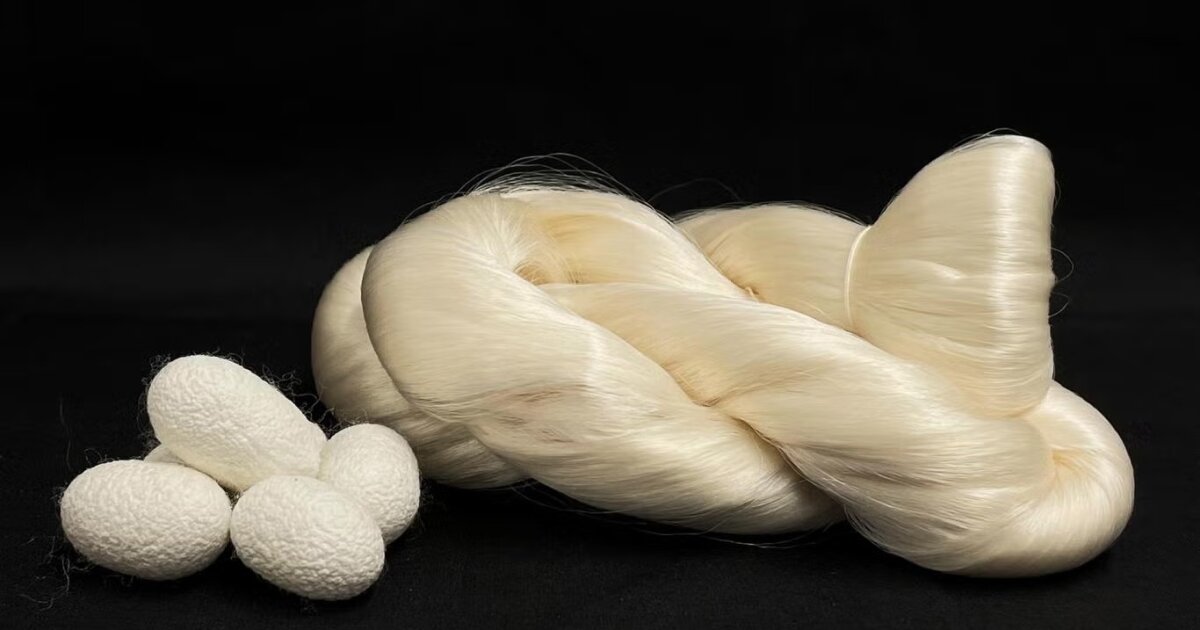
Silk isn’t just great as a smooth fabric for luxurious clothing: it’s finding a wide range of uses in everything from edible food-preserving wrappers to skin-friendly wearable health monitoring sensors. There’s plenty of scope to enhance its characteristics too, and a simple new approach has allowed it to get about as tough as Kevlar.
Silk fibers are typically harvested and dissolved before they’re turned into other forms for the aforementioned applications. A group of researchers from Tufts University, Imperial College London, and the University of Michigan went a different way: fusing the fibers together under precisely controlled heat and pressure.
By aligning the fibers in a single direction and then processing it in this way, you get a remarkably strong and tough solid bio-derived material. You can even control the structure depending on its target application by applying more or less heat and pressure, as the team noted in its paper that appeared in Nature Sustainability this month.

Qichen Zhou / Tufts University
Silk fibers are first treated to remove the sticky sericin that enables insects to build cocoons. They’re then hot-pressed at temperatures between 257-419 ºF (125-215 ºC) and pressures between 1,900-9,800 atmospheres, during which the amorphous phase of the fiber proteins enable the fibers to strongly fuse together.
The bond between these fibers transfers stress between them, making the fused material much stronger than before, similar to wood or carbon-fiber composites.

Imperial College London
This fused silk has numerous properties that open it up to a wide range of applications. It can withstand ballistic impact – demonstrating toughness similar to that of Kevlar. It’s transparent to visible light, and it’s biocompatible.
Tufts research assistant professor Chunmei Li noted that, “because of its strength, it could potentially be used for fixation devices like plates, pins, and screws as supports for bone fractures.” Tuning the processing conditions could also produce platforms for softer and more flexible implants.

Qichen Zhou / Tufts University
It can also polarize terahertz radiation, and the team believes this material could be deployed in next-gen communication systems like 6G networks that will quickly transmit high volumes of encoded information.
Lastly, this approach to treating silk could allow for upcycling used textiles, which previously would have to be dissolved before processing, or simply discarded.
The researchers’ next steps involve exploring ways to scale up production of this material, and exploring its role in sensing technologies.
Source: Tufts University