
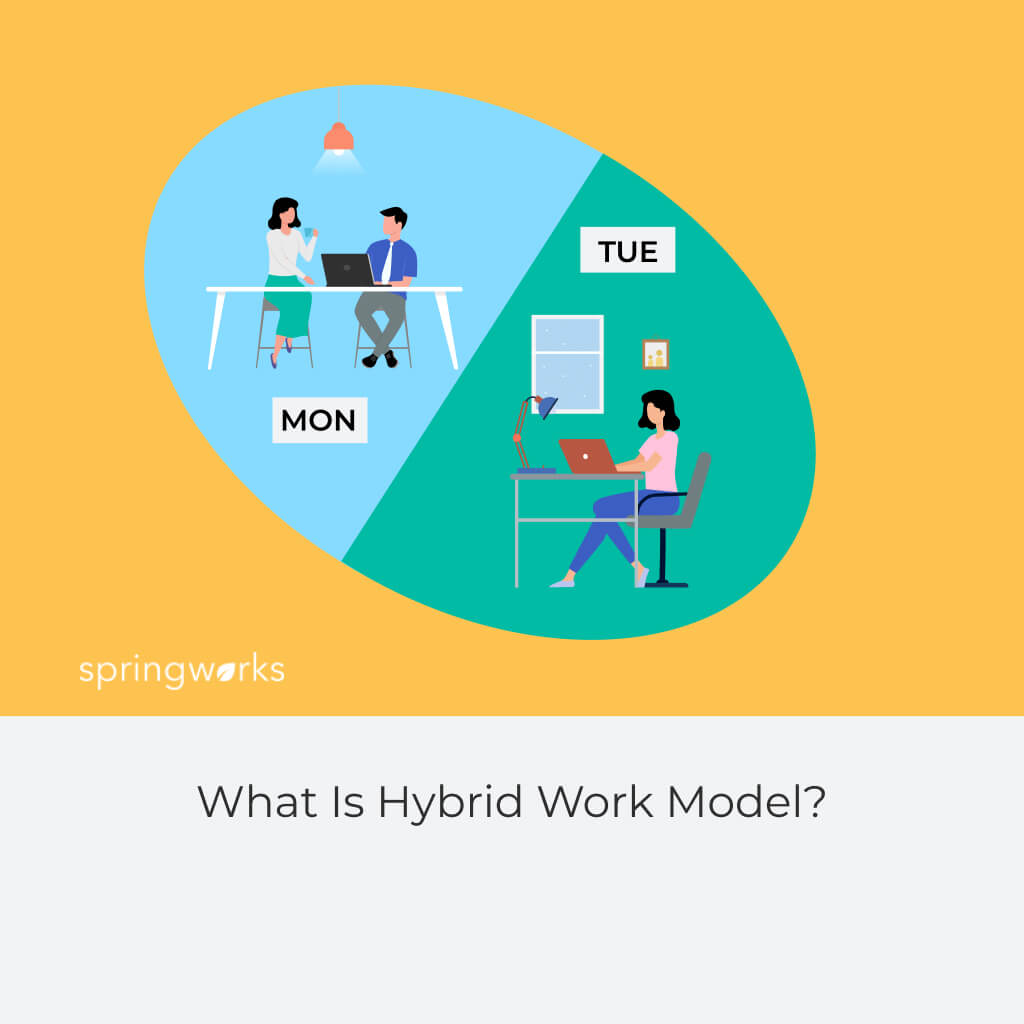
Hybrid work has moved from a pandemic workaround to a permanent workplace strategy. Six in ten employees with remote-capable jobs now expect it as a baseline and organisations that remove it risk losing their best people to competitors that offer it.
But choosing a model and running it well are two different things. A poorly designed hybrid policy creates an uneven playing field between remote and in-office employees. A well-designed one boosts productivity, reduces burnout, and widens the talent pool simultaneously.
This guide covers every major hybrid model type, the real benefits backed by data, the challenges you need to plan for, and a step-by-step HR checklist to implement it right. If you are also weighing the pros and cons of returning to the office, that companion article is worth reading first.
| Quick answer: A hybrid work model splits employee time between remote and in-office work. The four main types are scheduled, flexible, remote-first, and role-based. Success depends less on which model you choose and more on how clearly you define expectations, train managers, and measure outcomes. |
What Is a Hybrid Work Model?
A hybrid work model is a flexible arrangement where employees divide their working time between a physical office and a remote location. Unlike fully remote work where no office attendance is expected, hybrid preserves intentional in-person time while giving employees autonomy over the rest of their schedule.
Three things define any hybrid model:
• Location flexibility: employees can work from multiple places depending on task, team, or preference.
• Presence expectations: some models fix which days employees must be on-site; others leave the choice to individuals.
• Outcome orientation: with less physical oversight, managers measure results not hours spent at a desk. This requires strong goal-setting and time management practices to keep teams aligned across locations.
4 Types of Hybrid Work Models
1. Scheduled Hybrid
The company sets specific days when everyone or specific teams must be in the office. Remote work is the default on all other days. This is the most common corporate approach in 2025–2026.
Best for: Large organisations that need predictable in-person collaboration without requiring five days on-site. Microsoft requires employees within 50 miles of an office to attend three fixed days per week; Apple mandates Monday, Tuesday, and Thursday.
HR tip: Scheduled hybrid only delivers its intended benefits when on-site days are coordinated at the team level, not just mandated company-wide. A manager who can run their own schedule effectively will be far better at coordinating their team’s hybrid rhythm.
2. Flexible Hybrid
Employees choose which days to work remotely and which days to come into the office based on their tasks and team needs. No day is fixed. The office is available but never compulsory on a specific schedule.
Best for: High-trust organisations with varied role types. HubSpot runs this as a three-way choice — @home, @flex, or @office with 72% of employees choosing @home by 2025 and just 7% choosing @office full-time.
3. Remote-First Hybrid
Remote work is the default for all roles. An office exists and is accessible, but attendance is driven by purpose, quarterly planning sessions, team kickoffs, or relationship-building not by policy. This model pairs closely with the cultural principles in the remote work guide because remote-first is a mindset shift, not just a scheduling change.
Best for: Globally distributed teams that need to hire across geographies without salary adjustments for location. Airbnb and Atlassian both run remote-first hybrid models.
4. Role-Based Hybrid
Different job functions have different on-site expectations based on the nature of the work. Engineers may be fully remote; client-facing roles attend three days; managers coordinate on-site during 1-on-1 weeks. Adobe built its hybrid policy this way through interviews and focus groups with employees across functions rather than applying a single company-wide rule.
Best for: Organisations with a wide range of role types where a blanket policy would create either unnecessary friction or genuine operational gaps.
Key Benefits of Hybrid Work
• Higher individual productivity. Stanford economist Nicholas Bloom’s research found a 13% productivity lift for hybrid workers versus fully in-office peers. Employees match environment to task: deep focus at home, collaborative work in person.
• Better work-life balance and lower burnout risk. Eliminating even two commutes per week returns meaningful personal time to employees. A FlexJobs survey found 73% of workers cite improved work-life balance as their top reason for preferring hybrid arrangements. Left unmanaged, however, quiet burnout can still develop; flexibility alone does not guarantee well-being.
• Wider talent pool and stronger retention. Hybrid removes geographic hiring constraints for many roles and meets a baseline expectation that most candidates now have. McKinsey research identified a lack of flexibility as one of the top three reasons employees quit in 2024.
• Reduced real-estate costs. If meaningful numbers of employees are remote on any given day, organisations can reduce physical footprint, move to hot-desking, or redirect facility savings toward technology and compensation.
• Stronger employee engagement when designed intentionally. Top Workplaces research across 2 million+ employees shows a clear positive link between flexibility and engagement scores, provided the culture-building work is done deliberately alongside the scheduling flexibility.
Hybrid Work Challenges and How to Address Each One
Proximity Bias
The most damaging structural problem in hybrid work: managers unconsciously favour employees they see in person for promotions, project assignments, and day-to-day recognition. Stanford research found remote workers are 50% less likely to be promoted than equivalent in-office peers. Fix this through structured performance review processes that evaluate documented contributions, not physical presence.
Hybrid Meeting Friction
When some attendees are in a room and others are on a screen, the room dominates. Remote participants miss body language and often disengage. Apply an ‘all-remote or all-in’ rule for important meetings and use async-first communication (Loom recordings, shared docs) for updates that don’t require real-time discussion. The teamwork guide covers specific practices for hybrid collaboration.
Culture and Belonging Gaps
Remote and hybrid employees consistently report feeling less connected to their team. Design in-person time around relationship-building and collaboration, not tasks that could be done remotely. Use always-on recognition tools like EngageWith to keep peer appreciation visible and consistent across both remote and on-site employees. Pair this with intentional team building activities scheduled when everyone can participate.
Manager Capability Gap
Managing hybrid teams requires a different skill set than managing fully in-person teams. Managers need async communication habits, outcome-based goal setting, and the ability to build relationships across distance. Investing in manager training on time management and delegation is one of the highest-leverage things an HR team can do before rolling out a hybrid policy.
Hybrid Work Implementation Checklist for HR Teams
Most hybrid implementations fail not because the model is wrong, but because the rollout is underprepared. Use this checklist before launch.
• Audit your roles first. Map every role category by how much of the work genuinely requires in-person presence. This data, not competitor announcements or executive preference, should drive your model choice.
• Write a clear, specific policy. Employees need to know the minimum on-site days by role, which days are team coordination days, how exceptions are requested, and how the policy applies to new hires and contractors.
• Build async communication infrastructure. Hybrid fails if your team defaults to reactive Slack and impromptu Zoom. Document decisions in writing before meetings. Record updates. Make everything searchable for employees regardless of where they work.
• Redesign office space for hybrid use. Rows of individual desks designed for five-days-a-week occupancy become wasted space. Shift toward collaboration zones, huddle rooms, hot-desking systems, and better AV equipment in every meeting room.
• Train managers before launching. Managers who learned to manage in-person will default to presence-based habits that undermine hybrid work. Prioritise training on outcome-based management, inclusive meeting facilitation, and employee productivity in distributed contexts.
• Implement location-agnostic recognition. Recognition that only happens in the office is recognition that only reaches half the team. Use tools like EngageWith, which integrates directly into Slack and Teams, to make appreciation visible and consistent for every employee, wherever they are working.
• Measure and iterate quarterly. Track office utilisation rates, engagement scores segmented by work location, and attrition rates for remote versus in-office employees. Treat your hybrid policy as a living system, not a one-time announcement.
Frequently Asked Questions
What is the difference between hybrid and remote work?
Remote work means employees work entirely outside a traditional office, with no expectation of in-person attendance. Hybrid work combines remote and in-office time employees split their schedule between both locations according to company policy or personal choice.
Which hybrid work model is best?
There is no universally best model. Scheduled hybrid works well for large teams that need coordinated in-person collaboration. Flexible hybrid suits high-trust organisations with varied roles. Remote-first works for globally distributed teams. Role-based hybrid makes sense when different functions have genuinely different presence needs. The right answer comes from auditing your own roles and culture not from copying competitors.
How do you prevent proximity bias in a hybrid workplace?
Use structured performance management that evaluates documented contributions and outcomes — not who was in the office. Train managers to create visible opportunities for remote employees in high-profile projects and communications. Run important meetings with an all-remote-or-all-in format.
Is hybrid work better for employee wellbeing?
Flexibility correlates with lower stress and better work-life balance but only when workloads are manageable and managers actively monitor team health. The Springworks research on quiet burnout shows that flexibility without intentional culture investment can mask disengagement rather than prevent it.
Final Thoughts
Hybrid work is not a perk to offer or a mandate to enforce. It is a design challenge one that requires honest role analysis, clear policy, manager investment, and continuous iteration. Organisations that approach it that way consistently outperform those that announce a model and hope it runs itself.