
Today, the urgent need to digitalize work processes and customer service is driving businesses to seek ways to create their own solutions. Many companies are opting for IT outsourcing, as it helps save on development costs and quickly find the necessary IT development resources.
According to the research, the global IT services outsourcing market is growing and is expected to reach around $1,21 billion by 2030.
Nonetheless, despite the many benefits that IT outsourcing offers, choosing the right partner for it can be quite a challenging task these days. There’s a remarkable diversity of IT centers around the world, offering a wide range of software development services at varying price points.
In this comprehensive guide, we’ll explore the best outsourcing locations and explain how to find a responsible and highly qualified development team to create IT products of any complexity.
Why Outsource Software Development?
Before we start with a detailed analysis of the best countries for delegating software development, let’s have a look at the main reasons why businesses prefer to outsource their IT projects.
Lower Expenses
IT outsourcing vendors from different parts of the world offer various software development rates.
The rates are determined by the state of the economy, the cost of living, labor laws, and many other factors in a given region. Therefore, businesses often turn to IT providers with remarkably lower prices than those in their own region.
For example, German businesses prefer to outsource their software development to nearshore countries like Poland because the rates there are significantly lower than in Germany.
Additionally, by contracting out software development services, companies only pay for the services they actually need, avoiding the additional costs associated with hiring full-time employees, such as social benefits, health insurance, vacation pay, taxes, or purchasing IT equipment.
Business Growth and Scalability
With a fully-equipped remote software development team at their disposal, companies can free up their internal resources and employees, focusing more on core business processes.
Above all, companies can quickly scale up or down their IT outsourcing teams depending on the speed of their business growth and seasonal peaks.
Quick Access to IT Talent Pool
IT outsourcing companies can quickly assemble a team of software development specialists to satisfy both the technical and business requirements of a client’s project.
For example, SCAND, with its vast experience working on customer projects, can provide specialists of a high technical level and great domain knowledge in various fields like banking and finance, healthcare, e-commerce, education, and logistics.
This eliminates the need for businesses to waste time and effort searching for suitable IT specialists; instead, they can quickly hire the necessary developers through IT outsourcing companies.
Best Tech Expertise
Remote software development teams must keep up with the latest trends in emerging technologies to deliver their services at a high level.
Therefore, many software developers working for outsourcing companies have extensive experience creating a variety of digital solutions and implementing the latest digital innovations, such as IoT, blockchain, AI, and others.
And those businesses that hire outsourcing IT teams can be confident that their applications will be built in accordance with the latest software development trends and methodologies.
Compliance with International Standards
A reliable IT outsourcing company normally guarantees high quality and security of the software and creates digital solutions in accordance with international standards, such as ISO 9001 and ISO 27001, to name a few.
Software Outsourcing Moves Nearshore
There is a wide range of regions around the world that provide IT outsourcing services.
However, the latest trend is to choose a nearshore location due to time zone differences and the inability to manage teams that have a huge time collapse with the in-house team.
Thus, the US companies prefer to outsource to Latin American countries like Brazil, Mexico, and Argentina. Japan, China, and Australia outsource to India, and Western Europe turns to Eastern European IT outsourcing providers.
Let’s have a look at which Eastern European countries are an attractive nearshore location for most Western European companies:
Poland
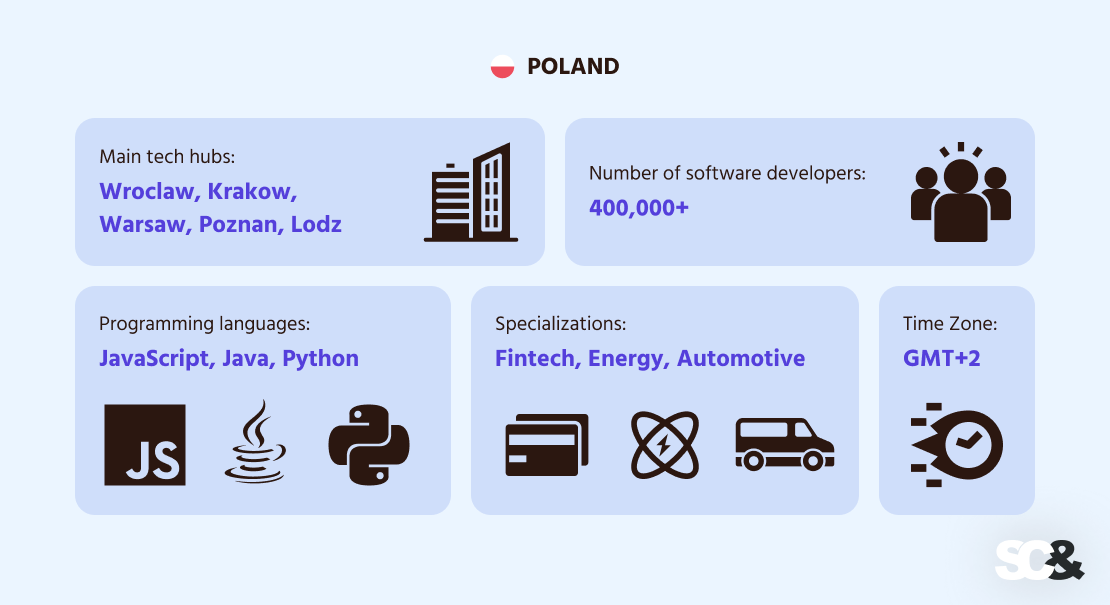
- Main tech hubs: Wroclaw, Krakow, Warsaw, Poznan, Lodz
- Number of software developers: 400,000+
- Programming languages: JavaScript, Java, and Python
- Specializations: Fintech, Energy, and Automotive
- Time Zone: GMT+2
Poland is the leading Central and Eastern European (CEE) IT outsourcing market, with the turnover reaching around $4 billion. It has the largest pool of IT specialists in the CEE region and a diverse IT ecosystem of startups, SMEs, and large enterprises.
The main tech hubs of Poland include Wroclaw, Krakow, Warsaw, Poznan, and Lodz. Warsaw, the capital, was included in the top 10 tech cities with the best startup environment and FDI performance.
The country was ranked 40th among the easiest places to do business and has one of the highest numbers of BPO, SSC/GBS, IT, and R&D service centers in Eastern Europe.
The major international investors in IT companies include Dell EMC, HP Inc, Lenovo, IBM, Apple, Cisco, Microsoft, Google, and others.
The Polish IT sector is strongly oriented towards the international market. The most popular programming languages are JavaScript, Java, and Python. The most popular industries among Polish software developers are fintech, energy, and automotive.
Bulgaria

- Main tech hubs: Sofia, Plovdiv, Varna, Burgas, Ruse
- Number of software developers: 70,000+
- Programming languages: JavaScript, Java, C#, Python, PHP
- Specializations: Fintech, E-commerce, Enterprise Software, and Healthcare
- Time Zone: GMT+2
Bulgaria has become an important IT outsourcing destination in Eastern Europe. The country has developed a strong technology sector supported by a well-established education system and a growing startup ecosystem.
Today, the Bulgarian IT industry continues to expand, attracting international companies and investors who look for skilled developers and reasonable development rates.
The Bulgarian technology sector employs more than 70,000 software professionals, with many international companies opening development centers in the country. Sofia, the capital, serves as the main technology hub, while Plovdiv, Varna, Burgas, and Ruse are also developing strong IT communities.
Bulgaria has a vibrant developer ecosystem with numerous tech events, conferences, and professional communities that help specialists stay up to date with modern technologies and industry trends. Many Bulgarian developers are experienced in working with international clients and distributed teams.
The most popular programming languages among Bulgarian developers include JavaScript, Java, C#, Python, and PHP. Bulgarian IT companies commonly work on projects in industries such as fintech, e-commerce, enterprise software, and healthcare.
Romania
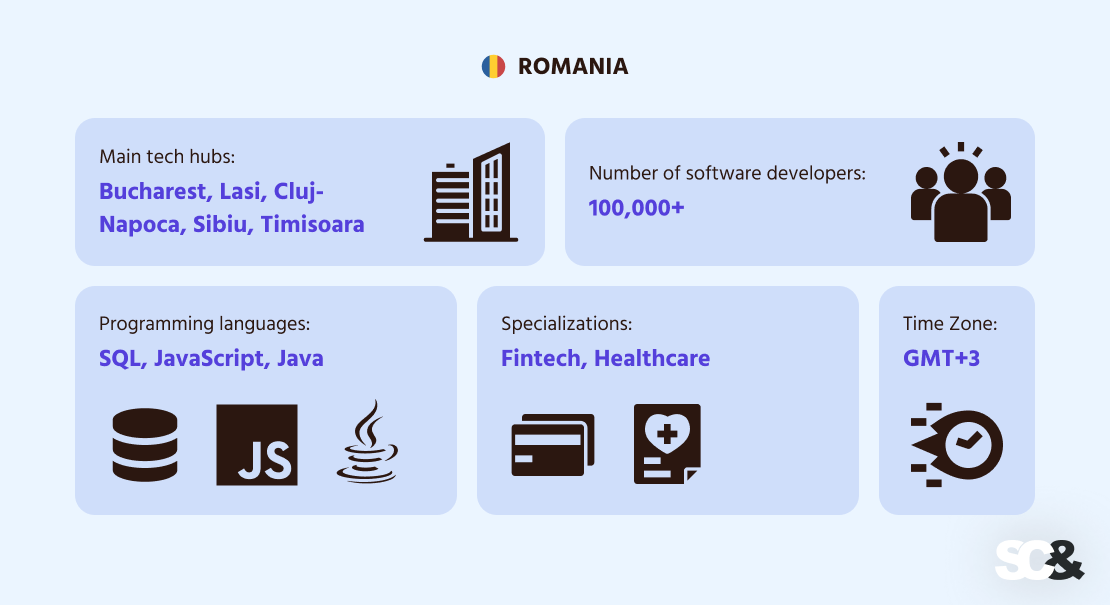
- Main tech hubs: Bucharest, Lasi, Cluj-Napoca, Sibiu, Timisoara
- Number of software developers: 100,000+
- Programming languages: SQL, JavaScript, and Java
- Specializations: Fintech and Healthcare
- Time Zone: GMT +3
Romania has the most experience in the IT outsourcing sector, with almost 20 years of experience in the international software development market.
Romania frequently ranks #1 in Europe and #6 globally for the number of certified IT specialists per 1,000 inhabitants.
With over 250,000 software engineers/specialists as of 2024–2025 and a population of roughly 19 million, the ratio is closer to 13-14 IT specialists per 1,000 citizens.
The most used programming languages in Romania are SQL, JavaScript, and Java, whereas the most popular industries are fintech and healthcare.
Czech Republic

- Main tech hubs: Prague, Ostrava, Brno
- Number of software developers: 150,000+
- Programming languages: Java, PHP, C, Python, Ruby on Rails, and Swift
- Specializations: Fintech, Healthcare, and Education
- Time Zone: GMT +1
Czech software developers are consistently ranked among the top in the world for programming proficiency, frequently placing within the top 10 in reputable global IT talent studies.
The Czech Republic is one of the most comfortable countries in Europe to do business with. It offers a corporate tax relief for up to 10 years, which stands at only 19%.
Among the world-renowned IT companies with development offices in the Czech Republic are Red Hat, IBM, NetSuite, AVG, Infosys, Honeywell, Microsoft, Google, Kiwi, and many others.
There are more than 150,000 software developers in the Czech Republic who prefer using Java, PHP, C, Python, Ruby on Rails, and Swift. The most popular industry specializations Czech developers work in are fintech, healthcare, and education.
Main Criteria for Choosing an Outsourcing Software Development Destination
Finally, how to select a single company among the large number of candidates? Here is a list of criteria that will help you make the right decision.
Project Technical Requirements
It’s essential to choose the outsourcing company that can fulfill your project requirements by 100%.
Therefore, before exploring the software development market, consider the goals and objectives of your project and what tech stack you want to base your digital solution on. With a clear list of requirements, it’ll be easy to realize if a provider fits the project or not.
Engagement Model
There are a variety of engagement models to choose from. If you have stable requirements and you don’t want to change anything in your project, then the Fixed Bid model is what you need.
The Time and Materials model implies that the project requirements can be changed during the development process to better meet the app’s user requirements.
The Outstaffing model means that you can hire the needed specialists for a certain period of time and manage them yourself. The Dedicated team model gives you full control of a development team that can be scaled while the project grows.
Relevant Experience and Portfolio
Past candidate company working experience in a field similar to yours can significantly speed up the time for your project development and delivery to the market.
Check the vendor’s portfolio, explore the software development customer stories and case studies, especially those that are similar to your project. It can give you a clearer vision of the IT vendor even before you get in touch with them.
Communication
When communicating with the vendor, find out how transparent their working process is, which tools they use to communicate with you, what project management methodology and tools they utilize to report on progress, what the time difference between your countries is, and how they organize their work based on time zone gaps.
Where to Find Outsourcing Software Development Companies
When you have decided to outsource software development and selected a preferred region, the next step is finding a reliable outsourcing partner.
Today, there are many platforms and resources where businesses can discover and evaluate software development companies based on their expertise, experience, and customer feedback.
B2B Review Platforms
B2B review platforms are among the most reliable places to search for outsourcing software development companies.
These platforms provide verified listings of service providers along with detailed company profiles, client testimonials, ratings, and project case studies.
Businesses can analyze vendors based on their industry expertise, team size, pricing structure, and technological specialization. Platforms such as Clutch, GoodFirms, DesignRush, and TechBehemoths allow organizations to compare companies from different regions and evaluate their reputation in the market.
By reviewing verified client feedback and past projects, businesses can gain a clearer understanding of a company’s reliability, technical expertise, and ability to deliver high-quality software solutions.
Professional Networking Platforms
Professional networking platforms also play an important role in discovering outsourcing partners and establishing business relationships.
One of the most widely used platforms for this purpose is LinkedIn, where custom software development companies actively showcase their expertise, share case studies, and publish insights related to technology trends and industry developments.
By exploring company profiles on LinkedIn, businesses can review the experience of development teams, evaluate employee expertise, and assess the company’s credibility through its online presence.
In addition, LinkedIn allows direct communication with company representatives, making it easier to initiate conversations, discuss project requirements, and build professional connections before entering a formal partnership.
Technology Conferences and Industry Events
Technology conferences and industry events are valuable opportunities for businesses to meet outsourcing providers, learn about emerging technologies, and establish potential partnerships.
Many software development companies participate in international technology events to present their services, demonstrate technical capabilities, and connect with prospective clients. Major events such as Web Summit, Collision Conference, and Slush attract thousands of technology companies, startups, and investors from across the globe.
Attending such events allows businesses to interact with tech companies face-to-face, evaluate their expertise firsthand, and build professional relationships that may lead to long-term collaboration.
Cost of Outsourcing Software Development
One of the most important factors companies consider when choosing an outsourcing destination is the cost of software engineering. While outsourcing is often associated with lower expenses, the final project cost depends on several factors, including location, team expertise, project complexity, and engagement model.
Understanding how pricing varies across regions can help businesses select the most suitable outsourcing destination while balancing cost and quality.
Average Product Development Rates in Europe
Hourly rates for software development differ significantly across Europe due to variations in living standards, labor markets, and economic conditions.
Generally, Western European countries have the highest development costs, while Eastern Europe offers more competitive pricing with comparable technical expertise.
Typical average hourly rates include:
| Region | Average Hourly Rate |
| Western Europe (Germany, UK, France) | $90 – $150 |
| Northern Europe (Sweden, Denmark, Norway) | $100 – $160 |
| Central Europe (Poland, Czech Republic) | $45 – $80 |
| Eastern Europe (Bulgaria, Romania) | $35 – $70 |
These rates can vary depending on the developer’s seniority level, technology stack, and project requirements.
For example, specialists in highly demanded technologies such as AI, blockchain, or cloud architecture may charge significantly higher rates than developers working with more common programming languages.
Frequently Asked Questions (FAQs)
What is software development outsourcing?
Software development outsourcing is the practice of hiring an external company or team to build, maintain, or support software instead of relying entirely on in-house developers. It allows businesses to access specialized expertise and accelerate development while reducing operational costs.
Why do companies outsource software development to Europe?
Europe offers a strong combination of skilled developers, reliable infrastructure, and cultural compatibility with Western markets. Central and Eastern European countries are especially attractive because they provide high-quality engineering talent at competitive rates.
How much does outsourcing software development in Europe cost?
Development rates vary depending on the country and developer experience. On average, hourly rates in Western Europe range from $90–$150, while Central and Eastern Europe typically offer rates between $35–$80 per hour.
What are the most popular outsourcing destinations in Europe?
Some of the most popular outsourcing destinations include Poland, Romania, Bulgaria, and the Czech Republic. These countries have large IT talent pools and strong reputations in software development.
How do you choose the right outsourcing partner?
When selecting an outsourcing company, businesses should evaluate technical expertise, industry experience, portfolio, communication practices, and client reviews to ensure the vendor can meet project requirements.