
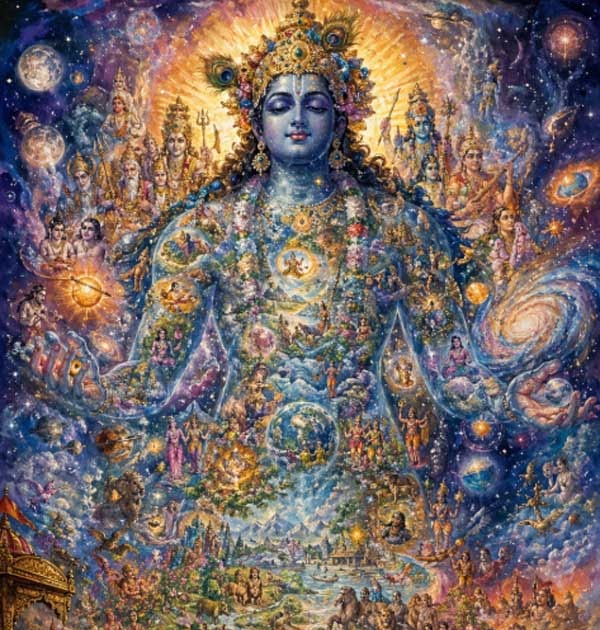
Beyond Form and Image — Why Every Depiction of the Divine in Hinduism Is Both Complete and Incomplete
The Human Hand Reaches for the Infinite
Since the earliest stirrings of human consciousness, one
question has driven men and women to their knees, to their chisels, and to
their paintbrushes — what does the divine look like? Every civilization has
wrestled with this question. Most have answered it by making the divine look
like themselves. Greek gods were sculpted as idealized humans. Abrahamic
traditions largely abandoned the image altogether, declaring the divine beyond
form.
Hinduism, or Sanatana Dharma — the eternal way — chose a
third and far more audacious path. It did not restrict the divine to the human
form. It threw open the doors of imagination and said: the divine can wear the
head of an elephant, the face of a monkey, the body of a half-lion, the wings
of an eagle, the neck of a peacock. It can be male, female, both, or neither.
It can have four arms or a thousand. It can be a river, a mountain, a tulsi
plant, or the morning dew resting on a blade of grass. This was not primitive
thinking. This was, in fact, a profound philosophical statement — that the
divine is not bound by the categories of the human mind.
And yet, even with all this breathtaking creative freedom,
every image of the divine in Hinduism remains incomplete. Not wrong. Not
inferior. Simply incomplete. Because the truth being pointed at is infinite,
and every form is only a finger pointing at the moon.

Neti Neti — The Philosophy of What Cannot Be Said
The Brihadaranyaka Upanishad offers one of the most honest
declarations in all of world philosophy. When asked to describe Brahman — the
ultimate, all-pervading reality — the sage Yajnavalkya responds with two words
repeated again and again: neti, neti. Not this. Not this.
He does not say the divine does not exist. He says that
every description, every form, every concept the human mind can produce will
fall short. Language, by its nature, limits. A word draws a boundary around a
thing and separates it from everything else. But Brahman has no boundaries. It
is, as the Chandogya Upanishad declares, sarvam khalv idam brahma — all of
this, everything, is Brahman.
This is the philosophical foundation on which every Hindu
image of the divine rests. The image is a doorway, not a destination. It is a
raft to cross the river, not the other shore itself. The Bhagavad Gita affirms
this when Bhagavan Sri Krishna tells Arjuna in Chapter 7, verse 24:
“The unintelligent think of Me, the unmanifest, as
having manifestation, not knowing My higher, immutable, and most excellent
nature.”
The divine takes form as a mercy — because the human mind
needs a foothold. But those forms are never the full truth.
The Symbolism Hidden in Every Image
What makes the images of Sanatana Dharma extraordinary is
that they are not arbitrary. Every element is layered with meaning, compressed
philosophy, and psychological insight.
Ganesha, the elephant-headed son of Devi Parvati, is
worshipped before any new beginning. The large head symbolizes expansive
wisdom. The small eyes indicate focused concentration. The large ears mean
listening deeply before acting. The broken tusk represents the sacrifice of
something precious in the pursuit of knowledge — it was with this broken tusk
that Ganesha is said to have written the Mahabharata as dictated by the sage
Vyasa. The mouse at his feet, often seen as an insignificant creature, represents
the ego — tamed and made a vehicle rather than an obstacle.
Devi Durga rides a lion, holds weapons in eight or ten
hands, and yet her face carries absolute serenity. The hands speak of action in
the world. The lion speaks of courage without aggression. The serene face
declares that she who is rooted in the self is never disturbed by battle. Every
weapon she holds was gifted by a different deva, making her the synthesis of
all divine power — not one god’s champion but the concentrated force of the
entire cosmos defending righteousness.
Bhagavan Vishnu’s four hands hold the conch, the discus, the
mace, and the lotus — representing the four goals of human life: dharma, artha,
kama, and moksha. His blue skin signals the infinite, as the sky and the ocean,
both without end, are blue. His resting on the cosmic serpent Adi Shesha upon
the waters of eternity is an image of supreme stillness holding the entire
creation in possibility, before it unfolds.
These images are not decoration. They are philosophy
compressed into visual language so that even a person who cannot read can
absorb deep truths through darshan — the sacred act of seeing and being seen by
the divine.
Navagunjara — The Creature That Changed Arjuna
Nowhere is this teaching made more vivid and more personal
than in the story of Navagunjara, found in the Oriya Mahabharata composed by
the poet Sarala Das.
During one of his forest expeditions, Arjuna encountered a
creature unlike anything he had ever seen or imagined. The Navagunjara had the
head of a rooster, the neck of a peacock, the hump of a bull, the waist of a
lion, the tail of a serpent, and four legs — one of an elephant, one of a
tiger, one of an antelope, and one that was a human leg. One of its arms was
that of a human being, and in its hand it held a single lotus flower.
Arjuna, the greatest archer of his age, the warrior trained
by the gods themselves, reached for his bow. Every instinct told him this was a
threat. It was monstrous. It broke every known law of nature. His mind,
brilliant and trained as it was, could not classify it, and what cannot be
classified feels dangerous.
But then something made him pause. The lotus.
A creature of destruction does not carry a flower of peace
and spiritual elevation. Something shifted in Arjuna. He remembered the words
Sri Krishna had spoken to him — that the universe is boundless, that existence
holds within itself far more than the human mind has ever dreamed, and that
just because something has not been seen or heard does not mean it cannot
exist.
Arjuna lowered his bow. He folded his hands. He bowed.
In that moment, the Navagunjara revealed itself as Bhagavan
Vishnu in a form that transcended all known forms. Arjuna’s willingness to
release his preconceptions, to stay with uncertainty rather than attacking it,
to look for the lotus even in what appeared monstrous — that was his real
victory. Not a battle won with arrows, but a battle won within himself.
The Psychology of Divine Forms
Modern psychology recognizes what Sanatana Dharma always
knew — that the human mind does not think in abstractions naturally. It thinks
in images, stories, and symbols. Carl Jung, the Swiss psychologist, spent much
of his life studying Hindu and other ancient traditions and arrived at the
conclusion that the gods of ancient cultures were not superstitions but were
representations of deep psychological forces within the human being — what he
called archetypes.
Sanatana Dharma understood this long before the vocabulary
of psychology existed. The divine is given form so that the devotee can relate,
worship, meditate, and internalize. Over time, the form becomes a mirror. The
devotee who gazes at the serene face of Devi Saraswati, the embodiment of
learning and creativity, begins to cultivate those qualities in themselves. The
devotee who bows to Bhagavan Rama, the ideal of righteous conduct, is subtly
sculpting their own character.
This is why the Srimad Bhagavatam teaches that even a mind
that approaches the divine with any emotion — love, awe, fear, or even anger —
is elevated by that contact. The form draws the mind inward. The inward journey
eventually leads beyond all forms.
Modern Relevance — Living Without Certainty
The lesson of Navagunjara is urgently needed today. We live
in an age of instant judgement. Algorithms show us only what confirms what we
already believe. We are told to take sides immediately, to label everything, to
distrust what we cannot categorize. Arjuna’s bow-raising reflex is the dominant
habit of our time.
The teaching embedded in that story — pause before you
attack what you do not understand, look for the lotus, remember that existence
is vaster than your experience — is not just spiritual advice. It is a
prescription for a more honest, more curious, and more compassionate way of
living.
Every image of the divine in Sanatana Dharma is, in the end,
an invitation. It invites us to expand beyond our current mental limits. It
tells us that the universe does not fit into our categories. It whispers what
the Mandukya Upanishad declares outright — that the ultimate reality is that
into which all of this dissolves, which is peace, which is auspicious, which is
non-dual.
The Dew and the Ocean
The next time you stand before an image of a Hindu deity —
with its multiple arms, its animal companions, its complex iconography — do not
see it as strange. See it as an honest attempt by a human mind to gesture
toward something it knows it cannot fully hold.
The forms are countless. What has been imagined so far is
only a beginning. The truth that the sages of this land pointed at is the same
truth that shines in the morning dew, light in a distant star, moves in the wind through the forest,
burns in the sun, and breathes quietly in the space between your thoughts.
Every image is a drop. The divine is the ocean. And the
ocean, as any devotee knows, cannot be contained — only entered.