
Trump would have all his comedian critics fired if he could. But Colbert represents a particular loss.
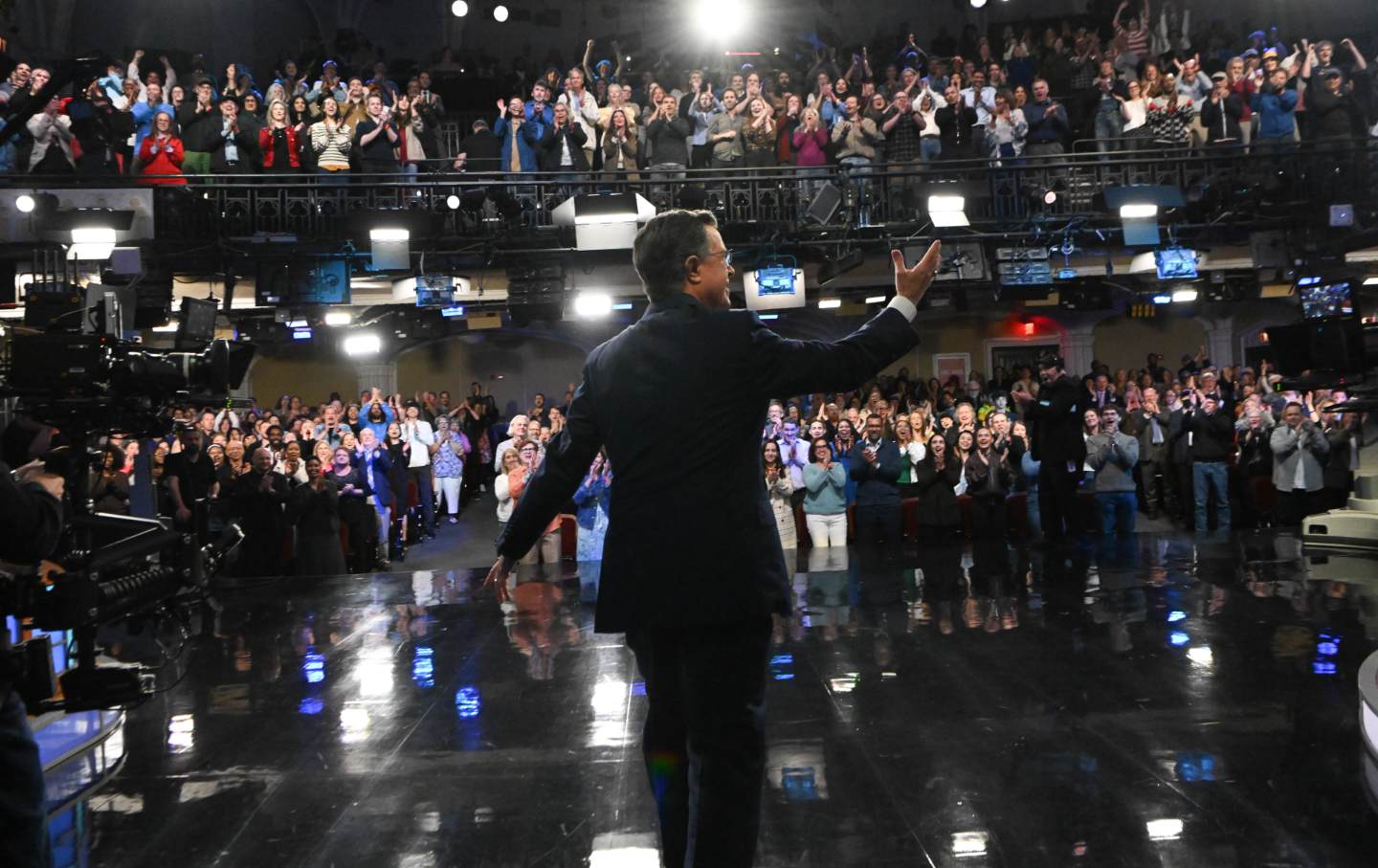
Stephen Colbert on the set of The Late Show on CBS on the last night of the show.
(Scott Kowalchyk / CBS via Getty Images)
Last night, Stephen Colbert of CBS’s The Late Show joined a growing list of critics of President Trump who lost their jobs this week. Republican Representative Thomas Massie of Kentucky lost his primary for defying Trump on the release of the Epstein files. Republican Senator Bill Cassidy of Louisiana lost his primary for voting to impeach President Trump in 2021. And Stephen Colbert lost his show for the far worse crime, the unforgivable crime, in Trump’s eyes, of laughing at him.
Of the three, I’ll miss one of them. Eleven months ago, as the Ellison family sought final approval from Trump’s FCC to buy Viacom-Paramount, which then owned CBS, it was announced that The Late Show with Stephen Colbert was to be canceled on May 21, 2026. CBS argued that even with high ratings, Colbert’s show was too expensive to make money for the network. Still, the timing of the announcement, alongside the FCC meeting, the $16 million 60 Minutes settlement paid to Trump, and David Ellison’s hiring The Free Press’s conservative editor and co-owner Bari Weiss as editor in chief of CBS News, sent a strong signal that the Ellisons offered Colbert up to appease Trump.
Of the late-night comedians, whether on weekdays or on Saturday Night Live, Colbert is hardly President Trump’s harshest critic. His jokes are not harder, meaner, or more piercing than Jimmy Kimmel’s or those on SNL’s Weekend Update. This week, Colbert’s monologue included a dissection of the absurd “negotiation” between Trump and his own IRS for the $1.776 billion “anti-weaponization” fund. The Late Show did it with a series of clips from seemingly dozens of Trump interviews stitched together to create a “negotiation” to give himself that amount. It illustrated the brazen corruption of the fund in a clear and funny way, but it can’t be said to have had the viciousness of a South Park scene showing Trump nude. It can’t be said to have infuriated the Trumps, like Kimmel’s recent joke about how lately Melania Trump has “the glow of an expectant widow.”
Back when Colbert played his alter ego—Stephen Colbert, host of The Colbert Report—he was a little more cutting. Then he played a spot-on parody of a right-wing Fox News host modeled in part on Bill O’Reilly. Colbert’s greatest moment in that era still remains his 2006 face-to-face monologue with then-President George W. Bush at the White House Correspondents’ Dinner. That night, he presented himself as George W. Bush’s biggest fan, there to celebrate Bush and commiserate with his hero that “reality has a well-known liberal bias.”
Twenty years ago was another world. One where a president could sit for a dressing down by a comedian and pretend to have fun. The president we have now demands that a comedian like Colbert be fired for his transgressions and Kimmel, too, in the wake of his joke on Trump’s insincere public grieving over Charlie Kirk’s killing. They suspended Kimmel, one thinks, only because, in the aftermath of the announcement of Colbert’s firing, public outrage over Trump’s silencing another comic led ABC to back off.
So why Colbert? Colbert is the one comedian critic that Trump could get rid of because the new owners of CBS were willing to sell out their own talent to clinch their deal—as they did their news division. Trump would have all his critics fired if he could. What sets Colbert apart is what made him so unique for these times. More than any of his contemporaries, Colbert is openly philosophical about the purpose of his humor, and that philosophy is what makes him so vital to the moment. As he told James Kaplan in 2007 in Parade magazine, “Not living in fear is a great gift because certainly these days we do it so much. And do you know what I like about comedy? You can’t laugh and be afraid at the same time—of anything. If you’re laughing, I defy you to be afraid.” As Colbert told Playboy’s Eric Spitznagel in 2012, “Fear is an attempt to impose tyranny over someone’s mind. It’s an act of oppression.”
Current Issue

Defusing that fear at the end of our day is what Colbert’s show tried to do. After his opening monologue, often laying into Trump, Colbert generally spent the rest of the show in an uplifting mood with his guests and comedy pieces. The Late Show band itself was called The Joy Machine. A bit twee? A bit corny? Yes, but Colbert’s show was meant as an antidote for the day’s Trump news, an attempt to disarm it, not out-snark it.
No president in American history has used fear on the American public like President Trump. Fear keeps the Republican Party in line, although of late some do seem to fear losing their jobs more than they fear Trump. Trump threatens Iran, Greenland, TV networks—his threats alone often get him what he wants. It’s how Trump rules, and no matter how many times his threats prove to be empty or he himself backs down, every once in a while it works, and so we lost Colbert.
Colbert’s final weeks brought some big-name guest stars to the program: President Obama, Steven Spielberg, Bruce Springsteen, and last night’s sole interview, Sir Paul McCartney. The last shows have been peppered with cameos, featuring old friends from Jon Stewart and Amy Sedaris to Robert De Niro and Neil de Grasse-Tyson and Tig Notaro. A lot of it felt random. Who are these people to Colbert? He did not bother to explain.
As Colbert prepared to sign off, his most interesting show, and most touching, was Monday’s “The Worst of The Late Show.” In that, he brought up several key writers and designers from his staff who got to present favorite bits of theirs that had been cut over the preceding 11 years. Were they overlooked gems, bad calls by Colbert? No, he was right about most of them. That wasn’t the point so much as the chance for Colbert to give them a moment to shine and say goodbye to his coworkers.
Shows get canceled. Hosts get replaced. This matters so much because Trump made it happen, not because it wasn’t going to eventually happen. Today, few people can quote Lenny Bruce, but we remember that he was censored and thrown in jail for telling jokes powerful people did not like. Few can quote The Smothers Brothers Comedy Hour on CBS from the 1960s and ’70s, but we remember that they were canceled for telling jokes powerful people did not like. Most of Colbert’s jokes about Trump are already forgotten with yesterday’s news, but Trump has assured Colbert a permanent spot in the pop-culture memory by canceling him. Trump has made sure that Colbert will be remembered as a comic who spoke truth to power, and that Trump will be remembered as a power that could not handle his truth.
From illegal war on Iran to an inhumane fuel blockade of Cuba, from AI weapons to crypto corruption, this is a time of staggering chaos, cruelty, and violence.
Unlike other publications that parrot the views of authoritarians, billionaires, and corporations, The Nation publishes stories that hold the powerful to account and center the communities too often denied a voice in the national media—stories like the one you’ve just read.
Each day, our journalism cuts through lies and distortions, contextualizes the developments reshaping politics around the globe, and advances progressive ideas that oxygenate our movements and instigate change in the halls of power.
This independent journalism is only possible with the support of our readers. If you want to see more urgent coverage like this, please donate to The Nation today.