
Miniseries have really gained traction over the last few years, but the truth is, they have existed for a long time as one of the most exciting spaces in television. There’s no denying that long-running shows often drag their stories out for multiple seasons, but miniseries thrive on precision. They tell complete, emotionally satisfying stories in just a few episodes, which practically forces storytellers to take creative risks. That’s exactly why miniseries generally feel sharper, more experimental, and more impactful than traditional television.
Not to mention that there’s something incredibly satisfying about starting a show and knowing that the story has a clear ending. The format gives audiences instant immersion while still delivering the emotional payoff of a fully developed narrative. With that said, here are such near-perfect miniseries that are worth every second.
7
‘The Night Of’ (2016)

HBO has practically perfected the art of the modern miniseries, and The Night Of is one of the strongest examples of that. The series follows Pakistani-American college student Nasir “Naz” Khan (Riz Ahmed), whose entire life changes after he spends the night with a young woman and wakes up to find her brutally murdered beside him. This leads to a chaotic series of events where Naz makes several terrible decisions before eventually being arrested and thrown into a justice system that transforms him into a completely different person. The murder mystery is obviously gripping, but the real focus of the show is the broken justice system that Naz has to navigate.
The story explores how fear, prejudice, and bureaucracy can completely reshape a person’s identity, and how damaging that can be. Ahmed delivers a career-defining performance as he portrays Naz’s confusion, vulnerability, and eventual emotional numbness. John Turturro is equally phenomenal as John Stone, the eccentric defense attorney who initially seems awkward and detached but is the only person genuinely trying to help Naz. The show doesn’t feature any flashy twists or exaggerated courtroom theatrics. Instead, The Night Of builds tension through silence, uncertainty, and the uncomfortable feeling that the system often cares more about closing a case than the truth.
6
‘Behind Her Eyes’ (2021)

Behind Her Eyes begins like a fairly straightforward psychological thriller, but it slowly takes a stranger and more ambitious turn. The story, based on Sarah Pinborough’s novel, follows single mother Louise (Simona Brown), who begins an affair with her boss, psychiatrist David Ferguson (Tom Bateman). However, things get messy when she unexpectedly forms a friendship with his mysterious wife, Adele (Eve Hewson). At first, the series feels like a slow-burning relationship drama filled with a typical love triangle, but that’s far from the truth. Behind Her Eyes stands out from other thrillers in how it gradually introduces supernatural and sci-fi elements into the narrative without cheapening the overall emotional stakes.
As Louise grows closer to Adele, she begins learning about lucid dreaming and astral projection, and that’s when the tone of the show changes completely. The miniseries constantly plays with perspective, which makes it difficult for the audience to trust any character. The deeper Louise gets pulled into David and Adele’s toxic relationship, the more disturbing the truth becomes. Behind Her Eyes maintains this sense of unpredictability till the very end, so when the twist finally comes, it lands with an impact that is almost impossible to shake off.
5
‘I May Destroy You’ (2020)

HBO’s I May Destroy You is easily the most emotionally rich and fearless miniseries of the last decade. The show, created by and starring Michaela Coel, follows Arabella Essiedu, a successful young writer whose life completely changes after she is assaulted during a night out in London. A premise like this could have easily resulted in an overwhelmingly bleak narrative, but that isn’t the case. I May Destroy You never ignores the damage caused by Arabella’s trauma, but it also refuses to define her entirely by that. Now, the assault itself happens early in the story, which means that the series actually explores everything that comes after it. Instead of building toward one big mystery or dramatic courtroom climax, I May Destroy You focuses on the messy, raw, and personal process of healing.
Arabella spends much of the show trying to piece together what happened to her that night while also trying to keep up with her friendships, work obligations, and maintain some sense of normalcy. The show’s greatest strength is how naturally it blends some of its most devastating moments with humor and even warmth. Arabella herself isn’t presented as the perfect victim, which is exactly why her journey feels so authentic. Michaela Coel’s writing constantly refuses easy answers, and often jumps between timelines to present multiple versions of what closure can look like. I May Destroy You is difficult, uncomfortable, funny, and heartbreaking at the same time. Most importantly, it’s the kind of show that trusts its audience to let the ambiguity of the situation sink in instead of trying to make it feel palatable.
4
‘Godless’ (2017)

Godless is the perfect Western for a modern audience. The miniseries, created by Scott Frank, is set in 1884 and follows outlaw Roy Goode (Jack O’Connell), who is on the run after betraying his former mentor and terrifying gang leader Frank Griffin (Jeff Daniels). Things take an interesting turn when Roy finds refuge in La Belle, New Mexico, a town populated almost entirely by women, after a devastating mining accident killed most of the men. Godless stands out from other Westerns because it doesn’t center on shootouts and revenge alone. The premise, of course, is the most unique part of the show, as Roy witnesses the women in La Belle rebuilding their entire community.
That alone gives the show a perspective that most Westerns rarely explore. Michelle Dockery’s Alice Fletcher is one of the most compelling characters in the show, who lives isolated on a ranch outside town while raising her son and dealing with prejudice from the people around her. Godless is easily one of the most character-driven Western series of all time, and that’s what makes its world feel truly alive. Even Roy and Frank’s conflict feels much more complex than a simple betrayal after the show slowly reveals their father-son dynamic through flashbacks. Godless also deserves major credit for its stunning cinematography and meticulous action sequences. That, combined with its slow-burning narrative, proves that the Western genre still has room for intimate and emotionally intense stories.
3
‘Baby Reindeer’ (2024)

Baby Reindeer is intense, uncomfortable, and a black comedy that constantly shifts between psychological thriller and personal drama. The series, created by and starring Richard Gadd, is based on his own experiences and follows struggling comedian Donny Dunn, whose life spirals after he shows a small act of kindness to a lonely woman named Martha (Jessica Gunning). What begins as an awkward encounter takes a dangerous turn when Martha develops an obsessive attachment to Donny and begins stalking him both online and in real life. What makes Baby Reindeer so different from most thrillers is that it refuses to present Donny or Martha as one-dimensional characters.
In fact, Martha comes across as oddly sympathetic despite her strange behavior, and Donny seems to be enjoying the validation he gets from her. However, as the stalking escalates, the show reveals Donny’s past experiences with manipulation that completely reframe everything the audience thought they knew. Baby Reindeer is emotionally messy, but brutally honest at the same time. The show never makes light of trauma, but balances its uncomfortable moments with dark humor, which somehow makes everything all the more unsettling. This isn’t an easy watch by any means, but an unforgettable one thanks to its hard-hitting premise.
2
‘Station Eleven’ (2021)

Station Eleven is a post-apocalyptic series that begins with a devastating flu pandemic wiping out most of humanity. However, this isn’t just a simple survival story built around violence and the collapse of society. Instead, Station Eleven follows multiple characters across different timelines to explore what people really hold on to after the world they know is gone. Kirsten Raymonde (Mackenzie Davis and Matilda Lawler), a former child actress who grew up traveling with a group of performers known as the Traveling Symphony, is the heart of the story.
Twenty years after civilization collapses, the Symphony moves from settlement to settlement performing Shakespeare plays for survivors to ignite hope within them. Station Eleven also jumps between timelines to slowly reveal how all of its characters are connected through actor Arthur Leander (Gael García Bernal) and the pandemic itself. Despite its setting, the series never feels cynical. Sure, it is heartbreaking at times, but above everything else, the show constantly emphasizes how important storytelling, music, theater, and shared memories are for the preservation of humanity. That emotional complexity sets it apart from every other dystopian show out there.
1
‘Firefly’ (2002)

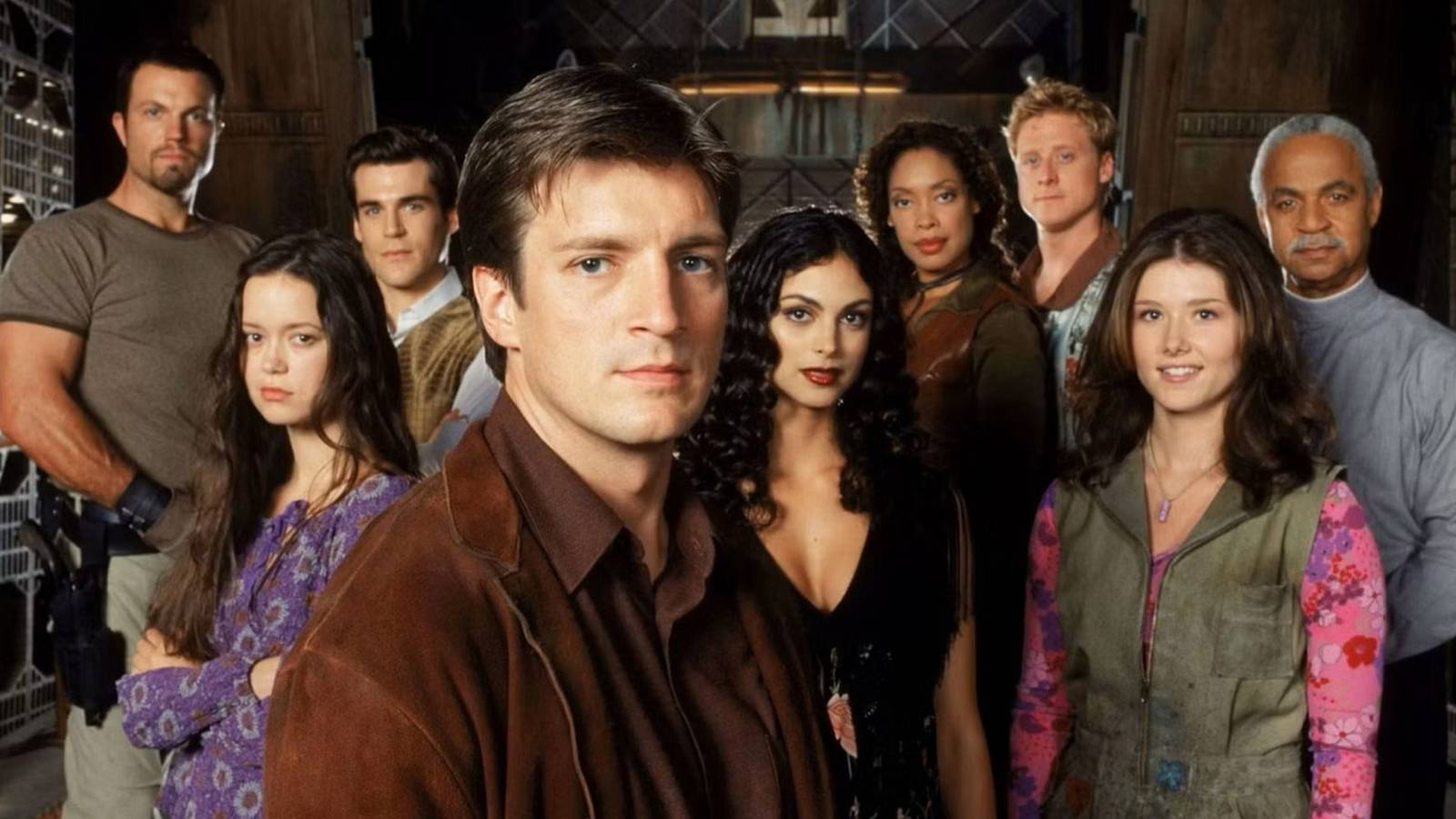
Firefly is the ultimate cult-classic sci-fi show, despite only lasting a single season before being prematurely canceled. The series, created by Joss Whedon, is set in the year 2517, where humanity has inhabited an entirely new star system controlled by a powerful central government known as the Alliance. Instead of focusing on grand wars or massive intergalactic politics, though, Firefly follows the crew of Serenity, a small transport spaceship led by former soldier Malcolm “Mal” Reynolds (Nathan Fillion). After losing a brutal civil war against the Alliance, Mal survives by taking whatever jobs he and his crew can find across the outer planets, like smuggling, theft, transport work, and even dangerous mercenary missions.
The crew itself is what makes the show so memorable. Serenity is essentially a dysfunctional family made up of people constantly navigating the emotional baggage from their pasts. Firefly also stands out from other shows in the genre thanks to its experimental genre-bending. The series combines space opera with classic Western storytelling, which was pretty unique for its time. The world feels dirty, lived-in, and grounded, which gives Firefly a very different tone compared to the sleek sci-fi shows that viewers were used to in the early 2000s. Very few canceled shows have left behind a legacy this strong, and Firefly remains one of the clearest examples of a series ending long before it could reach its full potential.

Firefly
- Release Date
-
2002 – 2002-00-00
- Network
-
FOX
- Showrunner
-
Joss Whedon
- Directors
-
Allan Kroeker, David Solomon, James A. Contner, Marita Grabiak, Michael Grossman, Tim Minear, Vern Gillum