
Kendra Pierre-Louis: For Scientific American’s Science Quickly, I’m Kendra Pierre-Louis, in for Rachel Feltman. You’re listening to our weekly science news roundup.
Last Wednesday the International Energy Agency announced that its member countries would release 400 million barrels of oil from their emergency reserves to “address disruptions in oil markets stemming from the war in the Middle East.” This is the largest release in the group’s history and the first since 2022, after Russia invaded Ukraine.
SciAm senior editor Dan Vergano is here to update us on the conflict and its oil impacts. Thank you for joining us today.
On supporting science journalism
If you’re enjoying this article, consider supporting our award-winning journalism by subscribing. By purchasing a subscription you are helping to ensure the future of impactful stories about the discoveries and ideas shaping our world today.
Dan Vergano: Good to be here with you.
Pierre-Louis: The U.S. has recently entered into a military conflict with Iran, and my understanding is that President Donald Trump has said part of the rationale for this bombing…
[CLIP: President Donald Trump speaking at a press conference: “They would’ve had a nuclear weapon within 2 weeks to 4 weeks and they would have used it long before this press conference.”]
Pierre-Louis: You recently wrote an article for Scientific American saying that isn’t the case, and I was hoping you could walk us through, like, why nuclear experts are saying that Iran was not on the precipice of having nuclear weapons.
Vergano: So the administration and President Trump have made a number of statements about how soon Iran would’ve had a nuclear weapon if they hadn’t launched this war. The thing is, we talked to experts in making nuclear bombs, and they said that that just ain’t so. What the president was describing is sort of at odds with just the raw physics or chemistry of making a bomb.
Pierre-Louis: I don’t want a “how to make a nuclear bomb” but sort of broadly speaking. [Laughs.]
Vergano: So, Kendra, when you make your nuclear bomb, what you first do is …
Pierre-Louis: [Laughs.] This is how we end up canceled.
Vergano: Yeah, don’t want that.
So it turns out there’s different ways to do it, but if you’re gonna use uranium, you have to start by digging up a bunch of uranium ore. And you can’t just stuff uranium ore into a bomb. It won’t work. So what you have to do is process it to a material that’s mostly just uranium, called “yellowcake.” And so you take that and you mix it with acid, and you make a gas, UF6. And you throw this UF6 into spinning centrifuges to bring it up first to the 20 percent enriched level, which is the first stage at which you could make some kind of bomb out of it, not a very efficient one, and then bring it all the way up to 60 percent in the case of the Iranians, which is sort of an intermediate step before you bring it up to the 90 percent enriched stage, where you have the stuff for your one standard atomic bomb.
Pierre-Louis: So what you’re saying is that the Iranians have uranium, but it’s kind of at that 60 percent enrichment stage.
Vergano: Correct. According to the IAEA—the IAEA is the International Atomic Energy Agency; these are the watchdogs for nuclear power plants—the Iranians had [an estimated] 441 kilograms of uranium at the 60 percent enriched stage.
How do you go to 90 percent enriched? You keep spinning it in centrifuges. And before June of last year, when the Iranians had pretty efficient cascades of centrifuges set up, this is something that had been estimated would’ve taken ’em about three weeks.
So they sat for years. The last decade, ever since the Trump administration canceled the first nuclear proliferation agreement with Iran, they’ve sort of kept this stuff at that 60 percent level. But they could have, at any time, started spinning it up to 90 percent, and they hadn’t.
Pierre-Louis: So to be clear, it would take about three weeks for Iran to go from that 60 percent enrichment, where they’re kind of hanging out now, to the 90 percent enrichment that you could potentially use to make a weapon.
Vergano: So prior to June of 2025, Iran could have upgraded its uranium, enriched it to 90 percent, because they had a working nuclear enterprise that had all these cascades of centrifuges going—hundreds of them, according to the IAEA. But they don’t have it anymore because we bombed them in June, and according to President Trump at the time, they were “obliterated.” So they can’t.
You could use the, the 60 percent enriched stuff to make a less effective bomb. This is a concern some people have had. But they’d have to be delivered covertly. It would be too heavy to launch on a missile, which is the other part of the equation. Iran hasn’t perfected a ballistic missile to deliver a nuclear weapon [to the U.S] as well. You have to have a way to get it to where you want it to go.
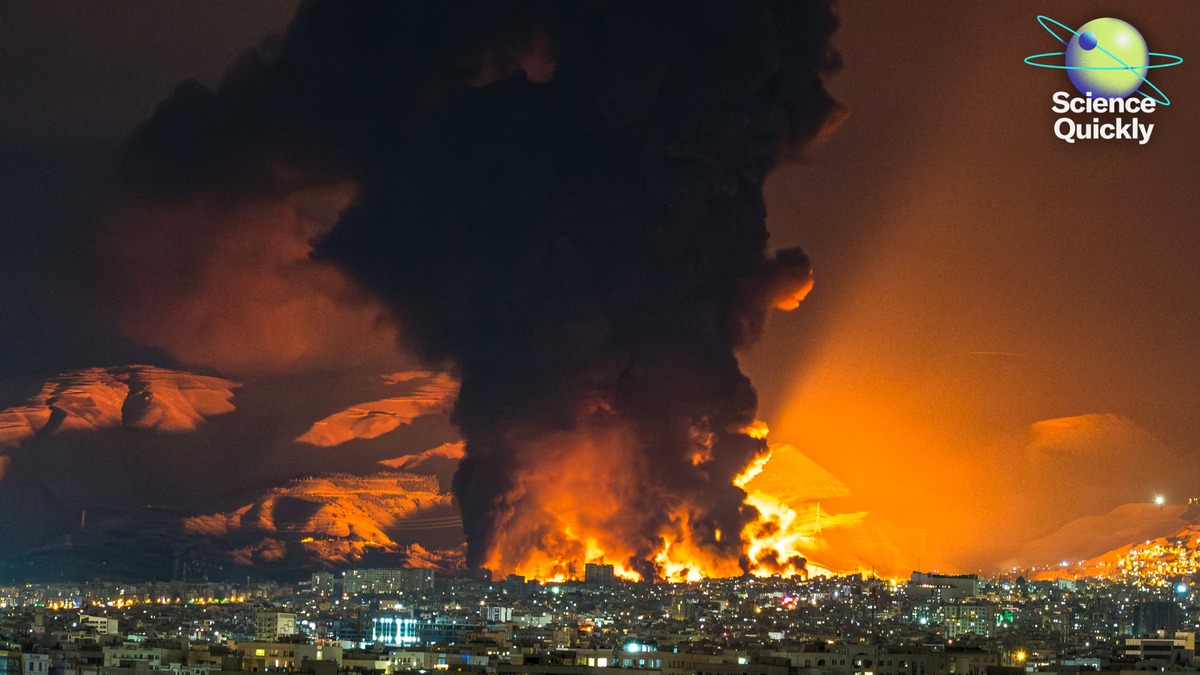
Pierre-Louis: I wanna pivot because one of the other things that we’re seeing happening in Iran is the U.S. has bombed some of the Iranian oil [facilities], and I know that the sky looks, like, black in photos. Shortly after some of the bombing, they’re talking about black rain, and I was wondering if you can talk a little bit about that environmental impact.
Vergano: So we know from the bombing of Kuwait’s oil fields in the Gulf War that, you know, it’s not good for people to be breathing in fumes from burning oil fields. It exacerbates lung ailments—asthma, respiratory diseases, all sorts of things. There’s short-term health effects of it that are real. Long term there is concern about increases in things like cancer and asthma and other sort of respiratory ailments.
Pierre-Louis: As someone who has primarily trained as a climate reporter, part of me is also wondering, like, we’re literally—in an era where we’re supposed to be reducing our use of fossil fuels, we’re literally just burning oil for no reason.
Vergano: From the climate perspective, it’s terrible. And I think the deeper point here is: we can see that turning away from renewables is a horrible mistake, not only just from a climate perspective [but] from a strategic point. If we instead had solar power and windmills and electric cars, which was a path we were on until a year ago, we’d be in a lot better shape, you know, than having to worry about a bunch of ships getting past this strait.
We have sort of exposed what a wrongheaded thing it was to, like, double down on fossil fuels, and this war makes that clear, that that was misguided.
Pierre-Louis: This has given us a lot to think about. Thank you so much for taking the time and speaking with us today.
Vergano: Thank you.
Pierre-Louis: Let’s continue with the theme of climate change.
If you were on social media last May, you may have seen viral images of the Paris region being pelted by hail as big as Ping-Pong balls, causing an estimated $350 million in property damage. When hail makes impact at high speeds, it can damage everything from a building’s roof to the exterior walls as well as dent cars and shatter windows. According to a study published last Monday in the journal Atmospheric Science Letters climate change likely increased the odds of hail forming in the first place.
Before diving into what the researchers did it helps to first understand that thunderstorms, because they tend to be both relatively small and short-lived, are difficult for researchers to model. So rather than trying to simulate the May 2025 storm, the researchers instead modeled the meteorological conditions. It’s a weather pattern that is familiar to those who live in the American Midwest or South, emerging when warm, wet air moves north, hitting cooler air masses that rest beneath strong atmospheric winds. By modeling those conditions under a cooler past scenario compared with a warmer present the researchers found that a warming climate increased the odds of hail forming under those conditions by up to 30 percent. And not only were the odds of hail accompanying the storm greater—the hail itself was also likely to be bigger.
This is not the first study to suggest that hail might be a growing risk with climate change. For example, a 2017 study in the journal Nature Climate Change that looked at the links between a warming climate and hail in North America found that while most areas were expected to see less frequent hail storms in the future, when those storms hit the hail itself would likely be larger because of climate change.
Now, let’s get to some health news.
When we get a touch excited, we have butterflies in our stomach. When we’re anxious, we feel a lump in our throat. When we make a decision based on a feeling, we say we went with our gut. Baked into the way we speak is the idea of the gut-brain connection, also known as the gut-brain axis, or the way that our nervous system links our brain with our gut and its microbiome. And new research published last Wednesday in the journal Nature suggests that, as we age, what’s in our gut may affect how we think.
At the center of the research is something called interoception, or our sense of what’s happening inside our body. In other words, interoception allows us to understand our internal bodily signals, which tell us when we feel things like hunger or pain. As we age, we get less good at this—older adults, for example, are famously bad at sensing when they are hot.
In this study, the researchers found that improving gut to brain signaling can reverse some of this cognitive decline—and that changes in the gut microbiome play a critical role in weakening that connection. They determined this by altering the gut microbiome of young mice to better mimic those of older mice. When the researchers did that, they found that the young mice behaved in ways related to a cognitive decline, such as memory loss, that we associate with aging. But when they wiped out the young mice’s older microbiome with antibiotics, it reversed the effects.
Cognitive tests showed that the mice were back to their young, sharp selves. The researchers also realized that mice bred to be germ-free did not experience the same cognitive decline with age as normal mice with conventionally aging microbiomes. The team even narrowed it down to which microbe they think is to blame for the phenomenon: a bacteria species called Parabacteroides goldsteinii that tends to accumulate in mice’s guts with age.
The study has some caveats, though, namely that it was done in mice and the researchers don’t yet know if that microbe affects human bodies in quite the same way. But it is reason enough to do additional research—and a good reminder to the rest of us of how important our guts really are.
That’s it—that’s our show. Join us on Wednesday, when we dig into the most recent happenings with GLP-1s.
Science Quickly is produced by me, Kendra Pierre-Louis, along with Fonda Mwangi, Sushmita Pathak and Jeff DelViscio. This episode was edited by Alex Sugiura. Shayna Posses and Aaron Shattuck fact-check our show. Our theme music was composed by Dominic Smith. Subscribe to Scientific American for more up-to-date and in-depth science news.
For Scientific American, this is Kendra Pierre-Louis. Have a great week!