
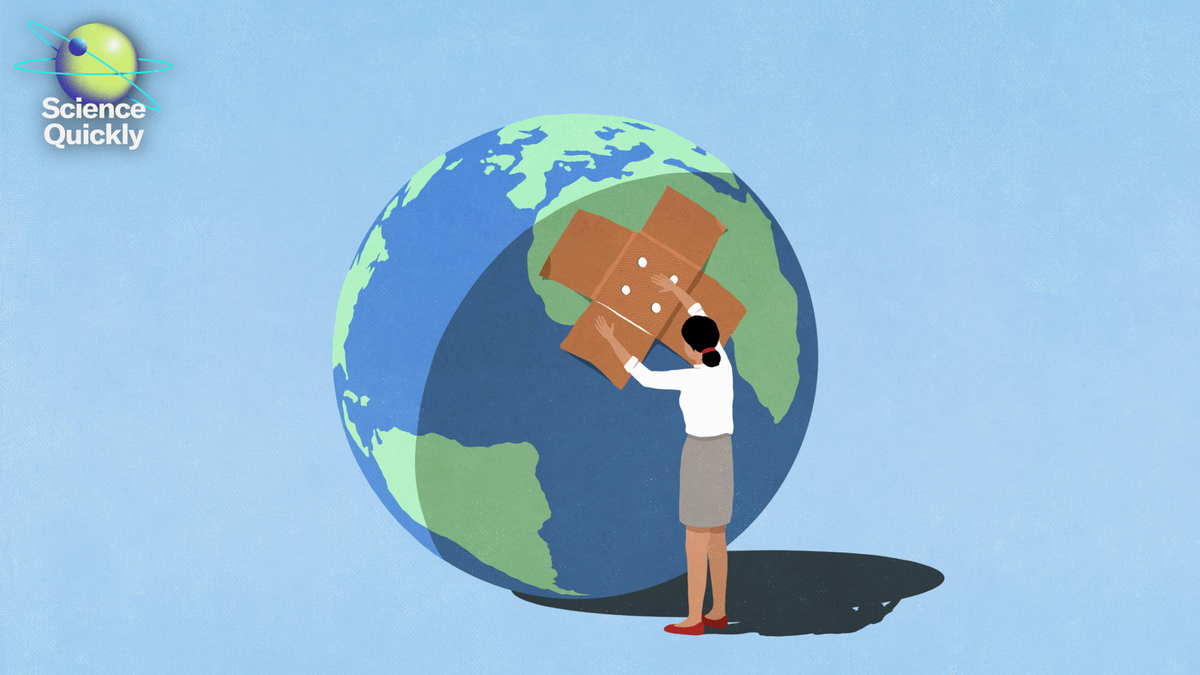
Rachel Feltman: For Scientific American’s Science Quickly, I’m Rachel Feltman. And today, in honor of Earth Day, we’re going to talk about why you should actually be excited about our planet’s future—yeah, really.
At Scientific American, we’re very aware that most folks don’t need a calendar reminder to make them think about issues like pollution and climate change. You probably read or listen to news stories about the environment more days than not—after all, we’re often the ones reporting and publishing them. And most of those stories probably don’t make you feel like celebrating at all.
But while it’s true that our planet’s environmental outlook is, in many ways, extremely dire, giving in to despair simply isn’t an option. I know that this sort of radical climate optimism, where we’re aware of and invested in environmental issues without, like, spiraling, is… tricky to figure out. I actually have a degree in environmental science, and I’ll be honest: knowing more about the field doesn’t always help me feel more optimistic.
On supporting science journalism
If you’re enjoying this article, consider supporting our award-winning journalism by subscribing. By purchasing a subscription you are helping to ensure the future of impactful stories about the discoveries and ideas shaping our world today.
But to help you actually celebrate this year’s Earth Day, we’re here to remind you that humans have as much power to save the planet as we do to destroy it. How do we know this? Because we’ve done it before.
Today we’ll hear from three environmental experts about past wins that give them hope—and what we can learn from those historic victories to help us work smarter in the future.
Our first story comes from climate scientist Kate Marvel, a former NASA research physicist who is now with the nonprofit Project Drawdown. And this story is about how London managed to stop looking like a production of Sweeney Todd.
Kate Marvel: When you think about the famous London fogs that you imagine during the Victorian [era], with Jack the Ripper and all sorts of dark things going on, those are actually not fog in the sense of low-cloud San Francisco fog; those are smogs. Essentially, those are created by pollution.
Feltman: While the industrial revolution—powered largely by coal—kicked off Britain’s smog problem, air quality would continue to worsen until the so-called Great Smog of 1952. That’s when a meteorological phenomenon known as a temperature inversion occurred. Basically, this is when there’s warmer air higher up in the atmosphere and cooler air down below. The warm air acts like a lid and keeps pollution from escaping.
Marvel: Essentially, the sky turned orange. The fog got incredibly thick—you couldn’t see anything—and thousands, or even tens of thousands, of people got sick or died.
Feltman: It wasn’t actually news to anyone that London had dirty air, but this tragedy pressured the government into forming a committee about it. The members found that the smog was mainly driven by smoke from the cheap, dirty coal that people were using to heat their homes.
Marvel: This real gross, real dirty, real soot-burning stuff called, of all things, nutty slack.
Feltman: Switching to a different method for heating would be the ideal solution, obviously, but the committee found that even changing to less nasty coal would make a big difference. So that seems pretty straightforward, right?
Marvel: Well, initially they were ignored, and the reason it was ignored was that Britain was in a real bad state at the time. It was still struggling to recover from World War II. It had huge debts, so it was selling a lot of the, quote, unquote, “better quality” coal on the export market, so people were burning nutty slack in their houses. And the government thought, “Well, this is unacceptable. We can’t tell people not to do that, and we can’t not export the better quality coal, and it seems like tyranny, the tyranny that we just fought and defeated, to tell people what to do in their own houses.”
Then what happens is we get a very unlikely—I don’t want to say hero. Let’s call him a protagonist. So this man is called Sir Gerald Nabarro. He has the most magnificent upper-class British mustache you have ever seen in your life. He was not an aristocrat. He was essentially a grifter who grew up very working class and just decided to remake himself as a fake aristocrat. And he wasn’t a very nice man. He was a big favorite of the British right-wing tabloids. He loved to pontificate about “kids these days” and “bring back the death penalty” and blah, blah, blah, blah, blah.
Feltman: In other words, Nabarro was far from some kind of bleeding-heart environmental-justice warrior. He just thought it would be cool if the air sucked a little less.
Marvel: What he did is come to the realization that, look, dirty air inconveniences everyone. It even inconveniences the aristocracy.
Feltman: He actually whipped out a 13th-century anecdote about a time when Nottingham’s air was so choked with coal that the queen herself reportedly had to be forced to evacuate. And obviously, you can’t have that.
Marvel: So he introduced a bill in Parliament, which essentially shamed the government into doing something about this problem.
Feltman: That led to the Clean Air Act 1956, which prioritized smokeless heating methods where possible and shifted coal-burning homes over to less nasty stuff than nutty slack. And just as the Beaver Committee had suggested, that did the trick.
Marvel: We saw pretty dramatic improvements in air quality within a decade.
Right now there is no coal in use in Great Britain at all. And so I find that to be a really neat end to the story. The coal that has been powering the country since Roman times, the coal that very much powered the industrial revolution is now obsolete.
Feltman: But Kate says her favorite thing about this story is that it reminds us climate wins can happen even when individual efforts seem to be failing.
Marvel: It’s really the combination of factors. It is the big marquee headline event, the Great Smog of London. It’s the formation of kind of a British medical establishment, very science-based, public-health-minded professionals, really advocating for this. It is this weirdo, Sir Gerald Nabarro, trying to pass this parliamentary bill. And it’s the Beaver Commission, their reports really sort of penetrating public consciousness and creating public pressure. And at the same time, there’s kind of the glimmer of new technologies on the horizon—the advent of central heating. And it’s really this combination of stuff that is a perfect storm in a way that allows the passage of the Clean Air Act in 1956.
And I think the thing to take away from that is that it’s never just one thing. It’s never just one hero. It kind of is everybody and everything acting at once. And that can seem really disempowering. Like, what can one person do? But you never know if you are going to be the one person who is going to tip the scales. You have to keep going. You have to keep fighting. Because, honestly, what is the alternative?
Feltman: And if hope feels out of reach, Kate suggests finding other emotions to keep you going instead.
Marvel: Whenever I am tempted to give in to despair and say, “Oh, it’s hopeless,” I look around, and I remember, “Who are the people who benefit if we stop fighting?” And I look at them, and I think, “I don’t like those people. I’m not gonna give them what they want.” And so I think spite is a really underrated motivation in keeping going. So maybe we don’t need hope. We just need spite.
Feltman: Let’s get into our second historical climate win. This one comes from Susan Solomon, the Lee and Geraldine Martin professor of environmental studies and chemistry at MIT.
In 1986 Susan was leading expeditions to the Antarctic for the National Oceanic and Atmospheric Administration. Scientists had recently identified a hole in the ozone layer there.
Ozone is a form of oxygen that absorbs UV radiation, and its presence in the stratosphere protects us from the sun’s rays. In 1985 researchers found that every year between September and December ozone levels were dropping in one particular patch of the stratosphere over Antarctica.
Susan Solomon: What we found, which was both exciting and obviously quite concerning, was evidence that the chemistry of the stratosphere was totally out of whack compared with what it is in other places.
Feltman: All that wacky chemistry helped Susan and her colleagues build an airtight case against the main culprit: chlorofluorocarbons. Now, I personally love saying the word “chlorofluorocarbon,” but they’re also known as CFCs.
These compounds were once widely used in air-conditioning, refrigeration and all sorts of aerosolized cans. And the fact that they were causing ozone issues wasn’t actually a shock to the scientific community or even the public.
Way back in the early 1970s researchers had shown that CFCs released down on the ground would, over time, make their way into the stratosphere—and that once they were up there, UV radiation from the sun would shave off their chlorine atoms. Those chlorine atoms would then react with ozone, and they would not play nice.
Solomon: Because people were so environmentally conscious in the United States at that time, they actually took it very seriously. And they learned that one thing that they could do would be not to use spray deodorant, to use the stick instead, and not to use hairspray.
In the United States we banned CFCs in spray cans in 1978.
Feltman: But while those papers in the 1970s predicted a small effect—one that might cause problems decades down the road—the ozone depletion scientists actually observed was fast and catastrophic.
Solomon: The ozone hole coming along in the middle of all this, you can just imagine what a furor that created. You know, it wasn’t, you know, 5 percent less ozone in 100 years. It was 50 percent less ozone now, you know, and in a place that no one ever said it would happen first, namely, the Antarctic. So then we had to scramble to try to figure out why
Feltman: Susan’s team helped show that this decline in ozone bore all the telltale markings of the theorized CFC debacle but at breakneck speed.
Solomon: It really all hung together as telling a story of a tremendously perturbed stratosphere due to human activities, namely, the production of chlorofluorocarbons.
Feltman: And once again people listened.
Solomon: People were fascinated by it, actually, everywhere that, you know, I went, whether it was sitting next to somebody on an airplane or, you know, whatever—my neighbors. So it attracted a tremendous amount of public attention, and it also attracted the attention of the United States Congress.
Feltman: And finally, in 1987 came the Montreal Protocol, where all 198 international members of the United Nations agreed to gradually phase out the use of CFCs. It happened piece by piece, year by year, but it happened.
Solomon: And amazingly, we can show, with 95 percent confidence, now the Antarctic ozone hole is beginning to heal. And I did some work on that together with a graduate student that was published in Nature last year. That was a real incredible moment for me because, you know, I was there in 1986, and in 2026 I saw this paper appear that actually shows that we can be confident we’re seeing recovery.
Feltman: Susan says the big takeaway is that public pressure was crucial in securing this win.
Solomon: Whenever I would talk to people about the ozone hole, they would say, “That’s so great. Why can’t we do the same thing about climate change?” I always say science alone is never enough to solve an environmental problem, but it’s always necessary. We had to have the science to explain what was going on. But after that a key, key thing is: What does the public demand? How interested in environment is the public? I think that people have to want things to change and they have to make their opinion known.
Feltman: Our third story comes from author, environmentalist and activist Bill McKibben. His 1989 book, The End of Nature, is widely considered to be the first book about global warming written for the general public. For those in search of climate optimism, he says, the clean energy sector is a great place to look.
Bill McKibben: Five years ago we crossed some invisible line where it became cheaper to produce energy from the sun and the wind than from setting things on fire—coal, gas, oil. That’s a pretty epochal moment in human civilization. I mean, it’s really worth stopping for a minute to understand that we live on a planet where the cheapest way to make energy is to point a sheet of glass at the sun.
The last 36 months have just seen an explosion in the amount of energy from the wind and the sun that we’re producing. It’s alternative no longer. It’s now the commonsense, straightforward, obvious way to power the future. About 95 percent of new electric generation around the world came from these renewable sources last year.
Feltman: Most of that surge in clean energy is coming from China, but parts of the U.S. are getting on board, too.
McKibben: California now most days produces all the electricity that it uses for long stretches from renewable sources. As a result California’s using 40 percent less natural gas to produce electricity than they were two or three years ago.
So those are the kind of numbers that won’t stop global warming—too late for that—but may allow us to shave tenths of a degree off how hot the planet eventually gets. And every tenth of a degree that we raise the temperature moves 100 million of our brothers and sisters from a safe climate zone to a more perilous one. So that is a very big deal.
Feltman: From Bill’s perspective, the economics here are so clear that fossil-fuel companies are terrified.
McKibben: The actions of the Trump administration and of the fossil-fuel industry that they’re closely intertwined with are really a reaction to this sudden surge in renewable energy around the globe. If you’re the fossil-fuel industry, it’s a mortal threat because someone’s come along with a better business model. They can’t compete on price, and they certainly can’t compete on pollution.
What they can compete on is political gamesmanship, so that’s what they’re engaged in. They’ve shut down wind farms, that kind of thing. On the other hand, the other things that the Trump administration is doing, especially the invasion of Iran, is having the opposite effect, I think. It’s reminding people across the world that they don’t wanna depend on a commodity that’s so easily embargoed. Sunlight travels 93 million miles to reach the Earth, but none of those miles are through the Strait of Hormuz.
Feltman: If we just sat back and allowed the free market to play out, Bill says, we’d probably be powering the whole planet with wind and solar in about 40 years.
McKibben: But if we let it take anything like 40 years, then the planet we run on sun and wind will be a broken planet. That’s what the climate scientists tell us every day in different ways. So right now is the moment for all of us around the world to seize this opportunity.
Feltman: Bill finds a lot of hope in one very small use case for solar. One that you might literally find in your backyard soon.
McKibben: I’m very happy to watch the rapid spread of what we’re calling balcony solar or plug-in solar. Now, this is not going to solve all the problems of the world; it’s the smallest increment of clean energy available. But 3 or 4 million Europeans have hung solar panels from the railings of their apartment balconies over the last couple of years.
They just go to Best Buy, whatever you call Best Buy in Belgium, and you come home, for a few hundred Euros, with a solar panel designed to be zip-tied to that apartment railing. And on the back there’s just a plug, and you just plug it into the wall, no electrician required. And it produces 20 percent, 25 percent of the electricity an apartment might use.
Feltman: Up until recently these plug-and-play solar panels were in a regulatory grey area in the U.S. that created a lot of barriers to entry. But that’s starting to change, thanks to activists, including those at Bill’s own climate advocacy group for people over 60, called Third Act. Utah moved to make it easier to use plug-in solar panels in 2025, and Virginia and Maine recently followed suit.
McKibben: This is very, very rapid progress for a quite beautiful technology.
Feltman: Balcony solar can only replace a small percentage of our fossil-fuel use. But what’s great about this tech is that it’s entirely driven by the demand of individual consumers. People around the world, and increasingly around the U.S., can look at the clear-cut economic wins of solar energy and decide to take advantage of them. These solar-power cells might be tiny, but they also put power right into the hands of the people most impacted by climate change.
McKibben: There are moments when I feel hopeless myself. The physical momentum of the changes that we’ve set off in the planet’s climate system are very large and very daunting.
But we have this one new wild card that we haven’t had in the past, and we don’t know yet how, how quickly we can deploy it, but the signs are from all over the world that it could happen very fast. Pakistanis working without a government program, just using YouTube videos to assemble the cheap Chinese solar panels they were importing across their border with China, managed to build the equivalent of about half the country’s national electric grid in 18 months.
Feltman: Bill wants us to remember how much power we can have when we band together with a common goal. He points to the movements of the 1960s and ’70s as proof.
McKibben: One of those events was Earth Day in 1970, which drew 20 million Americans, about 10 percent of the then-population of the U.S., into the streets and within 18 months had produced the Clean Air Act, the Clean Water Act, the Environmental Protection Agency. All the laws that the Trump administration is trying to gut now came out of that remarkable display of public demand.
One of the things that triggered all that was the picture that came back from Apollo 8 of the Earth seen from space for the first time.
Feltman: Fortunately, we did just get a few new shots of our pale blue dot, thanks to the Artemis mission.
McKibben: Maybe that’ll help a few of us think through things again.
Feltman: That’s all for today’s episode. We’ll be back in your feed on Friday.
Science Quickly is produced by me, Rachel Feltman, along with Fonda Mwangi, Sushmita Pathak and Jeff DelViscio. This episode was edited by Alex Sugiura. Shayna Posses and Aaron Shattuck fact-check our show. Our theme music was composed by Dominic Smith. Subscribe to Scientific American for more up-to-date and in-depth science news.
For Scientific American, this is Rachel Feltman. Happy Earth Day!