
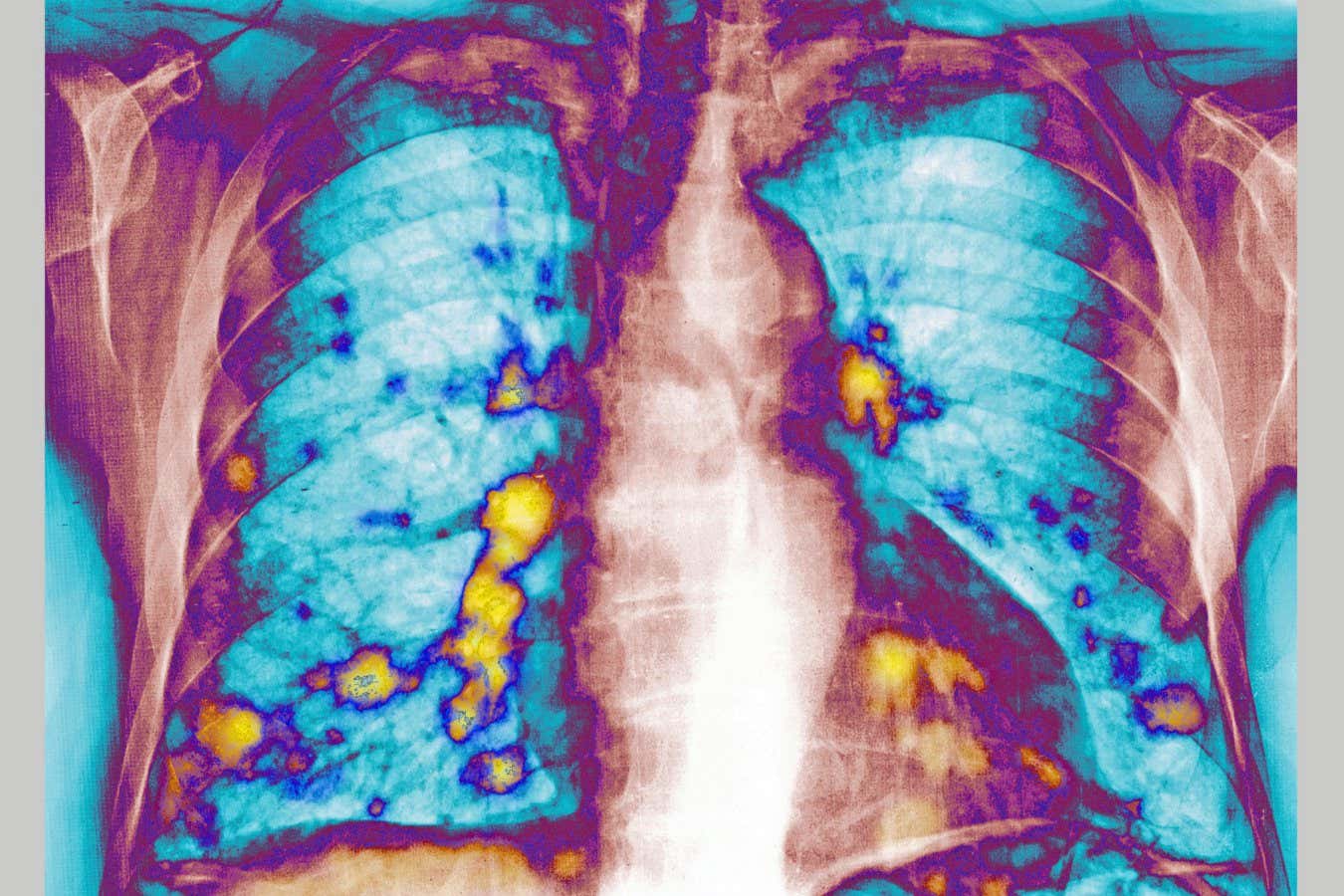

The lungs are one of the most common places for cancers to spread to from elsewhere in the body
CAVALLINI JAMES/BSIP/Universal Images Group/Getty Images
Respiratory infections seem to temporarily reduce the spread of cancer to the lungs from elsewhere in the body. Infecting mice with respiratory syncytial virus (RSV) – which causes cold-like symptoms and infects nearly everyone by age 2 – helped to prevent breast cancer cells from taking hold in their lungs. This has raised hopes that the same mechanism, which involves activating infection-fighting proteins, could one day be utilised in a drug.
Most cancer deaths occur when tumour cells spread from their original location in the body. They can often be treated with surgery or radiation in the early stages, but once the cancer has spread, “everything is much more difficult, and treatment success really diminishes”, says David Withers at Oxford University, who wasn’t involved in the research.
The lungs are one of the most common sites for cancer to spread to, which has made the role of respiratory infections like flu, covid-19 and cold-causing viruses an area of considerable interest to scientists.
Now, experiments on mice have shown that RSV appears to trigger an immune response that temporarily makes it harder for cancer cells originating in the breasts to spread to the lungs. “This is very exciting; no study has shown what we have shown,” says Cecilia Johansson at Imperial College London.
The researchers intranasally infected 23 mice with RSV, while 16 were given a saline solution, acting as the control group. Twenty-four hours later, the team injected all the mice with breast cancer cells. After 28 days, the mice with RSV had 65 to 70 per cent fewer tumour nodules in their lungs than the control group.
However, the nodules that did form were similar in size in both groups, indicating that once the cells had entered the lungs, the virus had little effect on their growth. This comes after another recent study found that the viruses behind swine flu and covid-19 may activate the growth of cancer cells that had been lying dormant after spreading to the lungs from elsewhere.
Next, Johansson and her colleagues wanted to uncover the role of type I interferons – proteins that help stop viruses from replicating after being detected in lung cells. They found that these interferons make it considerably harder for cancer cells to seed new tumours.
To determine whether giving type I interferons directly to the mice had the same effect as an RSV infection, the researchers administered two doses intranasally to another group of mice, 18 and 24 hours before cancer cells were injected. Another group was given a saline solution. Twenty-eight days later, the interferons had been “slightly more” effective than the virus in limiting entry of nodules to the lungs, says Johansson.
“The authors reveal that the type I interferon response, characteristic of acute viral infection, drives changes in the lung epithelia [sheets of cells that act as a lining] that impede tumour cell seeding,” says Whithers. “Whilst this research is at an early pre-clinical stage, it highlights an exciting potential way to manipulate tissue and help shield patients from metastatic spread. Any progress with reducing metastasis has potential for enormous clinical benefit.”
Although there are probably many ways that type I interferons prevent the seeding of tumour cells, the researchers’ experiments zeroed in on one that seems to be particularly effective. This involves galectin-9, a protein produced in response to interferons.
Johansson hopes this could one day be mimicked and turned into a drug to prevent breast cancer and other kinds of tumours from spreading to the lungs. “Excitingly, while these are early pre-clinical experiments, these factors can be tested in the absence of virus infection as new drugs to help stop the spread of cancer,” says Clare Bennett at University College London, who wasn’t involved in the research.
The same approach could theoretically protect the lungs against the spread of cancer from other parts of the body, although Johansson stresses that further research is needed. She also points out that intranasally putting type 1 interferons into the lungs may not be an option, because it could trigger damaging inflammation in the airways.
The team is now planning more studies to further our understanding of the role interferons play in cancer spread. “We want to find out if we can mimic the effect using IFN [interferon]-inducing agents, [and] other types of IFNs, and if it is possible to target the epithelial and stromal [connective tissue] cells of the lung to induce this effect,” says Johansson. “We also want to extend these findings to human studies and find therapeutic targets in the human setting, but this is more in the future.”
Topics: