
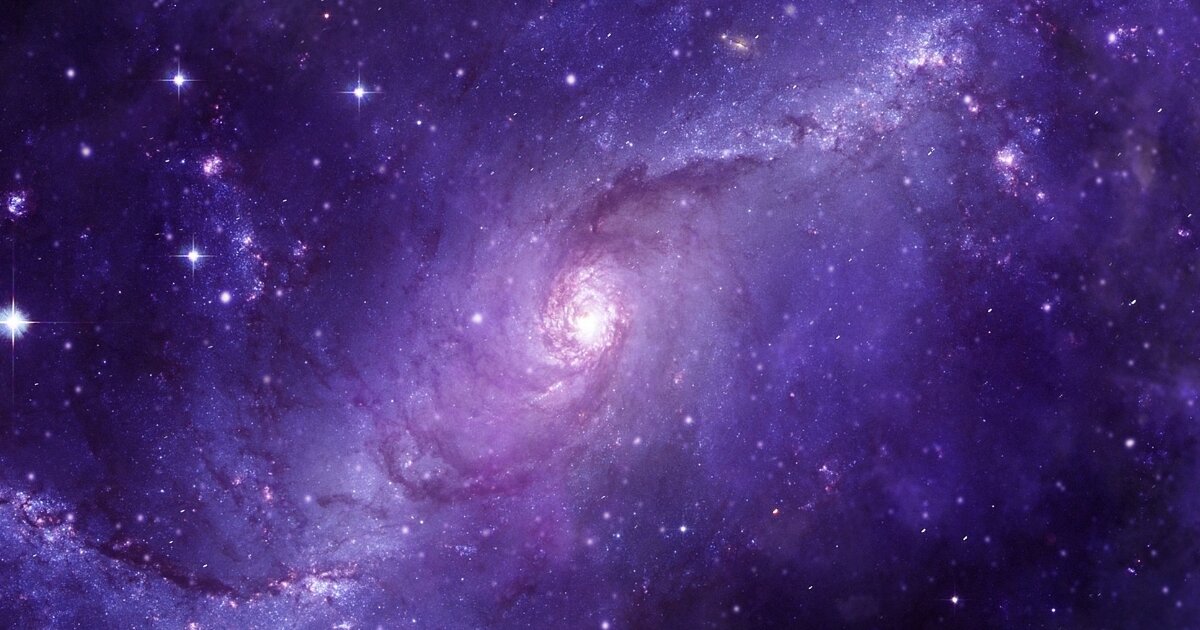
Observations of a far-distant galaxy several times the size of the Milky Way reveal a surprising stillness overcoming the sea of early stars.
Using spectral data collected by the James Webb Space Telescope (JWST), an international team led by scientists at the University of California, Davis, measured the relative movement and distribution of matter in three distant galaxies as they appeared roughly 1.8 billion years after the Big Bang.
One clearly rotated as expected. Another was described as “kind of messy”.
It was the third that really caught the astronomers’ attention. Spotted as part of a previous survey, the galaxy XMM-VID1-2075 was earmarked for its immense size and the fact that it was no longer producing new stars. It was also surprisingly devoid of spin.

Forrest et al/Nature Astronomy
While it’s not unusual to find nearby behemoths brought to a halt by eons of collisions, the Universe was barely 2 billion years old at the time XMM-VID1-2075 was observed, raising questions regarding the forces that may have robbed it of its rotation.
“This type of work has been done a lot with nearby galaxies because they’re closer and larger, and so you can do these kinds of studies from the ground, but it’s very difficult to do with high redshift galaxies because they appear a lot smaller in the sky,” says study lead author Ben Forrest.
Newborn galaxies typically begin to rotate as material in their expansive cloud of dust and gas falls inward, transferring angular momentum as it whips around a dense core.
Through the eons, a succession of collisions and mergers with other galaxies can send stars flying in random directions, potentially slamming the brakes on this cosmic whirlpool.
Time is a critical factor, though. While plenty of battle-scarred slow-rotators have been seen sitting relatively close by, astronomers never expected to stumble upon anything like it so far away.
“There are some simulations that predict that there will be a very small number of these non-rotating galaxies very early in the Universe, but they expect them to be quite rare,” says Forrest.
One possibility is a chance impact with a counter-spinning neighbor. With each galaxy swirling in opposite directions, any rotation would be cancelled out.
It’s an explanation supported by the distribution of light in XMM-VID1-2075, too.
“For this particular galaxy, we see a large excess of light off to the side,” says Forrest. “And so that’s suggestive of some other object which has come in and is interacting with the system and potentially changing its dynamics.”
It’s yet another way the JWST is challenging our understanding of the early Universe, from galaxies that are “impossibly massive” to those that are “impossibly mature”.
As our catalogue of ancient objects continues to grow, models describing our cosmic origins will be fine-tuned in ways that will almost certainly make your head spin.
This research was published in Nature Astronomy.
Source: University of California, Davis
Fact-checked by Bronwyn Thompson