

NASA’s moon plans relegate space planes to an almost-forgotten future
After all these years, Dream Chaser—a commercial U.S. space plane—is still chasing the dream of spacecraft that can fly from orbit to airports
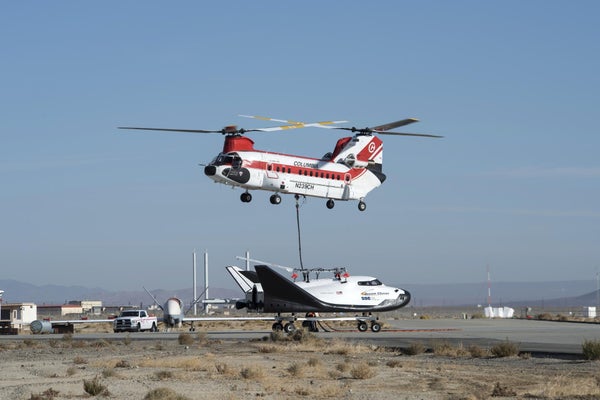
Sierra Nevada Corp’s Dream Chaser space plane is lifted by helicopter from a ramp at NASA’s Armstrong Flight Research Center in Edwards, Calif., before a successful approach and landing flight test on Nov. 11, 2017.
Late last month Dream Chaser, a commercial U.S. space plane, received no mention during NASA’s in-depth “Ignition” briefing, which set out the agency’s comprehensive plans to return to the moon. Dream Chaser will not be part of that push—there’s little use for aerodynamic flight on Earth’s airless moon, and despite its decades in development, the space plane has yet to reach space. The rise of reusable conventional rockets during that time has also undercut much of Dream Chaser’s notional utility, further dimming the project’s prospects. But NASA’s boldly moon-focused event did offer one potential lifeline: the possibility that Dream Chaser might still one day dock with the International Space Station (ISS).
Space planes that can fly back and forth between Earth and orbit have been part of the dream of space travel since the 1930s. NASA’s space shuttle program, which flew 135 orbital missions between 1981 and 2011, transformed those dreams into reality. But the shuttle program ended after the agency decided it was too expensive—and, after the Challenger and Columbia disasters, too dangerous—to continue.
Dream Chaser’s first flight to space is now targeted for an unspecified date later this year, but its path to launch has been very long. NASA developed its “lifting body” design in the 1980s as the HL-20 Personnel Launch System—a low-cost alternative to the shuttle. After the shuttle program, NASA kept the space plane idea going, but never again at so grand a scale—and, in 2004, a private company called SpaceDev picked up the HL-20 where the space agency left off. This would become the Dream Chaser project.
On supporting science journalism
If you’re enjoying this article, consider supporting our award-winning journalism by subscribing. By purchasing a subscription you are helping to ensure the future of impactful stories about the discoveries and ideas shaping our world today.
Since then, Dream Chaser’s development has been funded by private investment and the Sierra Nevada Corporation, which acquired SpaceDev in 2008. NASA did chip in some money, however, and Dream Chaser was once a contender for crewed flights to the ISS. But across the years, as the space plane has missed one major technical deadline after another—often because of difficulties with its heat shield—the dream has faded.
A recent setback was the loss of contracts for resupply missions to the ISS. According to Sierra Space—the division of the Sierra Nevada Corporation that now operates the spacecraft—an unpiloted version of Dream Chaser had been slated to resupply the ISS at least seven times, using a detachable module to deliver up to six tons of cargo. But those plans were set aside last year while the future of the ISS was debated, and Sierra Space announced a pivot to national defense and security applications in orbit.
Planetary Society policy analyst Casey Dreier thinks there may be future opportunities for Dream Chaser, but that the long-sought demonstration flight hoped for later this year might also be its last: “That is a possibility,” he says.
When—or if—it finally launches, the automated version of Dream Chaser is expected to perform a few maneuvers in orbit, before flying down to a runway landing at the Vandenburg Space Force base in California—one of two locations prepared for its arrival. NASA has not responded to recent inquiries about the status of the project, and Sierra Space has declined to comment—although there’s also been nothing to suggest the demonstration flight has been abandoned. NASA is now in the middle of returning to the moon, and the agency may not see this as a good time to comment on Dream Chaser.
Dreier thinks Dream Chaser will struggle without NASA’s support. Sierra Space have proposed the spacecraft could be retrofitted for other tasks, including national security missions, and Dream Chaser’s relatively gentle landings from orbit would be a key selling point for delicate onboard experiments. But Dreier says the Dream Chaser cargo space may not be suitable for many missions. He notes another opportunity, however: a bill to extend the life of the ISS, perhaps until 2032, is working its way through the U.S. Congress. If that goes ahead, NASA will need to make contracts for additional resupply missions, and it’s possible that Dream Chaser could be selected for those, he says.
But NASA could also use the tried-and-true Dragon spacecraft from SpaceX or the Cygnus spacecraft from Northrop Grumman for ISS resupply flights, both of which would cost less to launch. It’s estimated to cost about $90,000 to send a kilogram of cargo to the ISS by Dragon and about $130,000 by Cygnus. In theory, the automated Dream Chaser spacecraft could be cheaper—maybe as low as $40,000 per kilogram—because it would have used its detachable module to deliver more than twice as much cargo on each flight; but the numbers worked only because the automated Dream Chaser was going to resupply the ISS seven times.
NASA’s Ignition briefing in late March did mention another idea: a “core module” attached to the ISS that would allow commercial partners to build and run their own fledgling space stations there before detaching them for independent operations when the ISS ends. Sierra Space is a big investor, along with Blue Origin, in the planned Orbital Reef commercial space station, and the Dream Chaser design could be part of that. Putting the pieces together, one vision for the future would see a Dream Chaser space plane docking at a custom-made extension to the ISS—and perhaps, one day, at a separate Orbital Reef space station.
Sierra Space has more irons in the fire than just Dream Chaser. It recently announced its success in a $550 million private funding round to enhance its national security and defense capabilities. This is a domain where space plane technologies may have an important role: the U.S. Air Force already operates at least two secretive Boeing-built X-37B drone space planes, and China is experimenting with an uncrewed space plane provisionally called the Shenlong (Chinese for “Divine Dragon.”) Why the Pentagon would want more space planes, let alone ones descended from the problem-plagued Dream Chaser, is a question for which no clear answers exist.
Even so, such defense-focused concerns may keep the dream alive, for now. “In general, space planes are technologically more difficult than capsules,” says space analyst Phil McAlister, who once oversaw the Dream Chaser project for NASA. But their ability to land like an aircraft gives them an advantage: “If Sierra Space can demonstrate Dream Chaser’s design and make it cost-effective, I believe there will be many commercial markets that will emerge,” he says.
Aerospace consultant Amanda Simpson, however, fears the dream may be coming to an end. She says that, while the idea of landing at airports is appealing, spacecraft have already been making precise soft-landings on rockets for several years—although, so far, without any crew on board. And she notes that the wings and sleek fuselages of space planes are “dead weight” in orbit, which makes it harder to justify the cost of launching them: “Like everything else in commercial aerospace, it’s got to be economic.”