
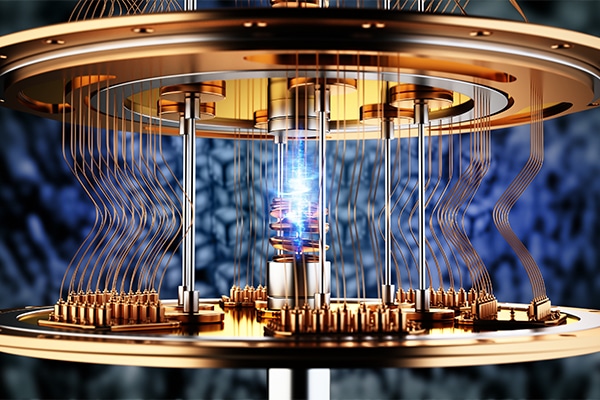
Quantum computing challenges our old assumptions about what machines can and cannot do. How will it transform intelligence, security, and creativity in ways we are only beginning to imagine?
Quantum computing is a breakthrough that works in a way completely different from classical computing. Instead of simple bits that hold either a 0 or a 1, qubits, defined by the rules of quantum physics, can act as both waves and particles. They can hold 0 and 1 at the same time, a property called superposition. This strange duality gives quantum systems exponential efficiency, making it possible, for example, to search through 2^n possibilities in just a few iterations. Searching is only one of many powerful applications; others already include cryptography, materials simulation, and complex optimisation.

General-purpose quantum computing is still in its early days. The technology is starting to demonstrate its practical applications, highlighting the problems it can already solve and where its limitations remain. Issues such as error correction and decoherence remain significant hurdles, but there is real potential in combining quantum and classical systems to tackle problems that neither could address alone.
Quantum computers will not replace laptops or desktops anytime soon, but they are already demonstrating the ability to tackle problems across science and technology that classical machines cannot solve.
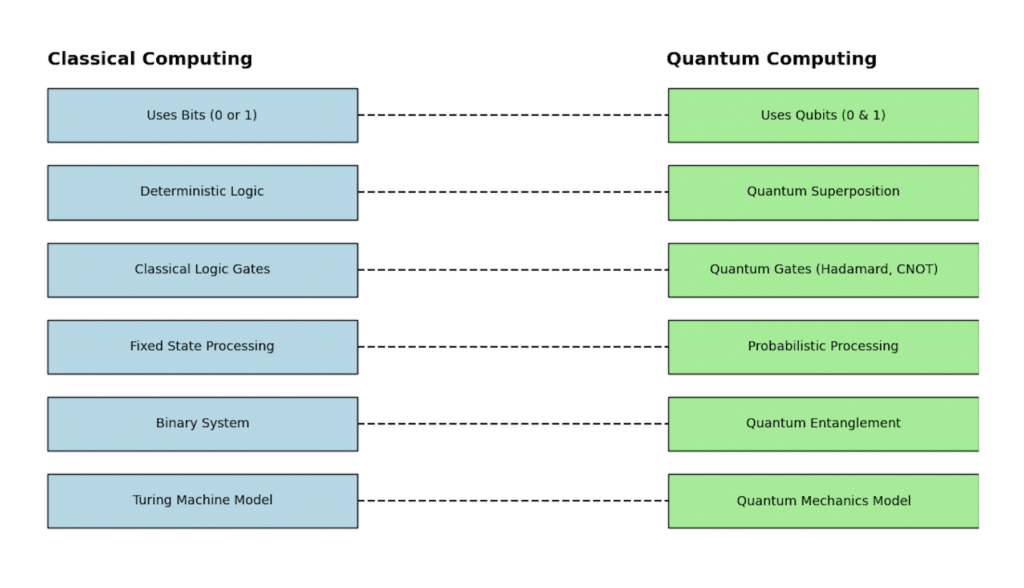
Classical computers rely on bits that are strictly 0s or 1s. Quantum systems, by contrast, use qubits, which can exist in multiple states through superposition. This ability to calculate in parallel enables quantum computers to handle tasks such as simulations, optimisation, and cryptography at speeds many orders of magnitude faster than classical systems.
Although still experimental, quantum systems offer enormous potential. In cryptography, they could redefine digital security. In machine learning, they may accelerate the training of complex models and reshape how artificial intelligence develops.
The challenges, however, are considerable. Quantum states are fragile, easily disrupted by noise and prone to decoherence. Current machines require cryogenic cooling and other extreme conditions, making them hard to scale. While algorithms such as Shor’s and Grover’s hold the promise of exponential acceleration, practical use remains limited.
The likely path forward is not one where quantum systems replace classical ones, but where the two work together, each tackling the kinds of problems they handle best.
Related work
Academic and corporate research into quantum computing has grown rapidly. Shor’s (1994) and Grover’s (1996) algorithms demonstrated the theoretical potential of quantum acceleration in factoring and searching tasks. These algorithms provided evidence that quantum computers could outperform classical systems in specific domains.
Industry leaders such as IBM, Google, Microsoft, and D-Wave are advancing quantum technologies. IBM provides cloud-based access to its quantum systems via the IBM Quantum platform, enabling developers to experiment with algorithms. Google’s Quantum AI division explores quantum machine learning and optimisation. D-Wave Systems specialises in quantum annealing for combinatorial optimisation, with organisations like Volkswagen and Boeing applying these systems to traffic optimisation and aircraft design.
The IBM Q Network connects businesses and universities to quantum resources for research and applications. Microsoft’s Quantum Development Kit provides tools for programming and a new language, Q#, aimed at supporting scalable quantum development.
The foundations of quantum computing are based on principles of quantum mechanics, including superposition, entanglement, and interference, combined with linear algebra and quantum gate theory. Current research prioritises error correction, reliability, and scalability.
Theory and methodology
Quantum computing builds on quantum mechanics, the study of matter and energy at the smallest scales. Classical computing encodes information in bits, while quantum computing encodes in qubits. Unlike bits, qubits can exist in superposition, being 0, 1, or both simultaneously.
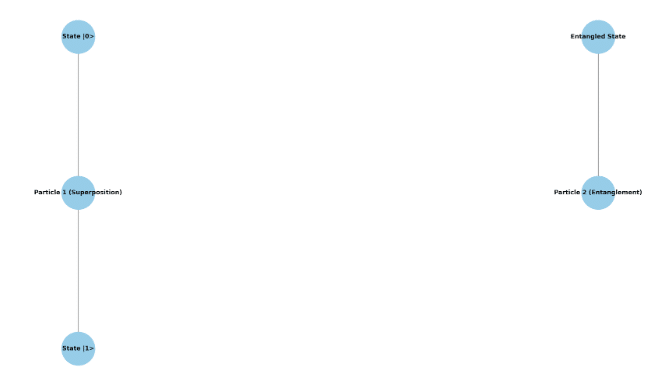
Superposition allows qubits to exist in multiple states at once. Entanglement, another key principle, links the state of one qubit to another regardless of distance. Measuring one instantly affects the other.
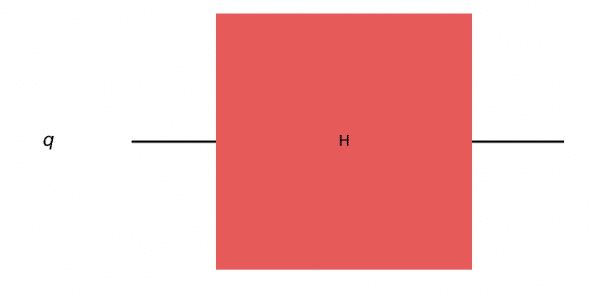
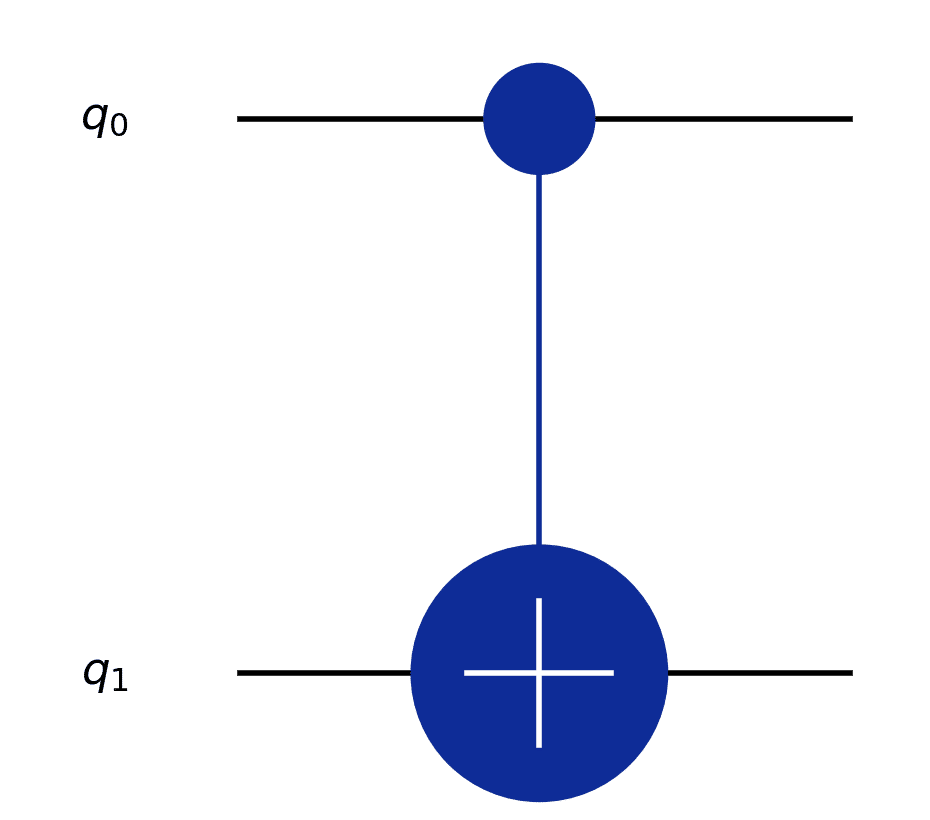
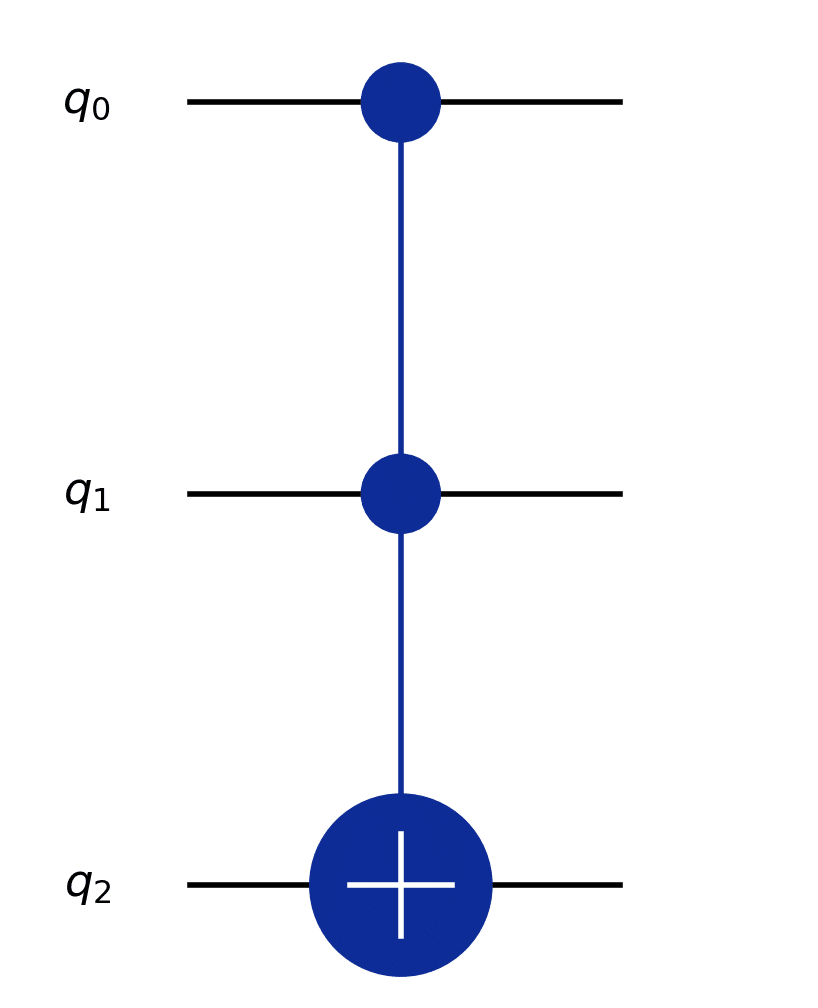
Quantum gates manipulate qubits, much like classical gates act on bits. Gates such as the Hadamard generate superposition, while the CNOT gate enables entanglement. The Toffoli gate provides more complex operations. These gates form circuits, which underpin algorithms.
Hamdard gate
CNOT Gate
Tofolli Gate
Algorithms like Shor’s, for factoring large numbers, and Grover’s, for accelerating searches, illustrate quantum advantages over classical approaches. However, decoherence —the loss of quantum information due to environmental interference —remains a significant barrier. Researchers are developing error correction codes to preserve fragile quantum states.
Quantum research typically involves designing circuits of gates, then simulating them on classical systems or running them on real hardware. Leading platforms include IBM, Google, and D-Wave processors.
Experimental setup and results
Contemporary quantum systems employ different approaches, including superconducting qubits, trapped ions, and quantum annealing.
IBM’s quantum computers rely on superconducting qubits, built from supercooled circuits. Its 65-qubit Hummingbird processor supports advanced algorithm development and error correction, accessible via the IBM Quantum Experience cloud platform.
Google’s Sycamore processor demonstrated ‘quantum supremacy’ in 2019, performing a specific task much faster than any classical computer could. Sycamore also supports research in quantum chemistry and machine learning.
D-Wave takes a distinct path, focusing on quantum annealing for optimisation problems. By simultaneously evaluating multiple solutions, it efficiently identifies optimal outcomes. Its systems are already applied in logistics optimisation and machine learning.
Conclusion and future work
Quantum computing promises to transform fields including cryptography, artificial intelligence, optimisation, and simulation. Despite advances, significant barriers remain, particularly in error correction, decoherence, and scalability. Current systems are best suited to specialised applications rather than general-purpose computing.
The future lies in hybrid approaches, where quantum and classical systems complement each other. Continued research may expand practical use cases, moving quantum computing from experimental prototypes to powerful tools capable of addressing challenges unsolvable by conventional means.
Authored By: Dhananjay Patil is working at a FAANG company’s consumer electronics division in Sunnyvale, California, USA.