
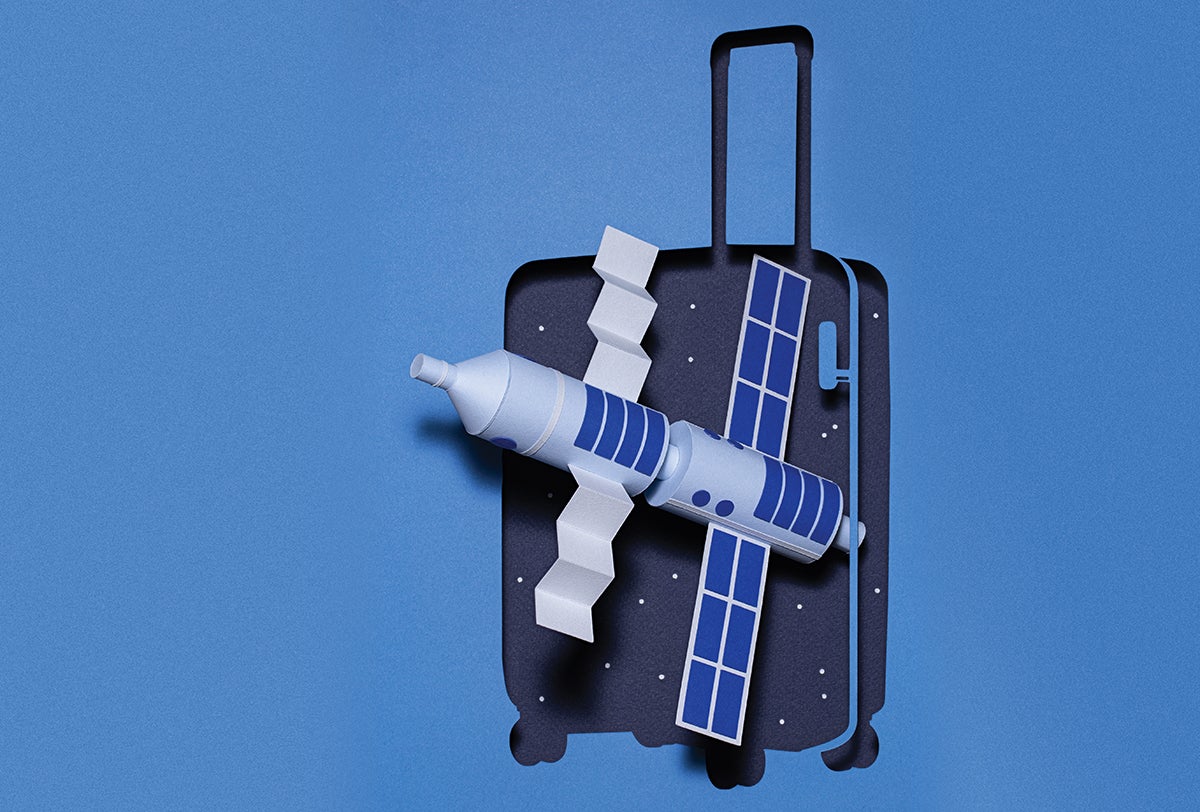
When astronauts first step onboard commercial space stations, the experience will be unlike anything they’ve encountered before. They could find wood paneling and warm interiors, next-generation sleeping pods, large windows for a stunning view of Earth, and an ambience akin to that of a high-end hotel on the ground. This vision is the promise of multiple private efforts to launch orbital habitats in the coming years that could welcome space tourists and government astronauts alike.
But the idea of luxury living in space—something commercial space station operators are so far being careful not to promise—can seem like an oxymoron. For instance, the International Space Station (ISS) is cramped, smelly and filled with crumbs and dead skin cells. Maintaining a comfortable, clean atmosphere, much less a five-star experience, on a functioning spaceship will present all kinds of hurdles. “I’m skeptical,” says Jeff Nosanov, an industry expert based in Atlanta and a former NASA proposal manager. “The challenges of keeping a space station functional are very underappreciated.”
The first of four planned commercial space stations, Haven-1 from California-based company Vast, is set to launch early in 2027. These outposts are being developed, some with funding from NASA, as successors to the ISS ahead of its scheduled retirement in the 2030s. The shift from public to private space stations, a first in human history, brings with it new opportunities for reimagining what life in orbit will look like.
On supporting science journalism
If you’re enjoying this article, consider supporting our award-winning journalism by subscribing. By purchasing a subscription you are helping to ensure the future of impactful stories about the discoveries and ideas shaping our world today.
“It’ll be a futuristic experience,” says Dylan Taylor, CEO and chair of Voyager Technologies in Colorado, the company leading the development of the Starlab Space Station, targeted for launch in 2029. “Instead of ‘luxury,’ ‘modern’ or ‘advanced’ is a better word,” he says, noting that the ISS—though magnificent—was based on 1980s and 1990s technology. “Everything we’re building is 2020s or 2030s technology.”
Of the four companies involved in such efforts, Vast may be closest to launching a space habitat. Two other competitors, Axiom Space of Texas’s Axiom Station and Orbital Reef, led by Blue Origin in Washington State, have also said they intend to launch by the end of the decade. Each of the stations must fulfill a long checklist of requirements from NASA if its maker wants the agency to send up astronauts, from limits on the level of carbon dioxide in the air to the color of indicator lights. But many decisions about how the stations will work—whichever of them make it to space—will be left to the operating company.
All of the stations are intended to orbit at an altitude similar to the ISS’s, around 250 miles above Earth, and to support crews of four to 10 people at a time. SpaceX’s Crew Dragon capsule or perhaps other vehicles, such as Boeing’s beleaguered Starliner, will probably handle most of the transportation. Stays onboard the stations will last weeks at first but could be extended to months or even years in the future.
“The space toilets on the [ISS] frequently have issues. It’s like sitting on a vacuum cleaner. It’s not luxurious by any measure.” —Jeff Nosanov, Former NASA Proposal Manager
Anticipated guests include space tourists, private researchers and government astronauts. Roman Chiporukha, co-founder of New York City–based company SpaceVIP, which brokers tickets to space, says the station operators are “quietly assessing interest” to figure out how many travelers they could expect. With ticket prices for a stay nearing $100 million, the potential customer base is unlikely to be huge. “There are maybe 1,000 people in the world who can afford that,” Chiporukha says.
Taylor expects the visitors, at least initially, to be “mostly” government-sponsored professional astronauts from agencies such as NASA. Onboard they will be able to conduct a wide range of research or manufacture products for use on Earth, such as advanced semiconductors and pharmaceuticals—similar to the setup on the ISS but with fewer constraints. “You can much more quickly run experiments on a commercial space station because you don’t have the red tape of the ISS,” Taylor says.
Those astronauts can expect to find stations that are conceptually wildly different from the ISS. Many of the operators have collaborated with leading designers and brands to give their stations a level of panache not seen in space in the decades of people living there. In 2022 Voyager announced it was partnering with Hilton to design its space station, with a promotional video later showing the kind of soft interiors, plush gray walls and soothing lighting that you might expect in a fancy hotel on Earth, not speeding at 17,000 miles per hour around the planet.
Vast hired former Apple designer Peter Russell-Clarke in 2023 to help envision its station. Haven-1 will boast a clean and sleek interior with wood paneling and soft surfaces; promotional images show visitors sleeping under a cozy, inflatable duvet that applies pressure to make it feel like they’re under gravity’s influence. “It’s absolutely meant to be more of a luxury experience,” Chiporukha says. Axiom, meanwhile, hired French designer Philippe Starck for the interior of its station, which includes bubblelike padded walls for comfortable living quarters.
Sleep will be a key part of making commercial space stations feel homey, says Anastasia Prosina, founder of space consultancy firm Stellar Amenities and a commercial space-habitat-development consultant based in California. That’s because of the potentially disruptive effect of seeing 15 or 16 sunsets and sunrises every 24 hours. “If you think about luxurious experiences, you want to make sure people feel okay,” she says. “Sleep quality is something astronauts speak very openly [about].” Options for improving shut-eye in orbit include using controlled lighting inside the station to simulate a sunrise and sunset at the start and end of the traditional day, maintaining some semblance of a diurnal cycle.
Even with all the best intentions, there are some aspects of living in a confined space in orbit that, for now, can’t be made plush. Toilets, for example, are infamously difficult to design with any level of glamour. “The space toilets on the [ISS] frequently have issues,” Nosanov says. “It’s like sitting on a vacuum cleaner. It’s not luxurious by any measure.”
There’s also the problem of actually running and maintaining the stations, which will require crews of dedicated astronauts, not just space tourists, to ensure everything operates smoothly around the clock. “Almost all the time astronauts spend on the ISS is for keeping it working,” Nosanov says. The new stations will “be really clean at first, but that’s not going to last long. I mean, a space station smells like farts all the time. And people don’t bathe—they wash a bit, but it’s really survival living.”
Still, perhaps these stations will be the first step toward a future of more luxurious abodes—maybe with the perfect space toilet to boot.