

May 2026: Science History from 50, 100 and 150 Years Ago
Synchronous fireflies; Grand Canyon fossil footprints
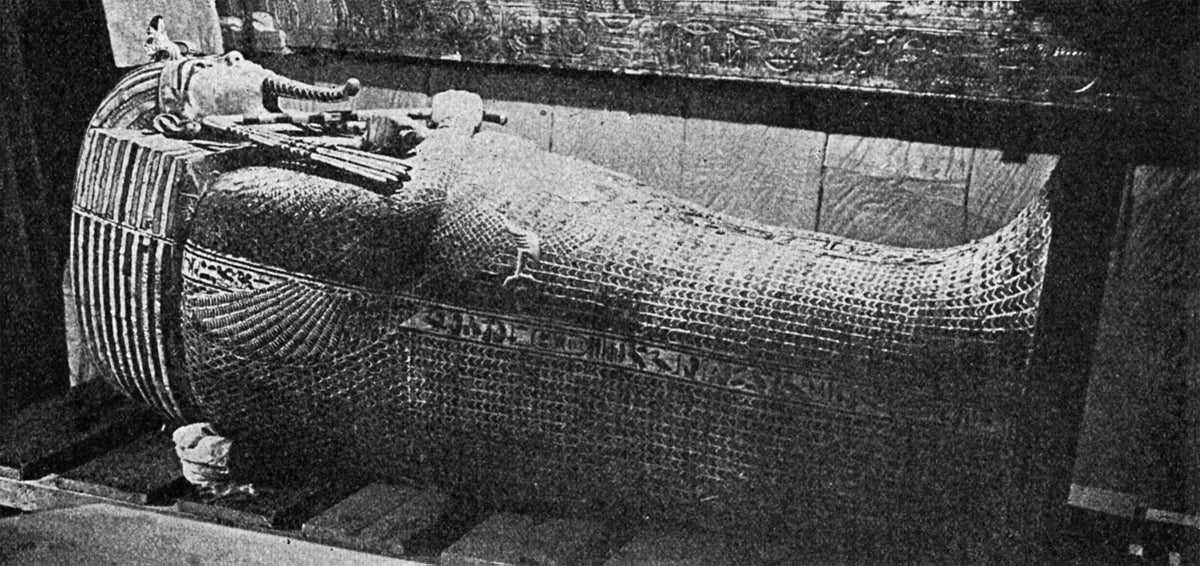
1926, King Tut’s Golden Coffins: “Within the burial chamber hewn from the solid rock, Tut-ankh-amen’s mummy was protected by many enclosures of wood, stone and gold. First came three large wooden, box-like shrines, one within the other. These were removed to reveal a great sarcophagus of yellow quartzite with a granite lid.”
Scientific American, Vol. 134, No. 5; May 1926
1976
Synchronous Fireflies
“Many of the familiar fireflies that flit over our lawns in summer are called roving fireflies because the males fly about singly, searching for females perched in low vegetation. The male flashes rhythmically, and when a female flashes in response, the two fireflies begin a courtship involving a series of alternating flashes that lead the male to the female. For 300 years explorers and naturalists have reported another kind of firefly behavior, seen in the region stretching from India to the Philippines and New Guinea. There the fireflies gather in trees in dense swarms, and the males flash on and off in the same rhythm.
On supporting science journalism
If you’re enjoying this article, consider supporting our award-winning journalism by subscribing. By purchasing a subscription you are helping to ensure the future of impactful stories about the discoveries and ideas shaping our world today.
“Observers have marveled at the beauty of the synchronous flashing, but beauty alone does not explain the persistent fascination of the displays. What has been irresistible to many are the questions of how and why. How is it possible for thousands of fireflies to coordinate their flashing so exactly, cycle after cycle, and why do they do it? We hope to show that the questions are linked, in the sense that one cannot understand the why of synchronous flashing without understanding the how.”
1926
Nature Faking
“When the late Theodore Roosevelt directed a well-aimed and perfectly logical blow at ‘nature faking,’ he rendered to popular natural science one of the most distinct services. But this sort of warfare must be continued, for the nature fakers still exist in growing numbers. Even the renowned Jean-Henri Fabre, who has been more lauded and quoted than any other nature writer of a foreign country, could not refrain from errors due to supposition and incomplete observation, one of which—namely, the intended puncture of the central ganglia of spiders by the captor wasp for the purpose of paralyzing—has been shown to be a fallacy. These cases, however, in which the carefully investigating naturalists are remiss, come from closely related facts and are not born entirely of the desire to relate wonders and unheard-of things.”
Read more about popular fallacies—such as birds being charmed by snakes—that grew out of pseudo-scientific nature lore in the May 1926 issue.
Fossil Footprints from the Grand Canyon
“Tracks of extinct animals, at least 25,000,000 years old, have been discovered in the Grand Canyon of the Colorado River. They are so remarkably well preserved that they have been prepared as a permanent exhibit on the Hermit Trail in the Canyon, to teach a lesson as to the great antiquity of the animal life that once roamed over these ancient sands millions of years before the Colorado River had excavated the deep canyon in which it now flows. The fossils of the Hermit Trail occur in a fine-grained sandstone of Permian age, the period after the Carboniferous or principal coal-forming period.
“One of the sandstone slabs that was excavated bears footprints of a new species; the creature was apparently a short, squat quadruped with a wide body and was evidently slow of movement, as indicated by the short stride.”
1876
Reclaiming the Steppes
“In the Russian empire lies an immense basin, depressed below the level of the ocean. This basin holds the Caspian Sea, and into it also flow the great rivers Ural and Volga, which drain a large portion of central Russia. Over the ages, the rivers have carried down soil and formed vast deposits which have encroached upon the sea, contracting its dimensions and elevating its bottom so that large vessels can no longer traverse it.
“As the sea diminished in size, so did the supply of watery vapor in the adjacent atmosphere; with less moisture, the land nearby has gradually changed into a desert. To reclaim this desert and restore it to its former state of fertility is the object of a gigantic engineering project that involves the connection of the Caspian with the Black Sea by means of a canal. The lead engineer estimates that in 40 years the levels of the two seas would be so nearly the same that the channel between them would be navigable and the fertile system would appear once more.”

It’s Time to Stand Up for Science
If you enjoyed this article, I’d like to ask for your support. Scientific American has served as an advocate for science and industry for 180 years, and right now may be the most critical moment in that two-century history.
I’ve been a Scientific American subscriber since I was 12 years old, and it helped shape the way I look at the world. SciAm always educates and delights me, and inspires a sense of awe for our vast, beautiful universe. I hope it does that for you, too.
If you subscribe to Scientific American, you help ensure that our coverage is centered on meaningful research and discovery; that we have the resources to report on the decisions that threaten labs across the U.S.; and that we support both budding and working scientists at a time when the value of science itself too often goes unrecognized.
In return, you get essential news, captivating podcasts, brilliant infographics, can’t-miss newsletters, must-watch videos, challenging games, and the science world’s best writing and reporting. You can even gift someone a subscription.
There has never been a more important time for us to stand up and show why science matters. I hope you’ll support us in that mission.