
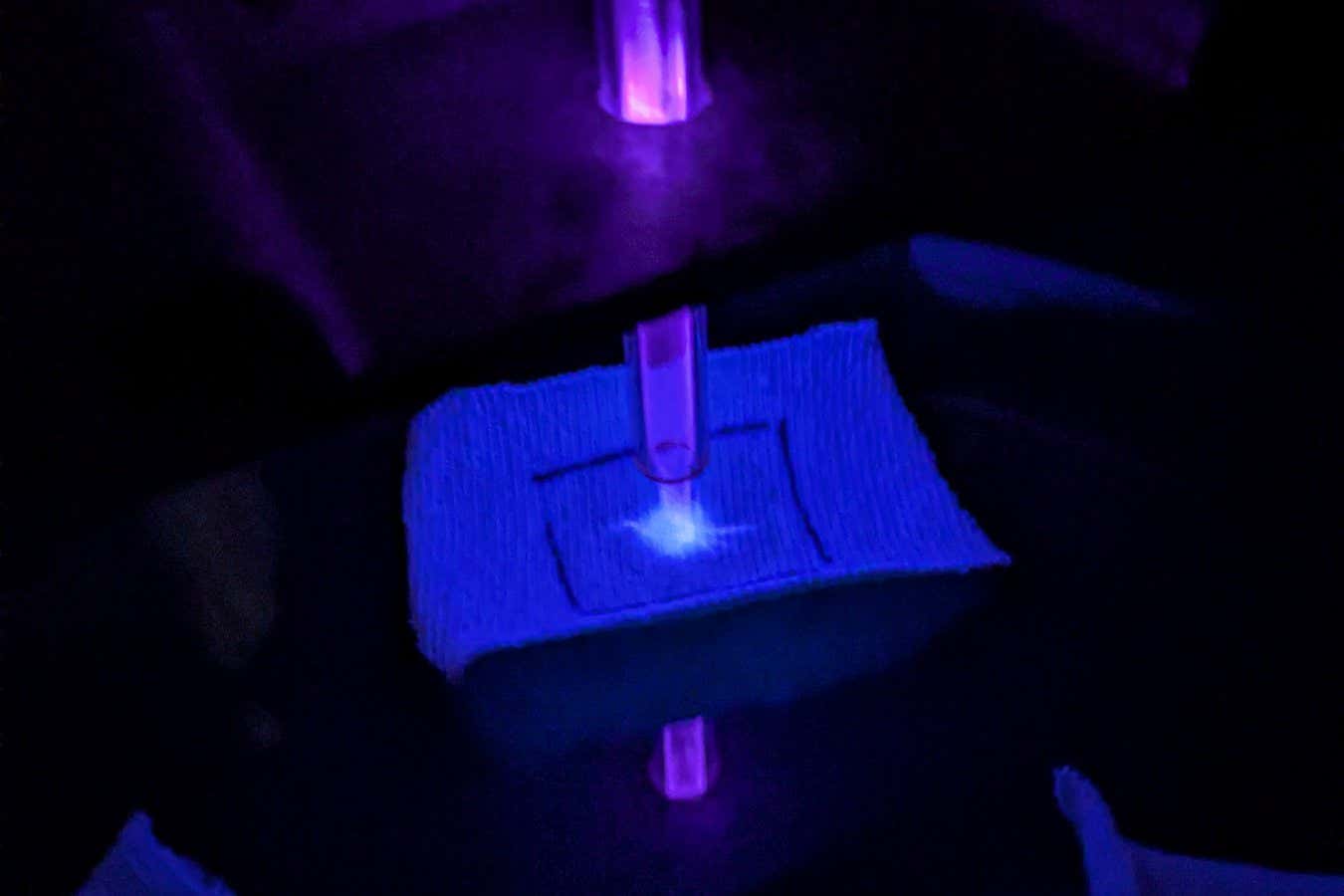

White shirt material being cleaned with cold plasma
University of Alabama in Huntsville, Propulsion Research Center
Astronauts in space can’t do laundry – but that may be about to change. And it could mean that those on longer-duration missions will be able to have more of the comforts of home on the surfaces of the moon or Mars.
Aboard the International Space Station (ISS), astronauts tend to wear the same clothes for days on end and then pack them up to be thrown back towards Earth where they burn up in the atmosphere. That’s all well and good for missions lasting a few weeks or even months, but it is not a viable solution for missions that last longer and that aren’t regularly resupplied from Earth.
That’s where Gabe Xu at the University of Alabama in Huntsville and Chelsi Cassilly at NASA’s Marshall Space Flight Center in Alabama come in. They have developed a sort of “laundry gun” that can be used to blast fabrics with cold plasma, killing off the microbes that cause unpleasant odours. Xu presented this work at the Astrobiology Science Conference in Wisconsin on 21 May.
Their device works by blasting a mixture of helium, air and water vapour with powerful bursts of electricity, which creates ions of oxygen. Those ions then seep into all the nooks and crannies of the fabric and are absorbed by microbes, killing them through what’s called oxidative stress.
That’s one of the benefits of this method over others, like exposure to UV light. “There are microbes that are UV resistant, but as far as we can tell from our experiments, there is nothing that is oxidative stress resistant – if you eat poison, it kills you,” says Xu. Tests showed that the purple plasma beam reduced spore colonies on a scrap of cotton fabric from 250,000 colonies per millilitre to about 60,000.
It does that without damaging the fabric or creating any danger. “When we think of plasma jets we think of lightning bolts or arc welding, which are typically very hot,” says Xu. “This jet you can put your hand in, you could use it at home.”
Using it at home wouldn’t be very efficient, though, as the current version only sanitises a patch less than a centimetre wide at a time. Xu and Cassilly are now working on developing two more practical versions: a “plasma washing machine” where the plasma is piped into a chamber along with the fabrics being cleaned, and a dual plasma jet-vacuum cleaner that could be used on surfaces.
“When you think about long-term habitats like the moon or Mars, astronauts will probably want a couch to sit on, somewhere nice, but they won’t be able to have that unless they can clean it,” says Xu. Plasma jets could finally make that happen.
Topics: