
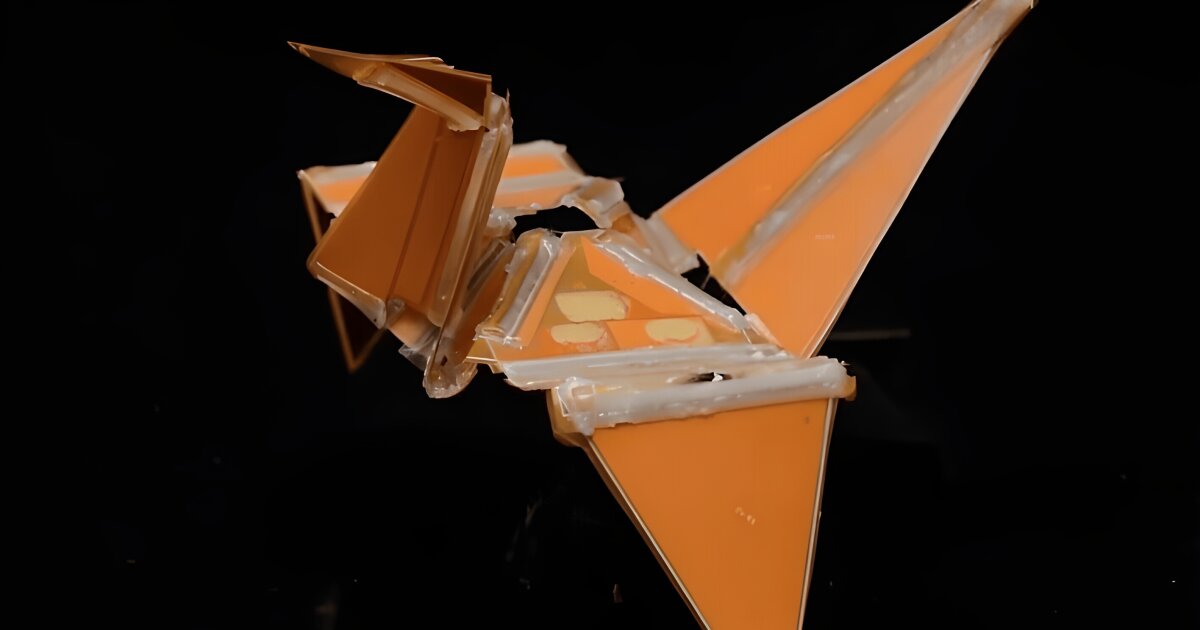
“Ancient Japanese Art Brings Spineless Robot To Life!” Sounds very much like a movie plot summary. In reality, it perfectly describes the work of Princeton University engineers who have created a robot that moves without a single motor or gear, using heat and the principles of origami instead. Their soft robotic system relies on a combination of heat-sensitive advanced materials, flexible embedded electronics, and carefully designed folding structures to produce motion, ditching traditional mechanical components.
Soft robotics, a subfield of robotics that says robots can be squishy, focuses on constructing robots from highly flexible, deformable materials and systems. The flexibility of these soft robots makes them well-suited for tasks that rigid machines struggle with, such as manipulating delicate objects, navigating tight spaces, and serving as medical implants or drug-delivery systems inside the human body.
The problem is that most soft robots still rely on motors, actuators, or external pneumatic systems to move, limiting how small, light, and truly “soft” they can be. The Princeton team tackled this challenge by combining two fields that rarely intersect: materials science and origami engineering.
At the heart of their design is a special polymer called a liquid crystal elastomer, which, unlike ordinary flexible materials, has an internally ordered molecular structure. Using a customized 3D printer, the researchers programmed the orientation of the molecules zone by zone as the material was printed, creating distinct zones that respond differently when heated.
By arranging these zones in specific patterns, the team effectively built “hinges” directly into the material. When heat is applied, these hinges contract in predictable ways, causing the structure to fold and unfold according to a pre-designed sequence.
Controlling exactly which zones heat up is where the electronics come in. The team embedded flexible printed circuit boards, complete with heating elements, directly into the hinges during the printing process itself. This approach, rather than attaching the boards afterward, simplifies fabrication and keeps the system compact. Embedded temperature sensors feed data back to the control software, which compensates for small errors that accumulate as the robot repeatedly folds and unfolds.
“I think the big contribution is we showed integration of a complex system where we have local heating control,” says David Bershadsky, one of the pioneers of the idea and a member of the research team. “We can control activation depending on where we heat.”
To demonstrate their concept, the researchers built a crane (bird), a classic origami figure, that flaps its wings on command. The crane repeatedly moved and returned to its original shape with no noticeable wear or distortion. It’s far from a complete functional robot, but it proves the concept is absolutely possible.
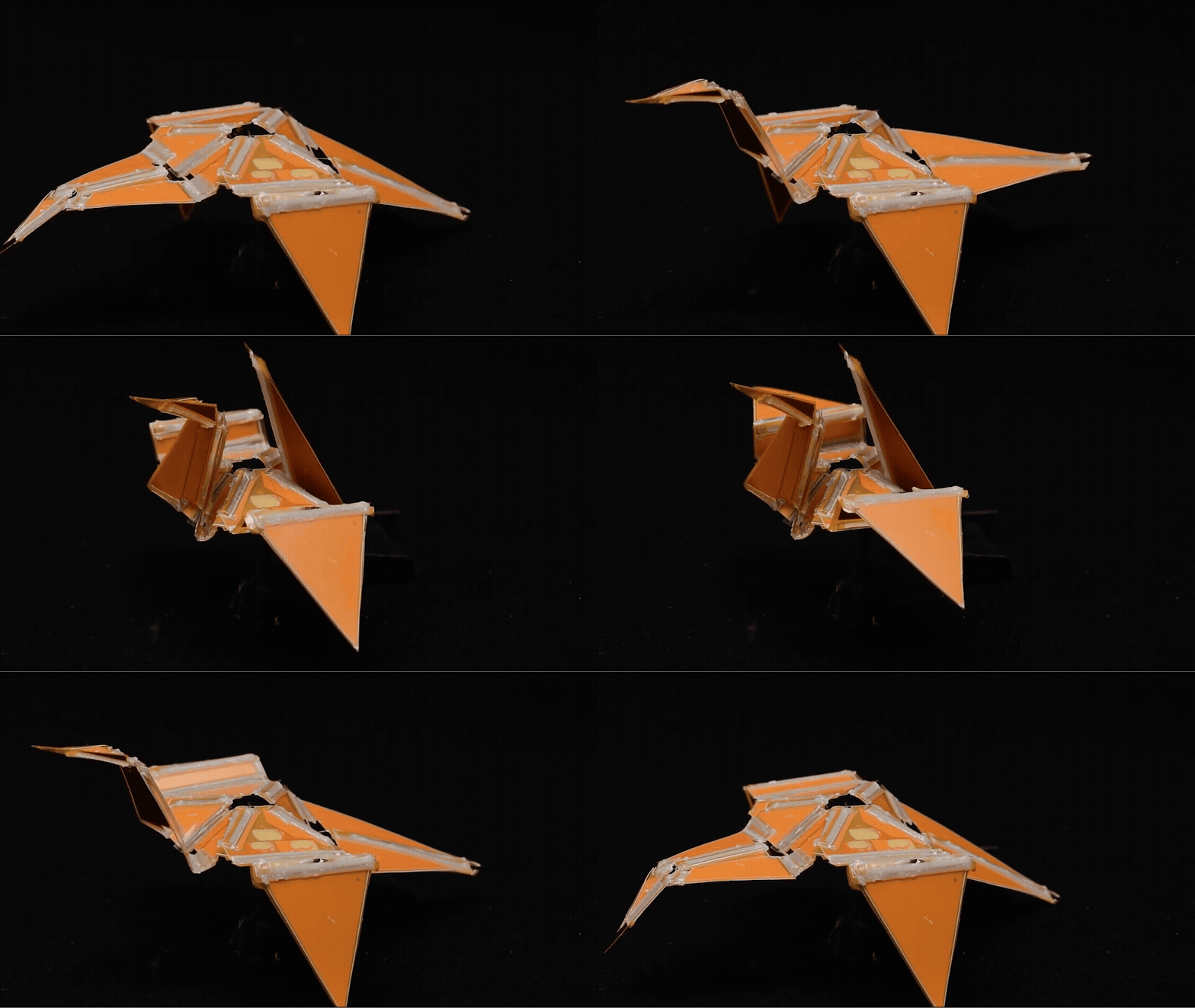
Princeton University
Removing the limitation of mechanical-based movement opens up a world of possibilities for soft robotics. For now, the system remains at the experimental stage, demonstrated in controlled laboratory settings. But its design is already geared toward manufacturability, using commercially available materials and scalable fabrication methods.
The team published its work in the journal Advanced Functional Materials.
Source: Princeton University