
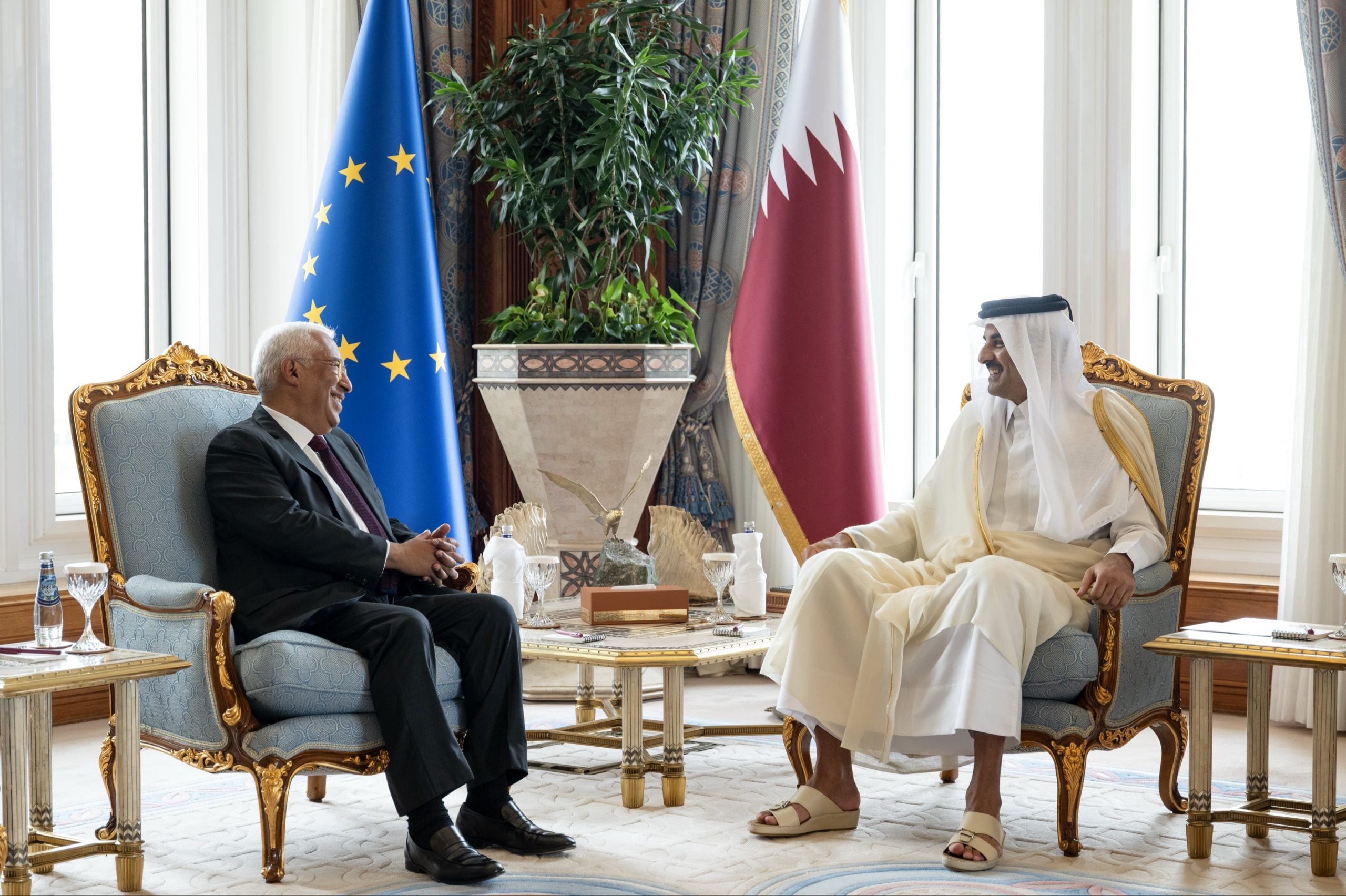
The meetings come as the fragile U.S.-Iran truce—brokered by Pakistan on 8 April—approaches its final day without a new deal in sight.
President of the European Council Antonio Costa praised Qatar’s mediation efforts, describing it as “an honest broker for peace and stability in the region”.
Costa’s remarks came in response to a question from the media in Doha on Wednesday on whether Qatar could play a role in maintaining maritime stability and ensuring the continuity of energy supplies in light of the U.S.-Israel war on Iran.
“Qatar is an honest broker for peace and stability in the region. They have already proved this during the war in Gaza and are now doing their work to stabilise this ceasefire, to obtain a lasting ceasefire and create conditions to open the negotiations to address the main issues,” Costa told the press at the Doha International Airport.
The key issues he highlighted included Iran’s nuclear and ballistic missiles programmes as well as what he described as its “support of the proxies who are destabilising the region”.
“We rely on Qatar to continue to do this. Of course, the blockage of the Strait of Hormuz is very dangerous for the global economy and all the world is already suffering the impact of this illegal blockage,” he said.
The briefing came after Costa wrapped up his high-level meetings in Doha as part of a regional tour that included the United Arab Emirates and Saudi Arabia.
“The Gulf countries can count on the European Union now and in the future,” Costa affirmed.
In Doha, Costa met Qatar’s Amir Sheikh Tamim bin Hamad Al Thani at the Amiri Diwan. The two sides reviewed regional and international developments, particularly in the Gaza Strip and Lebanon, in light of ongoing escalation and its humanitarian and security implications.
They also discussed the impact on regional security, including maritime navigation and global energy markets, stressing the need to ensure the smooth flow of energy supplies and stability in vital sea routes.
Costa and Qatar’s Prime Minister and Minister of Foreign Affairs Sheikh Mohammed bin Abdulrahman Al Thani also met, where they discussed similar topics, including the current U.S.-Iran ceasefire.
“The President of the European Council affirmed the European Union’s solidarity with the State of Qatar in light of the developments in the region, and its commitment to strengthening shared economic interests and supporting the stability of the global economy,” Doha’s foreign ministry said in a statement.
The meetings come as the fragile U.S.-Iran truce—brokered by Pakistan on 8 April—approaches its final day without a new deal in sight.
Islamabad had hosted a round of talks between the U.S. and Iran on Saturday, but it ended without a deal while it remains unclear whether a new round would take place to reach a lasting ceasefire.
On Monday, the U.S. imposed a naval blockade on Iran to pressure it to accept its terms in the ceasefire negotiations, including the unconditional opening of the Strait of Hormuz.
Iran maintains that the strait was not completely closed, but barred to American and allied ships while others are allowed to pass.
The Strait of Hormuz, located between Oman and Iran, is one of the world’s most critical routes for crude oil shipments, and its closure has become a key issue in the negotiations.
Costa stressed the need for all parties of the conflict to use the current momentum created by the ceasefire “in order to address the concerns of the international community regarding Iran”.
He also emphasised the importance of free maritime navigation as the “war has already had disastrous consequences that are being felt all over the world”.
“Restoring freedom of navigation in the Strait of Hormuz is crucial and urgent and Europe is committed to help guarantee the safe and impeded passage of ships,” he said.