
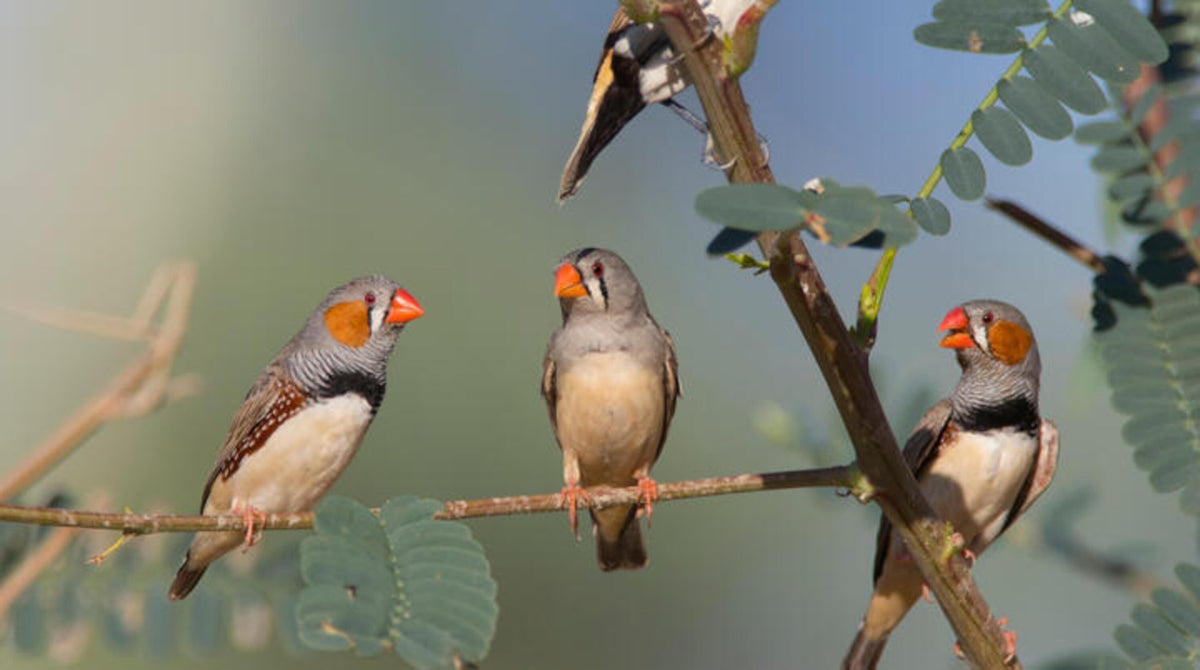

Songbirds reveal the dark side of making new brain cells as adults
A new study in songbirds might help explain why humans don’t generate many new brain cells, called neurons, as adults
Scientists have long studied songbirds, such as zebra finches, to understand the brain.
Every day the human body replaces billions of cells, flushing out the old and generating the new, healthy ones. The average lifespan of a red blood cell is just under four months, while skin cells last about a month and those in the intestinal lining exist for just a few days. This turnover is the default, but there’s one part of the body in which humans and other mammals don’t seem geared toward generating new cells: the brain.
Aging and damaged brain cells, or neurons, can cause memory problems and limit the brain’s ability to recover from illnesses. Some scientists have posited that if we could just turn on the ability to make new neurons in the brain—a process called neurogenesis—some of these deleterious changes might be reversed. But a new study suggests neurogenesis may be more destructive than we thought, adding weight to a countertheory that our brain’s apparent limitation is actually an evolved protection.
“Birds, reptiles, fish: they all have widespread neurogenesis throughout their forebrains throughout life,” says Benjamin Scott, the study’s senior author and an assistant professor at Boston University. “It’s really in mammals where we see this restricted.”
On supporting science journalism
If you’re enjoying this article, consider supporting our award-winning journalism by subscribing. By purchasing a subscription you are helping to ensure the future of impactful stories about the discoveries and ideas shaping our world today.
In the new paper, published today in Current Biology, Scott and his colleagues analyzed the brains of Zebra Finches, small songbirds that undergo neurogenesis throughout their life. The researchers wanted to know how adult neurogenesis affected surrounding brain tissue, so they used an electron microscope to watch how new neurons reach their destination in the brain. Researchers had previously assumed neurons might follow structures in the brain called glial scaffolds, which guide neurons to the right place during development. But Scott and his team observed that the new neurons tunneled straight through older neural pathways and that the new brain cells were more rigid than “squishy” mature neurons.
“They’re just sort of everywhere in the tissue,” Scott says of the new neurons. “They’re touching all the mature cells. They’re right in the middle of all of the action.”
Because adult brains are done growing, they don’t have room for new structures, so the tunneling wasn’t a complete surprise to researchers. Still, understanding the destructive side of neurogenesis—doing away with older paths through the brain to make new connections—could help researchers understand why mammals limit this ability in adults.
“One of the things that this study has revealed to us is that, as the new neurons move through the brain, they seem to be pushing or deforming the tissue,” Scott says. “You could imagine that they might be altering the circuit, breaking connections that are the basis of stored memories.”
Humans and other mammals might have evolved to limit adult neurogenesis to preserve important long-term memories, he and his colleagues speculate. But because mammals and birds are so different, it’s hard to know if the same tunneling process happens in mammalian brains, too.
“The human and bird forebrains have different organization patterns…, so some caution is called for in extending parallels to the level of brain circuits and cells,” says Eliot Brenowitz, a neurobiologist at the University of Washington, who was not involved in the new study.
It’s Time to Stand Up for Science
If you enjoyed this article, I’d like to ask for your support. Scientific American has served as an advocate for science and industry for 180 years, and right now may be the most critical moment in that two-century history.
I’ve been a Scientific American subscriber since I was 12 years old, and it helped shape the way I look at the world. SciAm always educates and delights me, and inspires a sense of awe for our vast, beautiful universe. I hope it does that for you, too.
If you subscribe to Scientific American, you help ensure that our coverage is centered on meaningful research and discovery; that we have the resources to report on the decisions that threaten labs across the U.S.; and that we support both budding and working scientists at a time when the value of science itself too often goes unrecognized.
In return, you get essential news, captivating podcasts, brilliant infographics, can’t-miss newsletters, must-watch videos, challenging games, and the science world’s best writing and reporting. You can even gift someone a subscription.
There has never been a more important time for us to stand up and show why science matters. I hope you’ll support us in that mission.