

The humble ham sandwich inspired a math theorem for sharing food fairly
A Polish mathematician’s theory on the famous problem of bisecting three solids using one plane
Emanuel Ursu/500px/Getty Images
This article is from Proof Positive, our friendly newsletter that explores the joys and peculiarities of math. Sign up today for a weekly math essay and puzzle in your email inbox.
Last week we discussed the best way to divvy up a pizza with an unevenly distributed topping. That offers a nice introduction to the mathematically rich subject of how to fairly divide food. It’s a topic that has occupied many great minds.
On supporting science journalism
If you’re enjoying this article, consider supporting our award-winning journalism by subscribing. By purchasing a subscription you are helping to ensure the future of impactful stories about the discoveries and ideas shaping our world today.
In the 1930s and 1940s, for example, a group of Polish mathematicians regularly met in a café in Lwów, Poland (now Lviv, Ukraine) to discuss mathematical problems. Problem number 123 was formulated by Hugo Steinhaus in 1938: Is it always possible to bisect three solids by one plane?
To illustrate that question, he proposed a thought experiment familiar in everyday life. Imagine a sandwich consisting of two slices of bread and a layer of ham. Is it possible to cut it in such a way that all three components are exactly halved?
His colleagues got to thinking. The task may seem simple, but the solution requires having some background in topology and identifying just the right approach.
In two dimensions, you can bisect two objects exactly with a straight cut—something our pizza example last week revealed. So Steinhaus wondered whether this approach could be transferred to three dimensions, which would involve finding a cutting plane to bisect three objects in three-dimensional space. Unfortunately, in the 3D case, the intermediate value theorem alone does not help. To use it, you would have to define an initial plane, to which you could return by rotation around an axis and by which you could prove that, at some point of the rotation, the objects were halved. In three dimensions, however, there is not a unique axis of rotation but several axes.
Using a Sphere and Another Theorem for Help
Fortunately, one of Steinhaus’s protégés, Stefan Banach, found another way to prove the conjecture. For this, he used the Borsuk-Ulam theorem, which states, among other things, that there are always two diametrically opposed points on Earth where the same temperature and air pressure exist. Similar to the bisection of a pizza, this theorem has to do with continuous functions (in this case, temperature and air pressure) and geometry (Earth as a sphere). More formally, Borsuk-Ulam’s theorem states that for any two-dimensional continuous function f(x, y) on a sphere, there is a point (a, b) on its surface for which f(a, b) = f(–a, –b). Banach realized that in the ham sandwich problem, one can also use a sphere to bisect the three components.
To do this, imagine a sphere that encloses the sandwich. Now pick a component—say, the bottom slice of bread—and a point p = (x, y) on the surface of the sphere. Then form a straight line connecting p and the center of the sphere. This allows us to construct a plane Ep that is perpendicular to the straight line and, at the same time, bisects the lower slice of bread. In fact, this is possible for any point p on the surface of the sphere.
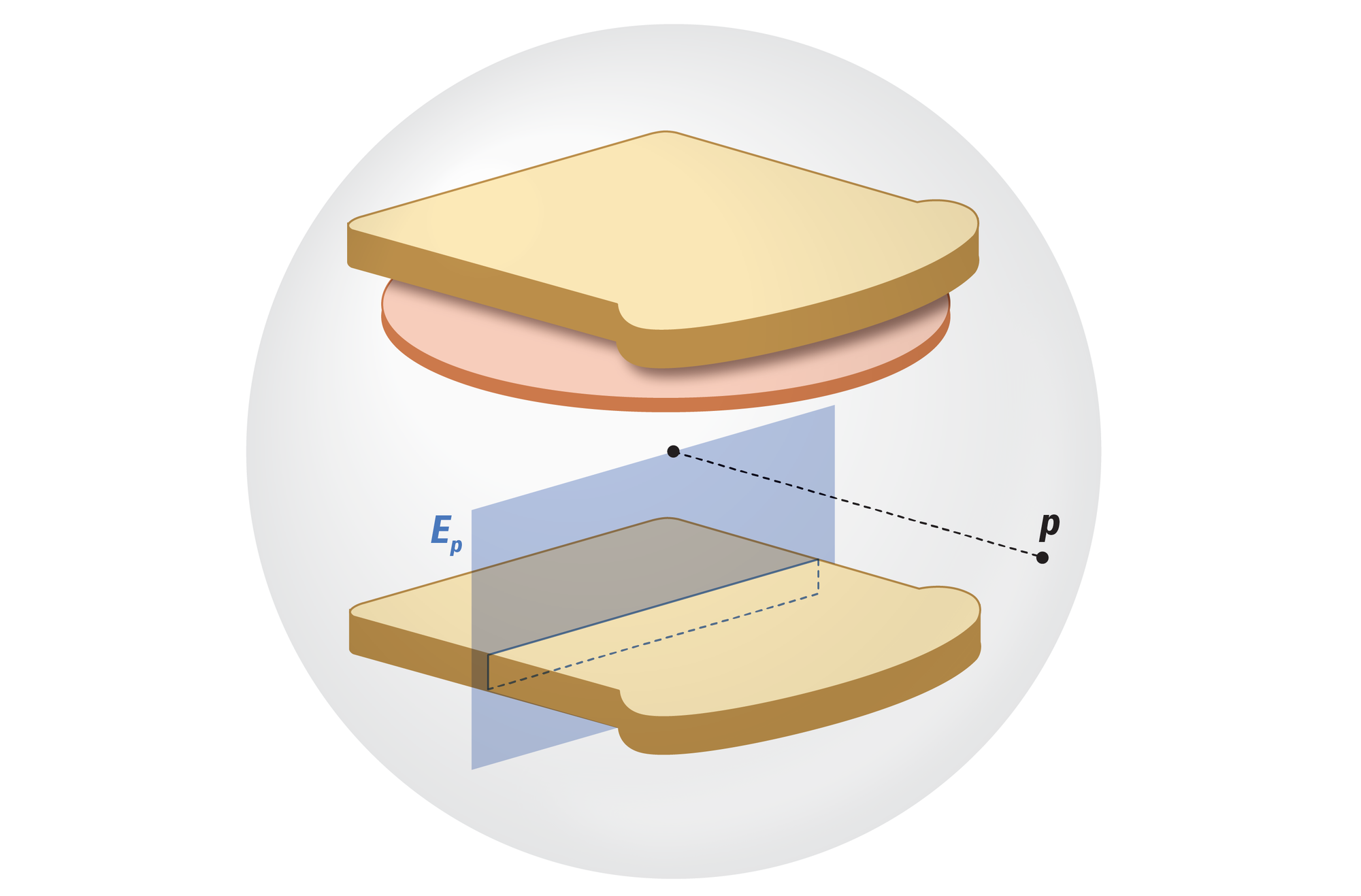
For the Borsuk-Ulam theorem to be used, Banach still needed a two-dimensional, continuous function. He defined it analogously to the pizza case by considering the volume of the two remaining components, the ham and the upper slice of bread. The function f is therefore: f(p) = (volume of the ham above the plane Ep, volume of the upper bread slice above the plane Ep).
Now he just had to apply the Borsuk-Ulam theorem. According to this, there is a point f(q) for which f(–q), which is diametrically opposite, has exactly the same value—that is, f(q) = f(–q). But the points q and –q describe the same plane Eq such that the only difference is the orientation: the proportion of the considered volume of the components in the function f(q) is the inverse of f(–q). If both are equal, the proportions of the volumes of the ham and the bread slice above and below the cutting plane must be exactly the same.
This brings us to our goal. The plane Eq always bisects the lower slice of bread, and, moreover, it splits the ham and the upper bread into two equal parts. As mathematicians Arthur Harold Stone and John Tukey proved in 1942, the ham sandwich theorem can be extended to arbitrary dimensions: in n-dimensional space, one can always bisect n objects by a straight (n – 1)–dimensional cut.
Unfortunately, the finding is very theoretical: it lets us know that a perfect division is possible, but it does not explain how to find that result. So mathematicians sadly cannot prevent the occasional quarrel over dividing a meal.
It’s Time to Stand Up for Science
If you enjoyed this article, I’d like to ask for your support. Scientific American has served as an advocate for science and industry for 180 years, and right now may be the most critical moment in that two-century history.
I’ve been a Scientific American subscriber since I was 12 years old, and it helped shape the way I look at the world. SciAm always educates and delights me, and inspires a sense of awe for our vast, beautiful universe. I hope it does that for you, too.
If you subscribe to Scientific American, you help ensure that our coverage is centered on meaningful research and discovery; that we have the resources to report on the decisions that threaten labs across the U.S.; and that we support both budding and working scientists at a time when the value of science itself too often goes unrecognized.
In return, you get essential news, captivating podcasts, brilliant infographics, can’t-miss newsletters, must-watch videos, challenging games, and the science world’s best writing and reporting. You can even gift someone a subscription.
There has never been a more important time for us to stand up and show why science matters. I hope you’ll support us in that mission.