
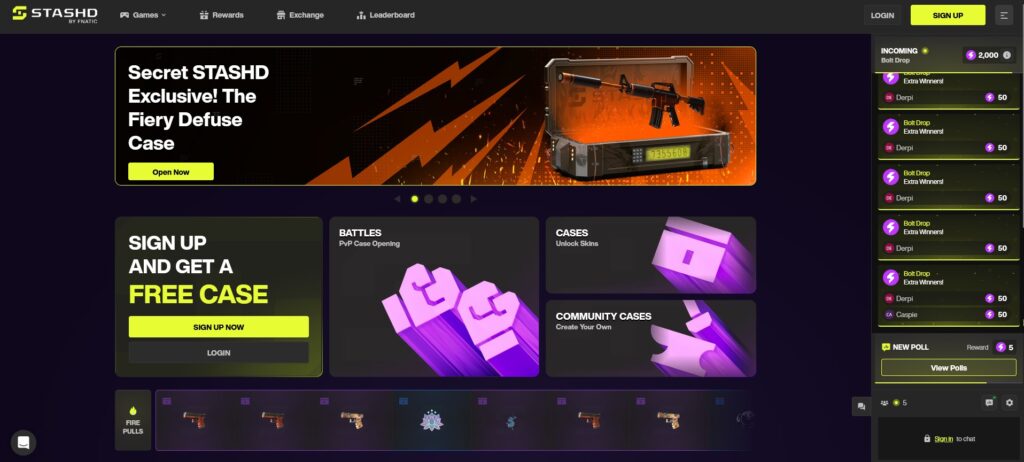
Fnatic wants its case-opening site STASHD to be “a place for the insane pulls, the rare finds and the stories you actually want to share.” The community has a different take: that it’s a gambling platform dressed as a fan engagement tool.
On STASHD.gg, users purchase a virtual currency called Bolts using a credit/debit card, cryptocurrency, or Valve skins, and spend them opening lootboxes containing CS2 skins. The skins can be withdrawn to Steam or converted to cryptocurrency through a tiered, time-gated system. If you would rather not withdraw, you can take your Bolts into a head-to-head battle against another user, staking them on who opens the higher value item.
The platform is branded in Fnatic’s black and orange, carries the words “By Fnatic” under the logo, and officially claims its goal is to “bring you closer to the things you love about Fnatic in a new way.”
The project has attracted immediate criticism across Reddit and X. Fnatic Dragons, the club’s official fan club and community, posted a tweet that made clear its stance was “about protecting a community that includes many young and impressionable fans,” before posting phone numbers to respective gambling addiction helplines across various countries.
Lootboxes, the mechanic that sits at the core of the STASHD product, are one of gaming’s most debated features and have been for the best part of a decade. In Europe, lootboxes were declared illegal in Belgium under gambling legislation in 2018.
Valve is currently facing litigation from the New York Attorney General and a class-action suit in Washington state. Both accuse lootboxes of being illegal gambling products. The New York AG suit argues that lootboxes deploy the same psychological mechanisms as traditional casino games: variable ratio reinforcement, entrapment mechanics, constant availability, and immersive reward loops.
The legal question is unresolved in most jurisdictions, but the direction of travel is not towards greater tolerance of the products. The legal defense is that, within the Valve ecosystem (ignoring third-party marketplaces), skins have no real-money value.
STASHD lands slap bang in the middle of that environment. It is a case-opening platform, with Fnatic’s name and colors plastered all over it. It also comes with a set of specific problems that go beyond the question of whether lootboxes are gambling. Here is a look at what those problems actually are.
STASHD Accepts Real Money and Pays Out In Crypto
One of Valve’s typical arguments against lootboxes in its games being gambling is that at no point can a user withdraw the sale of a skin into real money. This is not the case with STASHD, so any defense that this is not a gambling product on those grounds is not valid. Money entered as currency exits only as cryptocurrency or as skins.
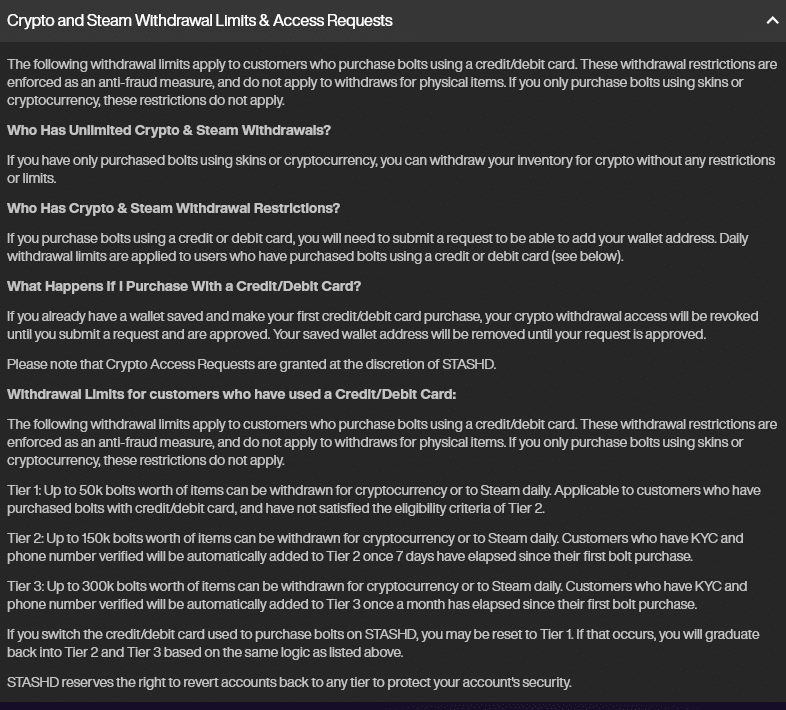
If you deposit cash to buy Bolts and open cases, you are subject to tiered withdrawal restrictions and can only withdraw your funds in cryptocurrency or skins. This is not clearly flagged to users when they are pushed towards purchasing Bolts in the first place. Frictionless entry but a more gated withdrawal process are deliberate features.
The only barrier to entry is the method of payment, whereas the barriers to exit (should you use the most conventional method of deposit, debit card) are time, identity documents, and a crypto wallet, none of which are mentioned at the point of purchase.
How STASHD’s Battle Modes Work and Why They Raise Concerns
The lootbox gambling debate is contentious and unresolved. The case battle format leaves less room for nuance.
STASHD allows users to enter head-to-head case-opening battles across four different games: Crazy Mode, where the loser takes all; Shared Mode, where players share their pulls; Group Uncasing, where friends open together; and Terminal Mode, where the final round determines the winner. Individual battles run from one-on-one up to four players. Users can also battle a bot.
Users purchase entry using Bolts (which can be purchased using debit/credit cards). Both players open a case. The case with the highest-value item wins the pot. By most countries’ legal definition of gambling:
- Consideration: Bolts paid to enter the competition.
- Chance: Outcome determined by the “Provably Fair” lootbox system.
- Prize: The winner takes all (or in Crazy Mode, the loser takes all).
A typical case-opening experience invites debate over whether the product constitutes gambling, but adding a battle format (also against bots) effectively turns it into a coin-flip product on the platform. Just because the platform hasn’t engaged with Dice or Plinko, which are more deliberate gambling games, it doesn’t mean that they’re not.
The winnings are paid in skins, which have a Bolts value, which can then be withdrawn either as skins or in cryptocurrency.
STASHD’s Age Policy Relies on Parental Permission Rather Than Verification
We have now established that, through STASHD, Fnatic is accepting real money, converting it into virtual assets, and offering a head-to-head experience that would broadly meet the legal definition of gambling in most jurisdictions. The next question is who’s able to use the product.
STASHD’s terms state: “If you are under the age of 18 years of age or not legally able to enter into contracts in your place of residence, you must have the permission of your parents or legal guardians to use the Service.”
This is parental permission, not age verification or know-your-customer protocol. There is no mechanism enforced to verify that permission has been granted or that the user is who they claim to be during the purchase process. A thirteen-year-old with a parent’s credit card details can be up and running in a couple of minutes. The terms also do not mention any geographies that are prohibited from using it (which makes sense, given identity verification is not mandatory).
STASHD does, however, have a self-exclusion mechanism. Self-exclusion is not a feature you typically find on a fan engagement platform. It’s a feature you find, required by regulators, on a gambling product. The presence of a self-exclusion tool is recognition that the product itself carries a recognized risk of harm to vulnerable users.
The self-exclusion text states: “Our goal is to help you enjoy the site responsibly. If you feel you need a pause, self-exclusion is a simple way to protect your experience and keep it fun.” This is the full extent of responsible messaging found across the STASHD FAQs and terms.
STASHD has a leaderboard feature that awards bonus Bolts each week to those who have earned the most points.
The way to acquire points and ‘flex’ is by spending money. So to climb the leaderboard and be able to ‘flex’ to the community, all you’ve got to do is… spend money, and battle.
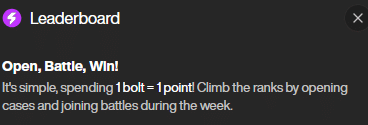
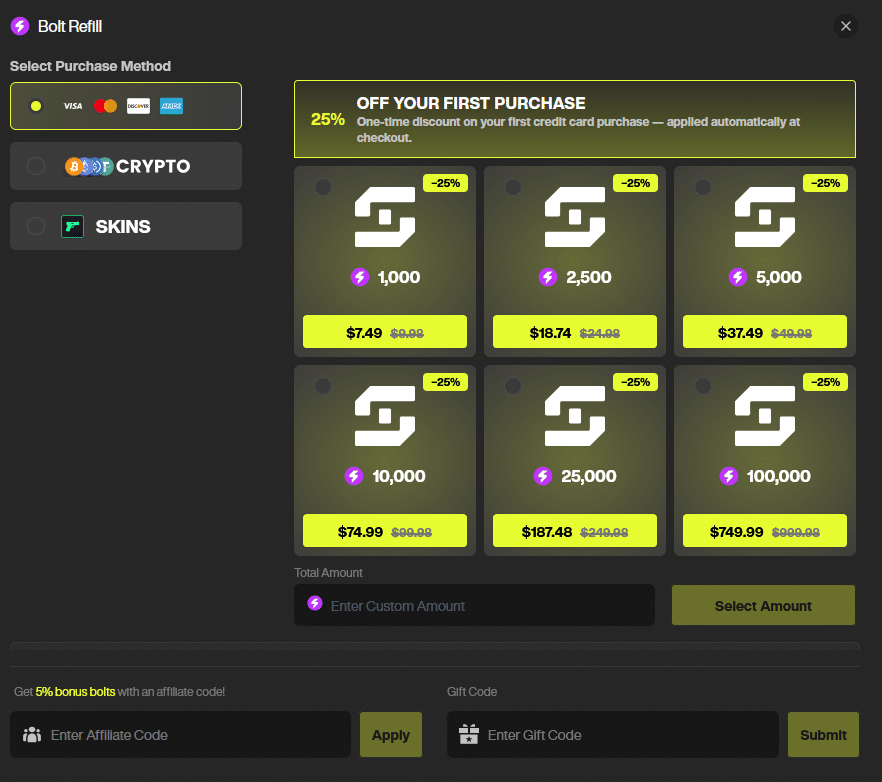
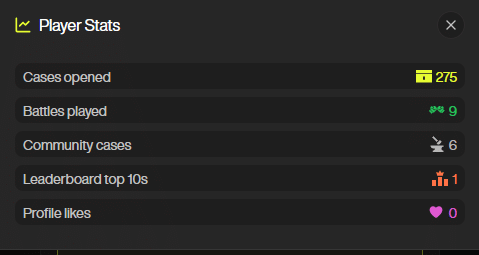
The top user currently sits on 92,248 points (on a four day streak) which at the cheapest rate of 100,000 bolts being $749.99, equates to spend in that vicinity. Note: this does not mean $750 was actually deposited, but that amount has been spent on entering battles and opening cases.
The user has opened 275 cases and played nine battles in that time.
STASHD By Fnatic Is Different From Just Another Sponsorship
The Fnatic brand is no stranger to gambling partnerships and commercial relationships, with Dafabet, Betify, and Skinrave among the partners formerly emblazoned across the storied org’s jerseys. With sponsorship, there is a distance between the organization and the product that, when questions arise, provides a degree of separation, allowing space to maneuver. Accepting sponsorship money from an entity and taking money directly from your audience are very different commercial propositions.
- Fnatic roster changes, meL’s competitive break, and still no Neon nerf: VALORANT’s hectic week
- Without South Korea, there is no reason for the Esports Nations Cup to happen
- Nikko gets badmouthed by OG’s coach, Taiga banned for life: Dota 2 ends April with a BetBoom
“By Fnatic” sits underneath the STASHD logo. The organization’s black and orange colors run throughout the homepage. Fnatic’s filings show a £4.5 million loss in 2024, indicating that commercial pressure clearly exists. With Valve limiting skin sponsorship opportunities following a December rules tweak, teams are seeking alternative revenue streams in what’s already a bleak landscape. That, however, doesn’t change what has been built here.
Fnatic holds a seat on the recently announced UK Esports Committee, which will liaise with the British government to drive positive policy change. It is one of the most recognizable esports brands across multiple titles. The move to offer a product with so few protections (but a propensity to harm) is optically questionable.
CS2 Skins For More Than Just a CS Audience
It would potentially cause less furor if this conversation stayed within Counter-Strike. CS has a long-established and storied history with skins. The audience has cultural familiarity with case opening, skin trading, skin betting, and the grey areas around them. As said previously, CS specific gambling sponsorships are focused specifically on this community.
The reality is that the breadth of the Fnatic brand includes VALORANT, League of Legends, Rainbow Six Siege, and a content creator network spanning multiple titles. Each title serves a different audience demographic and has different relationships and/or stances toward gambling. Riot Games has far stricter gambling sponsorship policies across its titles than Valve does.
The cases inside STASHD contain CS2 skins. There is no obligation to actually interact with the skin ecosystem at any point. A user can deposit money and withdraw with crypto. Bolts are just a virtual currency tethered to the value of CS skins. The association with Counter-Strike does not limit who can use the product.
Sam Matthews, Fnatic CEO, markets Fnatic commercially as having “deeper connections with highly sought-after, tech-savvy, younger audiences.” That is the CEO’s characterization of its own fanbase. Thus, by definition, it is the exact audience to which STASHD is being promoted. A fourteen-year-old League of Legends fan who has never opened a case in their life can hop on STASHD, spend real money, and enter a case battle against another user, or a bot, in a matter of minutes.
What STASHD Is Marketed as and What It Actually Does Are Not Equivalent
The backlash to STASHD has been a typical anti-gambling reaction among esports fans. Adults gamble. Adults open lootboxes and engage with casino products. The anti-gambling sentiment is an easy one to jump on.
Skins and lootboxes are a vertical that part of Fnatic’s fanbase engage with (some gleefully, and some in opposition), so from a commercial perspective, it makes sense to look to capitalize on it.
The issue here is that the company has a product that could pose very real gambling-adjacent harm (or at the very least, harm as a normal consumer) to its own young audience.
The product takes real money, converts it to virtual assets, exits it as crypto, and allows users to effectively flip a coin to increase their balance.
It has features to encourage people to use the product (free drops, a leaderboard where points are acquired by using the product), and all that’s required to get involved is ‘parental permission if under 18.’
The community has valid reasons to be up in arms, but the problem with STASHD is not that it may or may not be gambling. Rather, it’s the glaring red flags from a consumer protection perspective. It is designed to create an illusion of collection and ‘flexing’, all the while encouraging its own community to spend as much as possible, with little to no safeguarding in place.
“We want this to feel like a natural extension of our culture, and something that reflects who we are at our core.” Well, Fnatic, you may have done just that.
The post The problem with STASHD by Fnatic is not whether it’s gambling appeared first on Esports Insider.