


Tiny robot drones learn to navigate the world like honeybees
Mapping their starting point like bees do helps autonomous drones find their way
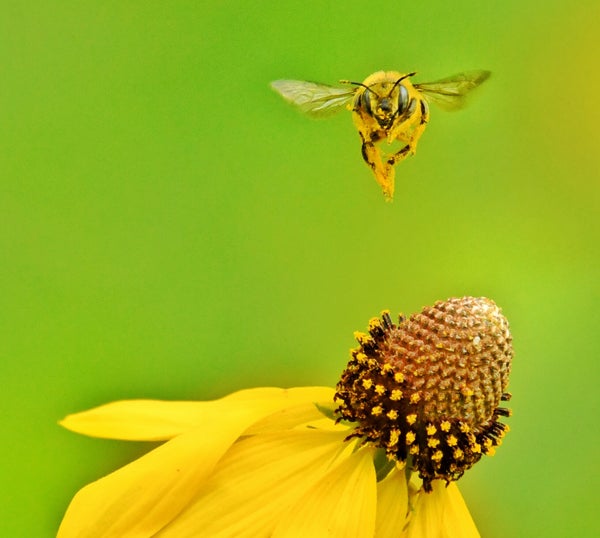
A honeybee-based navigation system could help miniature autonomous drones find their way home.
Insect-size drones are too small to lug around complex navigation systems. To help tiny autonomous fliers find their way home, researchers are taking their cues from honeybees with the Bee-Nav, described today in Nature.
A honeybee leaving the hive first takes a short learning flight to memorize nearby landmarks, explains the study’s lead author Guido de Croon, an artificial intelligence and robotics researcher at the Delft University of Technology in the Netherlands. As a bee flies away, “it keeps track of the direction and speed of its movement,” de Croon says, in a process called path integration. Because path integration is prone to accumulating tiny measurement errors over time, the insect relies on the memorized landmarks to correct its course as it gets back home. De Croon and his colleagues copied this workflow.
First, a drone performs a beelike learning flight around its starting point using a minuscule omnidirectional camera to capture the surrounding scenery. Midflight, it trains a tiny onboard neural network to map these images to home vectors, basically invisible arrows pointing back to the launchpad. This establishes a safe zone called the Learned Homing Area. Once trained, the drone can be sent far away and come back using path integration first, backtracking based on measured speed and direction. If the drone winds up anywhere inside its starting safe zone, the visual neural network guides it the rest of the way home.
On supporting science journalism
If you’re enjoying this article, consider supporting our award-winning journalism by subscribing. By purchasing a subscription you are helping to ensure the future of impactful stories about the discoveries and ideas shaping our world today.
The Bee-Nav does this using an off-the-shelf Raspberry Pi 4 computer the size of a credit card that runs neural nets with between 3.4 and 42.3 kilobytes of memory—thousands of times less than conventional mapping setups use. The team’s test bots homed in from a maximum of 600 meters (1,970 feet) away outdoors despite wind gusts and camera-blinding sun glares.
“What I find especially exciting is how little computation is needed,” says Sarah Bergbreiter, a mechanical engineer at Carnegie Mellon University, who was not involved in the study. “For the small-scale robots that my group and others work on, this is the kind of approach that makes serious outdoor deployments plausible.”
De Croon’s team is still working out a few challenges for the platform, such as navigating between multiple memorized places and dealing with landmark-free starting points. “Platforms running Bee-Nav will also need local obstacle avoidance and planning capability if the environment is cluttered or dynamic,” says Sean Humbert, a mechanical engineer at the University of Colorado Boulder, who was not involved in the study.
But even now, de Croon says, the Bee-Nav can make autonomous, outdoor drones smaller and more power-efficient. “We could easily put it on a 50-gram, even 30-gram drone,” de Croon claims. Scaling autonomous drones further down to the size of actual bees, he notes, would require solving other fundamental problems like miniaturizing batteries. “But we hope when these problems are solved in the long term, we will have the intelligence ready to match that,” de Croon says.
It’s Time to Stand Up for Science
If you enjoyed this article, I’d like to ask for your support. Scientific American has served as an advocate for science and industry for 180 years, and right now may be the most critical moment in that two-century history.
I’ve been a Scientific American subscriber since I was 12 years old, and it helped shape the way I look at the world. SciAm always educates and delights me, and inspires a sense of awe for our vast, beautiful universe. I hope it does that for you, too.
If you subscribe to Scientific American, you help ensure that our coverage is centered on meaningful research and discovery; that we have the resources to report on the decisions that threaten labs across the U.S.; and that we support both budding and working scientists at a time when the value of science itself too often goes unrecognized.
In return, you get essential news, captivating podcasts, brilliant infographics, can’t-miss newsletters, must-watch videos, challenging games, and the science world’s best writing and reporting. You can even gift someone a subscription.
There has never been a more important time for us to stand up and show why science matters. I hope you’ll support us in that mission.