
What if brain activity could be tracked for days without charging? A battery-free system moves wireless brain monitoring closer to long-term use.
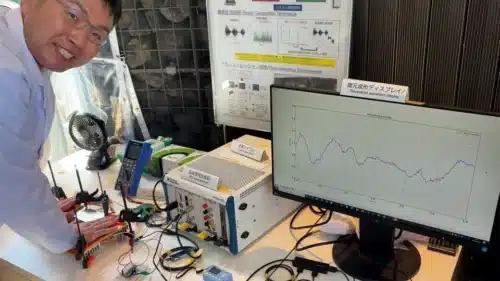
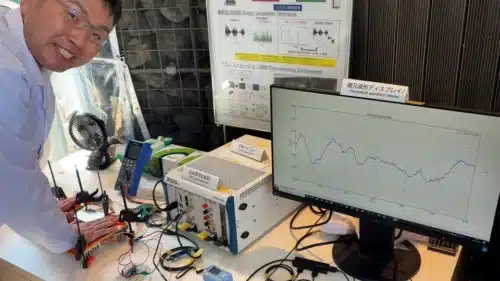
Researchers at Osaka University have developed a wireless EEG system that can transmit brainwave data without an external power source by cutting down how much data needs to be sent and reconstructing the full signal on the receiving end. The work, presented at the IEEE International Conference on Consumer Electronics, points toward wearable monitoring systems that could run for long periods with little or no maintenance.

The system tackles one of the main limitations of long-term electroencephalography (EEG) monitoring: power consumption. EEG, which records the brain’s electrical activity over extended periods, typically depends on wireless sensing systems that require steady power and regular upkeep, making continuous use difficult outside controlled settings.
To reduce energy demand, the researchers used a method called random undersampling, which captures and transmits only part of the EEG signal instead of the full dataset. A reconstruction algorithm on the receiver side then rebuilds the original signal with high accuracy. By shrinking the volume of transmitted data, the system lowers the power needed for wireless communication — the most energy-intensive part of the process.
The broader aim is to build sensing systems that can operate indefinitely without maintenance. In that context, enabling wireless EEG transmission without an external power source is a key step toward self-sustaining wearable health monitors.
The team tested the system in a live outdoor demonstration at Expo 2025 Osaka, where it continued operating in temperatures above 32°C without any added power supply or cooling airflow. The test was designed to assess whether the technology could function beyond lab conditions.
The results showed that even when the temperature difference between the human body and the surrounding environment narrowed to only a few degrees — reducing the amount of harvestable energy — the system was still able to maintain continuous wireless EEG transmission. That suggests the approach could remain viable in everyday environments, where heat-based energy harvesting conditions are less predictable.
Over time, the technology could support practical battery-free monitoring devices, especially as low-power circuit design improves. While EEG monitoring is an immediate application, similar self-powered sensing systems could also be adapted for infrastructure monitoring, environmental data collection, and smart city networks.