

Fraimic wants to turn AI art into something you can put on your wall, rather than forgotten images somewhere in your phone’s gallery. And honestly? That’s a pretty neat idea.
I’ve been testing a preproduction Standard Canvas unit for a while now, and while the software is still under active development, it’s been interesting watching features and fixes roll out over the last two months. New gallery functionality suddenly appeared. API access showed up. Local integrations evolved.
There were definitely bugs in the beginning. For example, my unit initially tried redirecting me to a broken dashboard, or API docs pointed to invalid endpoints … but really, none of this matters because I was testing a product that hasn’t even launched yet. It was still in active development. And seeing the real-time updates when I’d mention to them that something was broken, and Fraimic would reply the next day saying “fixed!” was pretty neat.
Fraimic itself won’t fully launch until June, and everything is looking very polished on the software side now.
JS @ New Atlas
But onto the art frame itself:
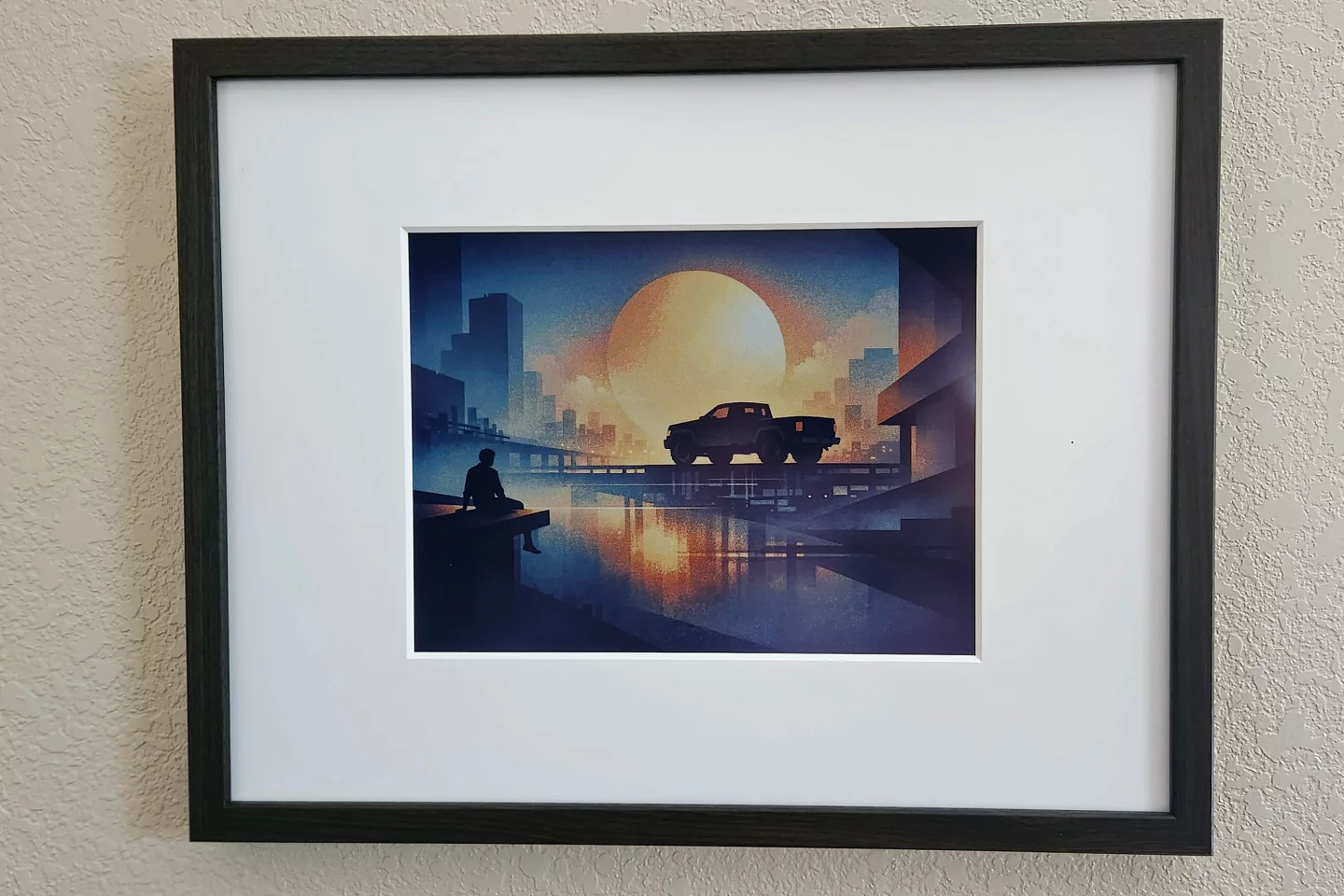
The Standard Canvas (US$499) uses a 13.3-inch color e-ink Spectra 6 display housed in a 14x18x1-inch walnut frame, while the larger Large Canvas bumps things up significantly in size and price: $1,499 for the 31.5-inch Spectra 6 display in a 24 x 36 x 2-inch (61x 91 x 5.1-cm) frame. Pricing isn’t for the faint of heart, but what price do you put on art, really? At least the Fraimic won’t shred itself at auction.
Banksy – Shredding his artwork at Sotheby’s live auction on October 5th 2018 (October 5, 2018)
I had the opportunity to talk to Anthony Mattana, CEO and creator of Fraimic. I did ask him about pricing, to which he said the Spectra 6 e-ink displays are really expensive. And it’s true. Just the 13.3-inch display alone – without battery, software, circuit boards, frame, etc – averages into the hundreds of dollars.
That being said, Spectra 6 is the latest and greatest in e-ink technology. Unlike traditional displays, it’s reflective rather than emissive, meaning no backlight or screen glare. It looks more like canvas than a screen. If it’s dark in the room, the Fraimic will also look dark, just like any other photo on your wall.
According to the specs, the Spectra 6 can reproduce up to 60,000 colors with better saturation and contrast than any previous e-ink tech. The standard frame has a 1,200 x 1,600 screen at 150 DPI, while the large has a 2,560 x 1,440 screen at 94 DPI, so you’re very much “getting what you paid for.”
Mattana’s entire ethos around Fraimic is “artists first.”
Instead of leaning into “AI-slop generator” territory, Fraimic is planning an ecosystem where real artists can upload and feature their work, create custom style prompts, and potentially monetize their creations through the platform. When Fraimic launches in June, they’ll do so with artwork from The Met. That’s kind of a big deal, I think.
JS @ New Atlas
Mattana repeatedly emphasized during our conversation that he doesn’t view the device as a “smart frame,” but rather as a “smart canvas.”
The guts of the frame itself run on an ESP32 platform – a low-power chipset – paired with a relatively massive 10,000-mAh battery (about two iPhones’ worth of power). It sounds silly when you think about how e-ink works: the display only really draws power when the image changes. Once an image is on the screen, it basically just sits there passively. No backlight. No constant refresh. No OLED burn-in. No LCD glow. Just art.
Granted, the matte around the display does have a Wi-Fi chip and completely invisible touch panel used to activate voice control to prompt your frame into generating a new image, so there is a little bit more power draw than just the display, but it’s peanuts, really. Fraimic says the battery can last for years between charges, depending on usage. I believe it, because even with all my tinkering on it, the battery is still at 85% after a few months. And it’s as easy as plugging in a USB-C cable to charge it.
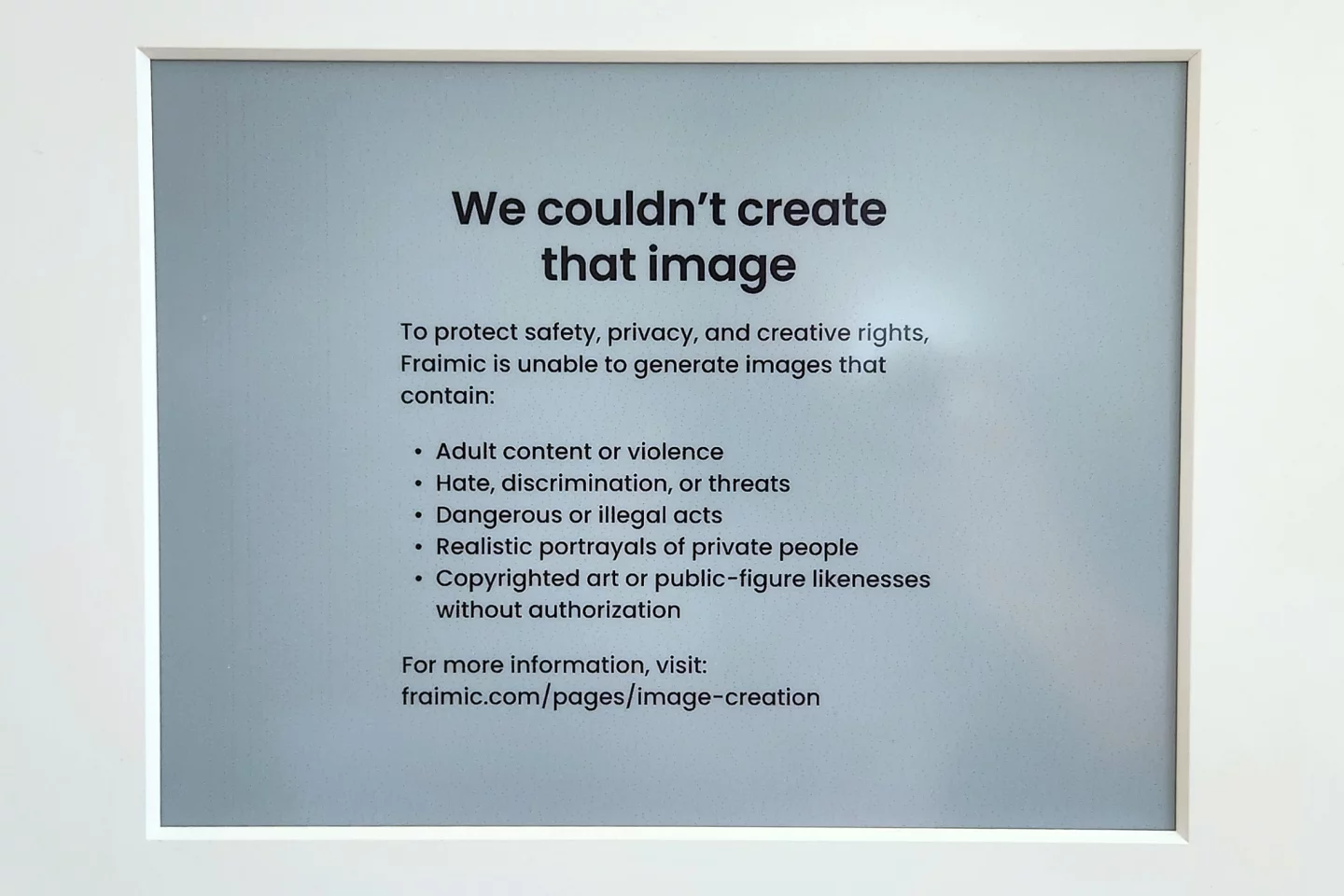
Voice-generated AI artwork is pretty much the headliner of Fraimic’s display. Tap that touchpad I mentioned to activate the mic (it doesn’t listen constantly) and a red LED comes on, then tell it what you want and tap it again to end voice input. The red LED turns white for a moment as it thinks about it (really, it’s a ChatGPT model that it relays the prompt to), and within a minute or so, you’ll have a brand new piece of AI art on your wall tailored the way you want it.

Fraimic
As it stands, users get 100 free AI image generations per year, which works out to roughly one new image every three-ish days if you get your prompt right the first time. Results may vary, and sometimes you’ll end up doing a couple in a row until you’re satisfied. You can buy more generations if you burn through those (best bang for your buck is 50 smackeroos to get 400 more generations … there are a few other cheaper options as well), but otherwise, there are no subscription fees.
AI image generation does require internet access, of course, but one of the coolest bits is that the frame itself doesn’t turn into a paperweight if Fraimic ever disappears. The local API can function entirely on your network, including piping it into platforms like Home Assistant (open source and free!). So while cloud-based AI image generation would come to a stop without Fraimic’s backend infrastructure, the frame itself would continue functioning locally as a programmable e-ink display, where you can simply upload your own image directly to the frame. It only has enough storage for a single image at a time, but that’s still pretty awesome. Score one for the homebrew crowd.
If you don’t know what an API is, it’s basically a way for different gadgets and software to talk to each other and tell each other what to do. For example, when your smart lights turn on because your Ring doorbell camera saw you come in. The camera and the lights used an API to talk to each other.
Honestly, for a tech nerd like myself, that won me over more than the AI-art angle did. You don’t even need an app to run the thing. This also brings me joy, especially as a reviewer who has far too many random apps for random products installed as it is.
Fraimic plans to expand multi-frame interactions in the future. Mattana described scenarios where several frames in the same home could coordinate together. He used the example “Create unique Super Bowl-themed artwork across all the frames in the house for our Super Bowl party.” Each frame would generate something different while still following the same prompt theme. Expensive, but awesome.

JS @ New Atlas
Personally, I mostly ended up using the frame for my own photos instead of constantly generating AI art. And while e-ink certainly isn’t photo-paper quality, it still looks surprisingly good from a couple of feet away. The best comparison I can make is like a Monet: broad strokes up close, but sure looks awesome once you take a few steps back.
The walnut frame itself is also legitimately nice. Nicer than any other frame I own. But even better, Fraimic designed the entire canvas so you can chuck it into any other same-sized frame if you want a different look entirely. Another nice touch is the single keyhole hanger that makes hanging the frame super easy, and it’s perfectly balanced, so it won’t hang cockeyed on your wall. It can be mounted landscape or portrait, and the display auto-orients itself.
What it is missing, however, is a side-stand. Unless you rig something up yourself, this frame is relegated to wall duty only, never to hang out with you at your desk or on a shelf next to the elf.
Frankly, I find it refreshing when a “connected product” is openly embracing local APIs and Home Assistant capabilities instead of building a sealed-off box that turns into e-waste the moment the servers go offline. Not to say they’re going to disappear … but this frame is good enough to pass down through generations.
Product Page: Fraimic
New Atlas may receive commission if you purchase that raw e-ink panel I linked to, but we are not partnered with Fraimic. This does not affect our reviews as our opinions remain our own.