
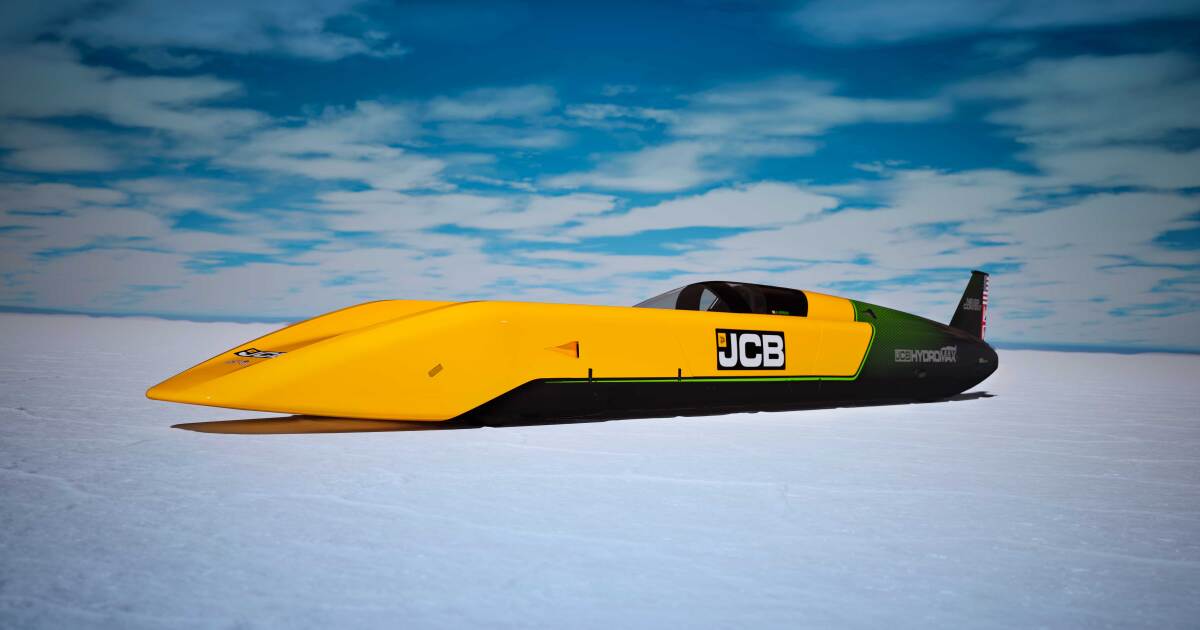
JCB, the British construction equipment giant best known for its signature yellow construction machinery, is returning to the Bonneville Salt Flats in Utah with the Hydromax – a hydrogen-powered land speed racer 32.8 ft (nearly 10 m) long – with a declared target of exceeding 350 mph (563 km/h).
The attempt is scheduled for this coming August. If it hits that mark, it will nearly double the current land speed record for a hydrogen internal combustion vehicle set by BMW’s H2R prototype at 187.62 mph (301.95 km/h). Yet the best mark for any hydrogen-powered vehicle of any kind belongs to Ohio State University’s fuel-cell Buckeye Bullet 2, which clocked 303 mph (487.7 km/h) back in 2009. JCB is aiming to beat both in a single run.
Introducing JCB Hydromax | All-New Hydrogen-Powered Combustion Car
The Hydromax is powered by two of JCB’s own hydrogen internal combustion engines – essentially modified versions of the kind already going into the company’s production excavators – tuned to deliver 800 horsepower each. Both engines drive all four wheels through a twin-clutch dual-transmission system. The bodywork has been redesigned from the ground up to be more aerodynamically efficient than its predecessor, the diesel-powered JCB Dieselmax, and every component – from suspension geometry to traction control calibration to camera placement – has been validated through simulation and stress testing before touching salt.
The speed demon behind the wheel will be Andy Green, a Royal Air Force Wing Commander and fighter pilot. Green is no stranger to Bonneville. In 2006, he drove the Dieselmax to a diesel land speed record of 350.092 mph (563.5 km/h), a mark that still stands. He also happens to be the only human to have broken the sound barrier on land, holding the outright world record at 763.035 mph (1,227.9 km/h).
“The JCB Hydromax car is lighter, more powerful, and faster than its predecessor of 20 years ago,” Green says. “Once again, we’re going to show the world just how good British engineering and technology really is. This August we’re going to smash the hydrogen-powered vehicle record in the world’s fastest (and most exciting!) zero-emissions vehicle. I can’t wait.”

JCB
Behind the spectacle sits a serious industrial bet. JCB has invested £100 million (roughly US$127 million) over five years developing its hydrogen combustion engine technology – the same engines now shipping in its commercial excavators. The Bonneville attempt comes just ahead of the inauguration of a new $500 million manufacturing megafactory in San Antonio, Texas.
Hydrogen internal combustion isn’t the only green powertrain out there, battery-electric and hydrogen fuel cells are both more established in automotive contexts. But JCB argues it offers a practical path for the heavy machinery sector, where energy density and refueling time matter enormously. A land speed record is, in that sense, a proof-of-concept run on the world’s most visible stage.
“JCB Dieselmax was always a bit of an unusual idea – but it proved a point,” says company chairman Anthony Bamford. “Putting an advanced engine into a land-speed car showed the world what it could do in a way a digger never could. It’s the same thinking with hydrogen today. If you’re serious about emissions, you have to be serious about hydrogen – and a land-speed project is the perfect way to prove it.”
Source: JCB